

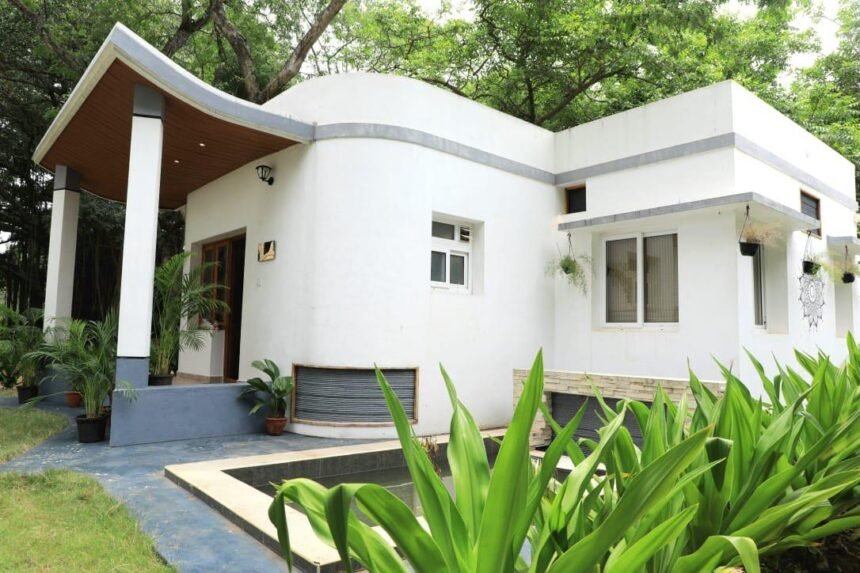
Incredible Facts About India’s First 3D Printed House: A Revolutionary Step Towards a Better Future
Built by Tvasta Manufacturing Solutions, a technology startup founded by IIT Madras alumni, this innovative house demonstrated how computer-designed structures and specialised concrete can transform the construction industry.
- 1. What Is India’s First 3D Printed House?
- 2. History of India’s First 3D Printed House
- 3. Seven Incredible Facts About India’s First 3D Printed House
- Fact 1: It was developed using indigenous Indian technology
- Fact 2: The house covered approximately 600 square feet
- Fact 3: Construction could become dramatically faster
- Fact 4: It uses specialised concrete and a 3D printer
- Fact 5: It demonstrated the potential for affordable housing
- Fact 6: The project involved collaboration beyond IIT Madras
- Fact 7: It opened new possibilities for India’s construction industry
- 4. How Does 3D Printing Technology Build a House?
- 5. Timeline of India’s First 3D Printed House
- 6. Significance of India’s First 3D Printed House
- 1. Affordable housing opportunities
- 2. Faster construction
- 3. Encouraging Indian innovation
- 4. Modernising the construction industry
- 5. Supporting sustainable development
- 7. Advantages and Disadvantages of 3D Printed Houses
- 8. Impact on Daily Life
- 9. Importance for Students and Future Generations
- 10. Importance of 3D Printed Houses for Indian Society
- 11. Observance and Awareness: Is There a 3D Printed House Day?
- 12. Review: India’s First 3D Printed House – Is It Really a Revolutionary Innovation?
- 13. Interesting Facts About 3D Printed Houses: Important Points
- 14. Wishes and Inspirational Messages for India’s Technological Achievement
- 15. Frequently Asked Questions (FAQs)
- Q1. Which is India’s first 3D printed house?
- Q2. When was India’s first 3D printed house inaugurated?
- Q3. Where is India’s first 3D printed house located?
- Q4. Who constructed India’s first 3D printed house?
- Q5. How big was India’s first 3D printed house?
- Q6. How many rooms did the house have?
- Q7. How does a 3D printed house work?
- Q8. How long does it take to build a 3D printed house?
- Q9. Are 3D printed houses cheaper than traditional houses?
- Q10. Are 3D printed houses safe?
- Q11. Is 3D printing environmentally friendly?
- Q12. Can 3D printing solve India’s housing shortage?
- Q13. What is the future of 3D printed houses in India?
- Q14. Which skills should students learn for a career in 3D printed construction?
- 16. The Future of 3D Printed Houses in India
- 17. Conclusion: A Small House with a Big Vision for India’s Future
The house was inaugurated on 27 April 2021 by Union Finance Minister Nirmala Sitharaman. It covered approximately 600 square feet and included a bedroom, hall and kitchen. The project was developed in collaboration with Habitat for Humanity’s Terwilliger Center for Innovation in Shelter.
This achievement was not simply about building a house with a machine. It was about imagining a future where quality homes could become faster to construct, more affordable and accessible to more families.
In this article, we will explore seven incredible facts about India’s first 3D printed house, its history, technology, timeline, significance, advantages, challenges, social impact and future possibilities.
1. What Is India’s First 3D Printed House?
India’s first 3D printed house was an innovative residential structure constructed using indigenous concrete 3D printing technology.
Unlike conventional construction, where workers generally build walls using individual bricks, blocks and mortar, 3D concrete printing uses a specialised machine to deposit construction material layer by layer according to a digital design.
The technology converts a computer-generated building design into a physical structure.
The project was developed by Tvasta Manufacturing Solutions, an IIT Madras alumni-founded startup. It demonstrated that advanced manufacturing techniques could be applied to residential construction in India.
The house was built on the IIT Madras campus in Chennai, Tamil Nadu.
Important details:
Location: IIT Madras, Chennai, Tamil Nadu, India.
Developer: Tvasta Manufacturing Solutions.
Technology: Indigenous concrete 3D printing.
Area: Approximately 600 square feet, according to the IIT Madras inauguration announcement.
Structure: Single-storey residential house.
Facilities: Bedroom, hall and kitchen.
Inauguration: 27 April 2021.
Collaboration: Habitat for Humanity’s Terwilliger Center for Innovation in Shelter.
2. History of India’s First 3D Printed House
The history of this remarkable project began with an ambition to introduce advanced manufacturing technology into India’s construction sector.
For decades, conventional construction has depended on bricks, cement, sand, steel, machinery and significant human labour. Although these methods have helped build cities and villages, construction can take several months and involve considerable material waste.
Researchers and entrepreneurs started exploring whether 3D printing could offer a more efficient alternative.
The beginning of the innovation
In 2018, IIT Madras and Tvasta Manufacturing Solutions were already working on indigenous 3D construction technology. Their early research focused on developing a system capable of producing building structures through automated printing.
The objective was to make construction faster and explore new possibilities for affordable housing.
From an idea to a real house
The project gradually moved beyond laboratory experiments. Tvasta developed specialised printable concrete, printing equipment and digital construction techniques.
The first residential project at IIT Madras demonstrated how this technology could be used in a practical setting.
A historic inauguration
On 27 April 2021, Finance Minister Nirmala Sitharaman inaugurated the house virtually.
The project received national attention because it demonstrated the potential of Indian-developed construction technology.
It also highlighted the importance of cooperation between educational institutions, startups and organisations working to improve housing access.
3. Seven Incredible Facts About India’s First 3D Printed House
Fact 1: It was developed using indigenous Indian technology
One of the most inspiring aspects of this project was that it showcased technology developed in India.
Tvasta Manufacturing Solutions, founded by IIT Madras alumni, worked on the equipment, software, construction methodology and specialised concrete needed for 3D printing.
This demonstrated that Indian startups and educational institutions could contribute to advanced global manufacturing technologies.
It also supported the broader vision of Atmanirbhar Bharat, which encourages domestic innovation and technological independence.
Fact 2: The house covered approximately 600 square feet
The first IIT Madras house was a single-storey residential structure covering approximately 600 square feet.
It included three important living spaces:
One bedroom.
One hall.
One kitchen.
Although it was relatively compact, it demonstrated that 3D printing could be used for practical residential applications rather than only producing small decorative objects or experimental models.
Fact 3: Construction could become dramatically faster
Traditional residential construction can take several months, depending on the design, labour availability, weather and materials.
The technology demonstrated by Tvasta was presented as capable of constructing a house in approximately five days.
This was an important indication of how automated construction could reduce the time needed for certain building activities.
However, this figure should be understood as a technology demonstration rather than a guarantee that every complete house, including foundations, roofing, plumbing and finishing, can always be delivered in five days.
Fact 4: It uses specialised concrete and a 3D printer
The technology works through a digital construction process.
A computer-generated design is sent to a specialised concrete 3D printer. The printer then deposits a specially formulated concrete mixture in successive layers to create the required structure.
The material must have suitable flow properties so that it can pass through the printer while maintaining enough strength to support the layers placed above it.
This is one of the most important technological achievements behind the project.
Fact 5: It demonstrated the potential for affordable housing
Housing affordability remains a major challenge for many Indian families.
A house is not just a physical building; it represents security, dignity, stability and a better future for children.
3D printing could help reduce certain construction costs through automation, lower material wastage and more efficient use of labour.
The project’s original vision was to make good-quality housing more accessible, especially for people who need affordable homes.
However, actual affordability depends on land prices, material costs, equipment, transportation, labour and local regulations.
Fact 6: The project involved collaboration beyond IIT Madras
The project was developed in collaboration with Habitat for Humanity’s Terwilliger Center for Innovation in Shelter.
This partnership was significant because affordable housing is not only an engineering challenge. It is also a social and economic issue.
By bringing together technology developers and organisations focused on housing innovation, the project connected scientific research with real-world social needs.
Fact 7: It opened new possibilities for India’s construction industry
The project demonstrated that construction could gradually move towards automated and digitally controlled manufacturing.
Future applications may include:
Affordable residential houses.
Disaster-relief shelters.
Community buildings.
Rural housing.
Specialised architectural structures.
Infrastructure components.
The technology does not mean that traditional construction will disappear. Instead, it offers another method that could complement conventional techniques.
That is what makes this achievement so important for India’s future.
4. How Does 3D Printing Technology Build a House?
Many people associate 3D printing with plastic toys, small models, machines and decorative products. However, modern 3D printing technology has expanded into construction.
In building construction, the process is commonly known as 3D Concrete Printing (3DCP).
Here is how the process generally works.
Step 1: Digital house design
Architects and engineers prepare a digital building design using specialised computer software. The design includes the dimensions, wall arrangements, openings and structural requirements.
Step 2: Preparing specialised concrete
A suitable concrete mixture is prepared. It must be sufficiently fluid to move through the printing equipment but strong enough to retain its shape after being deposited.
Step 3: Machine setup
The 3D printer is positioned according to the building design. Its printing system is connected to the digital construction instructions.
Step 4: Layer-by-layer printing
The printer deposits concrete through a nozzle in carefully controlled layers. These layers gradually form the required walls and other printable structural components.
Step 5: Assembly and finishing
Depending on the construction method, printed components may be assembled at the construction site. Foundations, roofs, doors, windows, electrical installations, plumbing and finishing may require conventional construction techniques.
Step 6: Quality and safety checks
Engineers inspect the completed work to ensure that it meets applicable structural, material and safety requirements.
The biggest advantage is that digital design and automated material placement can make certain construction activities more precise and efficient.
5. Timeline of India’s First 3D Printed House
The development of India’s 3D construction technology involved several important milestones.
- 2018 – Early developmentIIT Madras and Tvasta worked on indigenous 3D printing construction technology and explored its use in building structures.
- 2020 – Residential construction milestoneTvasta developed its first residential 3D printed house project at IIT Madras. The development attracted attention for its potential to reduce construction time and cost.
27 April 2021 – Official inauguration
Finance Minister Nirmala Sitharaman inaugurated India’s first 3D printed house at IIT Madras.
Indian Institute of Technology Madras
30 June 2021 – Vice President’s visit
Vice President M. Venkaiah Naidu visited the house and highlighted the importance of innovation and industry-institute partnerships.
Indian Institute of Technology Madras
- 1 October 2025 – Rural housing milestoneA separate milestone followed when Union Minister of State Dr. Pemmasani Chandra Sekhar inaugurated India’s first 3D concrete printed rural house at CSIR-CBRI, Roorkee. This was a distinct project focused on rural housing.
6. Significance of India’s First 3D Printed House
The importance of this innovation goes beyond technology. It has the potential to influence housing, employment, education, architecture and economic development.
1. Affordable housing opportunities
Millions of families aspire to own a permanent home. More efficient construction techniques could help reduce some of the financial challenges associated with building houses.
2. Faster construction
Automated printing can reduce the time required for certain construction activities. This could be particularly useful when housing is urgently needed.
3. Encouraging Indian innovation
The project demonstrates how Indian startups, engineers and researchers can develop solutions for domestic challenges.
4. Modernising the construction industry
Digital construction techniques could encourage companies to adopt automation, robotics, advanced materials and computer-based design.
5. Supporting sustainable development
More controlled material placement may reduce construction waste. Depending on the concrete mixture, production process and energy source, 3D printing may also offer environmental benefits.
However, it is important to remember that concrete production itself has a significant environmental footprint. Therefore, sustainability must be assessed across the entire building lifecycle.
7. Advantages and Disadvantages of 3D Printed Houses
Every new technology has benefits as well as limitations. Understanding both sides helps people make better decisions.
| Advantages | Challenges |
|---|---|
| Faster construction of printable components | High initial equipment investment |
| Digital design flexibility | Requires trained technical professionals |
| Potential reduction in material waste | Specialised concrete is necessary |
| Automated construction processes | Building codes and approvals must be addressed |
| Potential for affordable housing | Foundations and finishing may remain conventional |
| Greater architectural flexibility | Repairs and maintenance need specialised knowledge |
The important lesson: 3D printing is promising, but it is not a magic solution to every housing problem. It must be tested for safety, durability, affordability and suitability for local environmental conditions.
8. Impact on Daily Life
How can a technology developed at an engineering institution affect an ordinary person’s life?
The answer lies in its future applications.
For students: It creates opportunities to learn about robotics, civil engineering, architecture, artificial intelligence, automation and advanced manufacturing.
For families: More efficient construction could eventually make home ownership easier for some families, depending on the final cost.
For workers: The construction industry may create new roles in printer operation, digital design, material science, equipment maintenance and quality control.
For rural communities: Locally suitable 3D construction methods could potentially support faster development of homes and community facilities.
For society: Better construction methods could help communities recover more efficiently after natural disasters, provided the technology is adapted and approved for local conditions.
9. Importance for Students and Future Generations
India’s first 3D printed house offers an important lesson to students: education becomes meaningful when knowledge is transformed into practical solutions.
Young people interested in this field can explore several educational and professional pathways.
Civil Engineering.
Mechanical Engineering.
Robotics and Automation.
Artificial Intelligence and Machine Learning.
Architecture and Building Design.
Materials Science.
Construction Management.
Sustainable Engineering.
Students can also learn 3D modelling, computer-aided design (CAD), building information modelling (BIM), programming and additive manufacturing.
The future construction industry may need professionals who understand both traditional engineering principles and modern digital technologies.
For students, this is an opportunity to prepare for careers that did not exist in the same form a few decades ago.
10. Importance of 3D Printed Houses for Indian Society
India has a large and diverse population, with different housing requirements in cities, towns, villages and remote regions.
A construction method that works in one location may not automatically work in another. Climate, soil conditions, transportation, local materials, building regulations and economic circumstances all matter.
Nevertheless, 3D printing could contribute to several social objectives.
Reducing housing difficulties: More efficient building methods could support affordable housing initiatives.
Improving disaster preparedness: Specially engineered printed structures may be useful in certain emergency and rehabilitation projects.
Promoting technological independence: Domestic development of printers, materials and software can strengthen India’s manufacturing capabilities.
Supporting innovation-led employment: The technology can create opportunities for engineers, technicians, entrepreneurs and researchers.
The Government of India’s interest in alternative construction technologies is also reflected in the Ministry of Housing and Urban Affairs’ Global Housing Technology Challenge initiatives. Tvasta’s technology has been included in the government’s technology-incubation material.
11. Observance and Awareness: Is There a 3D Printed House Day?
There is no widely recognised official annual Indian observance specifically dedicated to India’s first 3D printed house.
However, the anniversary of its inauguration on 27 April can be used as an opportunity to discuss construction innovation, affordable housing and modern engineering.
Schools, colleges, engineering institutions and technology organisations can mark the occasion through:
Science exhibitions.
3D printing demonstrations.
Architecture competitions.
Technology awareness programmes.
Student discussions on affordable housing.
Workshops on sustainable construction.
The purpose should be to encourage young people to understand how innovation can solve real-world problems.
12. Review: India’s First 3D Printed House – Is It Really a Revolutionary Innovation?
India’s first 3D printed house deserves recognition as an important achievement in engineering and construction technology.
The most impressive aspect is the use of indigenous technology to turn a digital building design into a physical residential structure.
From an innovation perspective, the project deserves appreciation for three major reasons:
Technological development: It demonstrated the potential of Indian-developed concrete 3D printing.
Construction efficiency: It showed how automation could reduce the time required for certain building activities.
Social potential: It opened new possibilities for affordable housing and more efficient construction.
What could be improved?
The technology still needs wider testing, commercial expansion and reliable cost comparisons. Structural safety, earthquake resistance, weather durability, insulation, building approvals and long-term maintenance must be properly evaluated.
There is also an important detail about the reported construction figures. The 2021 IIT Madras announcement described a roughly 600-square-foot house and said the technology could construct a house in five days. Tvasta’s current project case study separately describes a 500-square-foot, 1BHK house completed in 21 days using 3D-printed wall modules, with conventional construction for the foundation and roof. These figures describe different project accounts and construction measurements, so they should not be treated as interchangeable.
Verdict: A remarkable Indian innovation with significant potential for the future of housing, provided that affordability, safety and practical performance continue to improve.
13. Interesting Facts About 3D Printed Houses: Important Points
Here are some additional points worth remembering:
3D concrete printing is a form of additive manufacturing.
The construction process uses computer-generated designs.
Specialised concrete is deposited in successive layers.
The printing process can reduce the need for some conventional construction activities.
3D printing can support customised architectural designs.
It may reduce material waste through controlled material placement.
Human engineers and construction professionals remain essential.
Not every part of a 3D printed building is necessarily printed.
Different countries are exploring 3D printed housing.
India has continued exploring this technology for both urban and rural housing.
14. Wishes and Inspirational Messages for India’s Technological Achievement
India’s first 3D printed house is a reminder that big achievements often begin with small ideas and determined people.
Here are some inspirational wishes and messages to celebrate this achievement.
1. Congratulations to India’s scientists, engineers and innovators for taking construction technology towards a new future.
2. May Indian innovation continue to create affordable homes and better opportunities for every family.
3. Let technology become a bridge between dreams and reality. India’s first 3D printed house is a wonderful example.
4. A better future begins when education, creativity and hard work come together.
5. May young Indian students continue to develop ideas that solve real problems and make society stronger.
6. Let us build not only stronger houses but also a stronger, more innovative and sustainable India.
15. Frequently Asked Questions (FAQs)
Q1. Which is India’s first 3D printed house?
India’s first 3D printed house was developed by Tvasta Manufacturing Solutions, an IIT Madras alumni-founded startup, at the IIT Madras campus in Chennai.
Q2. When was India’s first 3D printed house inaugurated?
It was inaugurated on 27 April 2021 by Union Finance Minister Nirmala Sitharaman.
Q3. Where is India’s first 3D printed house located?
It is located at the Indian Institute of Technology Madras campus in Chennai, Tamil Nadu.
Q4. Who constructed India’s first 3D printed house?
Tvasta Manufacturing Solutions constructed the house using indigenous concrete 3D printing technology.
Q5. How big was India’s first 3D printed house?
The IIT Madras inauguration announcement described it as approximately 600 square feet.
Q6. How many rooms did the house have?
The house included a bedroom, a hall and a kitchen.
Q7. How does a 3D printed house work?
A specialised 3D printer follows a computer-generated design and deposits printable concrete in layers to create building components.
Q8. How long does it take to build a 3D printed house?
The IIT Madras project announcement stated that the technology could construct a house in approximately five days. Actual project duration depends on design, printing, foundations, roofing, assembly and finishing.
Q9. Are 3D printed houses cheaper than traditional houses?
They have the potential to reduce certain construction expenses. However, actual costs depend on equipment, materials, labour, transportation, land and finishing. Not every 3D printed house is automatically cheaper.
Q10. Are 3D printed houses safe?
They can be designed to meet structural safety requirements, but their safety depends on engineering, materials, testing, construction quality and compliance with applicable building regulations.
Q11. Is 3D printing environmentally friendly?
It may reduce construction waste and improve material efficiency. However, the environmental impact also depends on cement production, energy consumption, transportation and the building’s entire lifecycle.
Q12. Can 3D printing solve India’s housing shortage?
It could become one useful solution by improving construction efficiency and supporting affordable housing projects. However, land availability, finance, infrastructure and housing policies are also essential.
Q13. What is the future of 3D printed houses in India?
The future may include affordable homes, rural housing, disaster-relief structures, community facilities and customised buildings. Wider adoption will depend on safety, costs, regulations and commercial scalability.
Q14. Which skills should students learn for a career in 3D printed construction?
Students can explore civil engineering, mechanical engineering, robotics, CAD, BIM, material science, programming and additive manufacturing.
16. The Future of 3D Printed Houses in India
The future of construction may look very different from what we see today.
Imagine a situation where a family can customise a house design digitally, engineers can prepare the structure using specialised software, and automated machines can print selected building components with greater precision.
This possibility is one of the reasons why 3D construction technology is attracting attention around the world.
India has already taken further steps in this direction. On 1 October 2025, a separate rural housing milestone was achieved when CSIR-CBRI inaugurated a 3D concrete printed rural house in Roorkee. The initiative also highlighted the potential of region-specific and disaster-resilient housing solutions.
In the coming years, several developments could shape this industry:
More affordable construction equipment.
Improved concrete mixtures.
Greater automation and robotics.
Artificial intelligence-assisted building design.
Better integration with renewable energy.
Stronger quality-control systems.
Wider adoption of sustainable building materials.
However, technology alone cannot guarantee a better future. It must be combined with responsible engineering, affordable financing, environmental awareness and effective public policies.
17. Conclusion: A Small House with a Big Vision for India’s Future
India’s first 3D printed house at IIT Madras was much more than a construction experiment. It represented the power of education, research, entrepreneurship and indigenous innovation.
Developed by Tvasta Manufacturing Solutions, the project demonstrated how digital designs and specialised concrete printing could create real residential structures.
Its importance lies not only in the speed of construction but also in the possibilities it offers for affordable housing, modern engineering, employment opportunities and technological development.
For students, it is an inspiring example of how scientific knowledge can solve practical problems. For entrepreneurs, it demonstrates the value of transforming innovative ideas into useful products. For society, it creates hope for more efficient and accessible construction methods.
Of course, several challenges remain, including safety standards, affordability, scalability and environmental performance. But every major technological revolution begins with experimentation, learning and improvement.
The real achievement is not simply printing a house. It is using innovation to build a better future for people.
India’s journey towards modern construction has already begun, and 3D printing could become an important part of that journey.
Read internal linking topics of Minorstudy:
Science and Technology
Artificial Intelligence
Sustainable Development
Renewable Energy
Future Careers for Students
Smart Cities in India
Environmental Science
Primary reference sources:
Editorial note: Construction specifications and performance figures should be checked against the relevant project documentation before publication. The article distinguishes the original IIT Madras project from later rural 3D printing developments.










Great post, I conceive people should larn a lot from this web blog its really user friendly.
Hello very nice website!! Man .. Excellent .. Wonderful .. I’ll bookmark your site and take the feeds also…I am glad to seek out a lot of helpful information right here in the post, we want work out more strategies on this regard, thank you for sharing.
I just couldn’t depart your web site before suggesting that I really enjoyed the standard info a person provide for your visitors? Is gonna be back often in order to check up on new posts
Thanks for sharing. I read many of your blog posts, cool, your blog is very good.
Your article helped me a lot, is there any more related content? Thanks! https://www.binance.com/register?ref=JW3W4Y3A
Thanks for sharing. I read many of your blog posts, cool, your blog is very good.
I don’t think the title of your article matches the content lol. Just kidding, mainly because I had some doubts after reading the article.
Thank you for your sharing. I am worried that I lack creative ideas. It is your article that makes me full of hope. Thank you. But, I have a question, can you help me? Skapa personligt konto
I don’t think the title of your article matches the content lol. Just kidding, mainly because I had some doubts after reading the article. https://accounts.binance.com/register/person?ref=GGYHGRE