Exciting Ways Agentic and Physical AI Are Transforming Our Future
Artificial Intelligence: The Shift to Agentic and Physical AI is one of the most important technological developments shaping the future of humanity. Artificial Intelligence (AI) has evolved from simple computer programs that follow instructions into intelligent systems capable of understanding information, making decisions, completing tasks, and interacting with the physical world.
For many years, people mainly experienced AI through search engines, recommendation systems, voice assistants, chatbots, and automated software. Today, a new generation of AI is emerging. Agentic AI can independently plan and execute multi-step tasks, while Physical AI brings intelligence into robots, vehicles, machines, and other real-world systems.
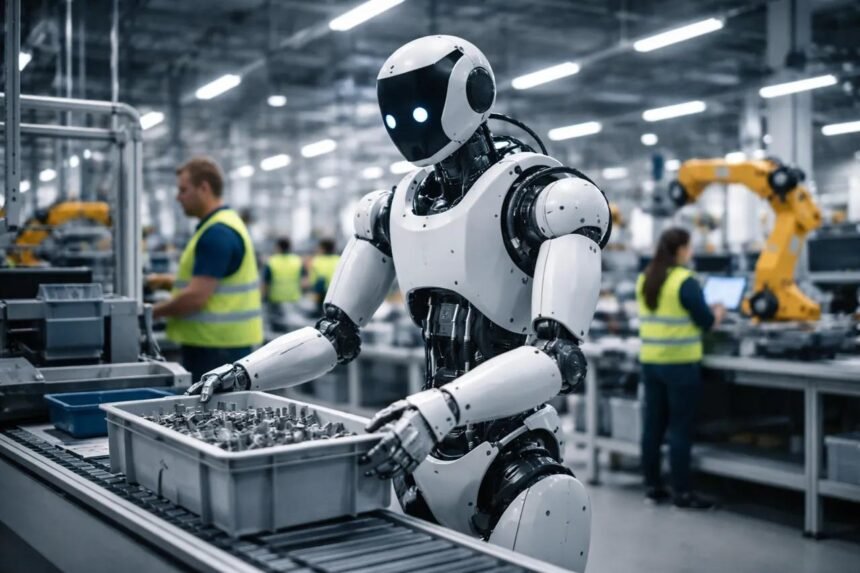
Imagine an AI assistant that does more than answer your questions. It can research a topic, organize your schedule, prepare a report, and complete approved tasks using digital tools. Now imagine a robot that can recognize objects, understand its surroundings, pick up items, and assist people in hospitals, factories, and homes.
These developments are changing how people work, study, communicate, travel, and solve everyday problems.
In this article, we will explore the meaning, history, facts, timeline, significance, advantages, challenges, future opportunities, daily-life impacts, and social importance of Agentic AI and Physical AI.
1. What Is Artificial Intelligence?
Artificial Intelligence is a branch of computer science that focuses on creating machines and software capable of performing tasks that normally require human intelligence.
These tasks include:
Learning from information and experience.
Understanding human language.
Recognizing images, voices, and patterns.
Solving problems and making predictions.
Supporting decision-making.
Generating text, images, audio, and videos.
Planning and performing complex activities.
Traditional software generally follows instructions written by developers. AI systems can use data and trained models to identify patterns, generate responses, and make predictions.
For example, when you use a smartphone to unlock your screen through facial recognition, AI helps identify your face. When a streaming platform recommends a movie, an AI-based recommendation system may be analyzing your interests and viewing history.
However, the latest development goes beyond recognizing patterns and generating answers. It involves systems that can take action.
2. What Is Agentic AI?
Agentic AI refers to AI systems that can work toward a defined goal by planning, making decisions, using tools, and carrying out multiple steps with varying levels of human supervision.
Unlike a conventional chatbot that primarily responds to questions, an AI agent can potentially complete an entire workflow.
For example, imagine asking an AI agent:
“Research five universities offering affordable computer science courses, compare their fees, prepare a report, and organize the results in a spreadsheet.”
A capable agent might:
Understand your objective.
Break the task into smaller steps.
Search relevant information.
Compare university details.
Organize the findings.
Create a spreadsheet.
Present the completed work for your review.
This is the central idea behind Agentic AI: moving from answering questions to accomplishing goals.
Important characteristics of Agentic AI
Autonomy: Performs tasks with limited human intervention.
Planning: Divides complex goals into smaller activities.
Reasoning: Evaluates available information before selecting actions.
Tool usage: Interacts with approved software, applications, and services.
Adaptability: Adjusts its approach when circumstances change.
Memory: Can use relevant information from earlier interactions when supported.
Human collaboration: Can request permission or assistance when necessary.
Agentic AI does not mean unlimited independence. Its actions should operate within permissions, safety rules, and human oversight.
3. What Is Physical AI?
Physical AI refers to intelligent systems that perceive, understand, and interact with the physical environment through machines, robots, sensors, and actuators.
In simple language, Physical AI gives machines the ability to connect intelligence with physical actions.
Consider a robot working in a warehouse. It must recognize boxes, understand its location, avoid obstacles, identify objects, and move items safely. Physical AI helps bring these capabilities together.
Physical AI can be used in:
Humanoid robots.
Autonomous vehicles.
Industrial robotics.
Smart manufacturing.
Agricultural machines.
Healthcare assistance robots.
Delivery robots.
Intelligent drones.
Smart homes and buildings.
The main difference is that conventional digital AI works primarily with information, whereas Physical AI connects intelligent decision-making with real-world movement and interaction.
4. Agentic AI vs Physical AI: What Is the Difference?
Although both technologies are connected, they have different purposes.
| Feature | Agentic AI | Physical AI |
|---|---|---|
| Main purpose | Complete goals and tasks | Interact with the physical world |
| Environment | Mainly digital | Physical and real-world |
| Key abilities | Planning, reasoning, tool usage | Perception, movement, control |
| Examples | Research agents, coding agents | Robots, autonomous vehicles |
| Applications | Business, education, administration | Healthcare, factories, agriculture |
| Main challenge | Reliability and permissions | Safety and physical accuracy |
Can they work together?
Yes. In fact, combining them could be one of the most important developments in the future of AI.
For example, a hospital robot could use Physical AI to navigate corridors and transport medical supplies, while an Agentic AI system could coordinate its tasks according to hospital requirements.
5. History of Artificial Intelligence: From Early Computers to Intelligent Robots
The development of AI did not happen overnight. It is the result of decades of research, scientific experiments, mathematical discoveries, and technological innovation.
The history of AI demonstrates how human curiosity gradually transformed the idea of intelligent machines into practical technology.
Early foundations
1943 – Artificial neural networks: Warren McCulloch and Walter Pitts published influential research describing mathematical models of artificial neurons.
1950 – Alan Turing: British mathematician Alan Turing published his famous paper, Computing Machinery and Intelligence, introducing the question of whether machines could demonstrate intelligent behaviour.
1956 – Birth of Artificial Intelligence: The Dartmouth Summer Research Project, associated with John McCarthy and other researchers, is widely considered the formal beginning of AI as an academic field.
1957 – Perceptron: Frank Rosenblatt developed an early neural-network learning system that helped establish the foundations of machine learning.
Growth of modern AI
1960s–1970s: Researchers developed early chatbots, expert systems, and problem-solving programs. However, limited computing power and insufficient data restricted their capabilities.
1980s: Expert systems became important in business and specialised industries.
1997: IBM’s Deep Blue defeated world chess champion Garry Kasparov, demonstrating the potential of specialised computer intelligence.
2012: Deep learning gained significant attention following major advances in image recognition.
2016: DeepMind’s AlphaGo defeated Go champion Lee Sedol, marking an important milestone in AI research.
2020–2022: Large language models and generative AI systems developed rapidly, enabling machines to generate text, images, and other forms of content.
2023–2025: AI assistants, coding agents, multimodal models, and autonomous workflow systems expanded the possibilities of AI applications.
2026: Agentic AI and Physical AI are increasingly important areas of technological development, connecting autonomous digital decision-making with intelligent machines in the physical world.
Historical background is documented in IBM’s AI history overview and the OECD’s technical landscape review.

6. Timeline of Artificial Intelligence Development
Here is a simplified timeline showing the important stages of AI evolution.
| Year | Important development |
|---|---|
| 1943 | Artificial neuron model |
| 1950 | Turing’s machine intelligence paper |
| 1956 | Dartmouth AI workshop |
| 1957 | Perceptron |
| 1960s | Early conversational programs |
| 1980s | Expert systems |
| 1997 | Deep Blue defeats Kasparov |
| 2012 | Deep learning breakthrough |
| 2016 | AlphaGo defeats Lee Sedol |
| 2020 | Major progress in large language models |
| 2022 | Generative AI becomes widely accessible |
| 2023–2025 | Advanced AI assistants and agentic workflows |
| 2026 | Growing focus on Agentic AI and Physical AI |
The timeline illustrates a transition from rule-based computing toward learning, reasoning, content generation, autonomous task execution, and real-world interaction.
7. Ten Powerful Ways Agentic and Physical AI Are Transforming Our Future
1. Transforming education
Education is one of the biggest areas where Agentic AI can make a difference.
Students can use AI agents to research subjects, prepare study schedules, organise learning materials, and receive personalised explanations.
For example, a student preparing for a competitive examination could use an AI agent to organise a timetable, identify weak subjects, prepare practice questions, and track progress.
Physical AI may also support interactive learning through educational robots and intelligent laboratory equipment.
However, AI should support teachers rather than replace the human guidance, motivation, and emotional understanding that students need.
2. Revolutionising healthcare
Healthcare systems can benefit from AI-powered diagnostic support, medical imaging analysis, administrative automation, and intelligent medical equipment.
Agentic AI may help healthcare professionals organise patient information, prepare reports, and coordinate approved administrative workflows.
Physical AI can support robotic surgery systems, rehabilitation equipment, and hospital assistance robots.
For example, a hospital robot could transport supplies while an intelligent scheduling agent coordinates delivery requirements.
Medical professionals must remain responsible for clinical decisions, patient safety, and treatment.
3. Changing manufacturing industries
Factories are increasingly adopting automation and intelligent robotics.
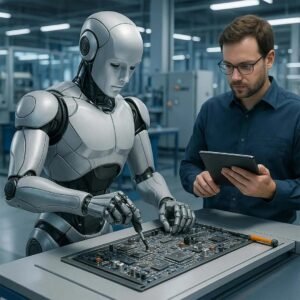
Physical AI can help machines identify objects, handle different materials, inspect products, and adapt to changing production environments.
Agentic systems may help coordinate inventory, production schedules, quality-control workflows, and maintenance planning.
This can improve productivity while reducing repetitive manual work.
4. Improving agriculture
Agriculture is essential to human survival, and AI could help farmers make better decisions.
AI-powered drones and agricultural robots may help with:
Crop monitoring.
Soil analysis.
Irrigation management.
Pest identification.
Crop health assessment.
Precision farming.
Harvesting assistance.
For farmers, these technologies could support better resource management and more informed agricultural decisions.
5. Transforming transportation
Autonomous vehicles are an important application of Physical AI.
Self-driving systems use cameras, radar, sensors, and AI models to understand their surroundings and make driving decisions.
In the future, more advanced autonomous systems could help with transportation, logistics, delivery services, and traffic management.
However, safety, legal responsibility, infrastructure, and reliability remain important challenges.
6. Building smarter homes
Imagine coming home after a long day and finding that your intelligent home system has adjusted the temperature, managed lighting, and organised certain household activities according to your approved preferences.
Agentic AI could coordinate connected devices, while Physical AI could power domestic robots capable of interacting with objects and navigating rooms.
These developments could make daily life more convenient, especially for older adults and people who need assistance with everyday activities.
7. Supporting business and entrepreneurship
Businesses can use Agentic AI to automate repetitive digital activities.
Examples include:
Customer support.
Market research.
Data analysis.
Report preparation.
Marketing assistance.
Business planning.
Inventory management.
Small businesses and startups could gain access to capabilities that previously required larger teams.
Nevertheless, business owners must check important decisions, financial transactions, and customer-facing information.
8. Creating new opportunities in science and research
AI can help scientists analyse large datasets, explore scientific literature, model complex systems, and generate research hypotheses.
Physical AI and robotics can also support laboratory automation and experiments.
This may help researchers investigate areas such as biotechnology, renewable energy, materials science, and environmental protection.
9. Helping people with disabilities
Intelligent assistive technologies could improve accessibility and independence.
Examples include:
Smart mobility devices.
Voice-controlled systems.
Robotic assistance.
Intelligent prosthetics.
Navigation assistance.
Communication technologies.
The most meaningful purpose of technology is not simply to make machines more powerful. It is to make human life better.
10. Creating a new generation of jobs
The growth of Agentic and Physical AI will change the employment landscape.
New opportunities may emerge in:
AI agent development.
Robotics engineering.
Machine learning.
AI safety and governance.
Automation engineering.
Robotics maintenance.
Computer vision.
Data science.
Human-robot interaction.
Students who start learning these skills today may be better prepared for tomorrow’s technology-driven economy.

8. Important Facts About Agentic and Physical AI
Here are some interesting facts that students, teachers, professionals, and technology enthusiasts should understand.
AI research existed decades before modern chatbots became popular.
The 1956 Dartmouth workshop is widely regarded as the formal beginning of AI as a research field.
Agentic AI focuses on achieving goals through planning and actions.
Physical AI connects intelligent models with real-world machines.
Robots require sensors to collect information about their surroundings.
AI agents can use approved external tools to complete multi-step tasks.
Physical AI can use simulations and synthetic data during development and testing.
Autonomous vehicles are an important example of Physical AI.
AI can support human creativity, research, and productivity.
Human oversight remains important when AI systems make consequential decisions.
Physical AI development increasingly combines models, sensors, real-world data, simulation, and computing infrastructure.
9. Significance of Agentic and Physical AI in Human Life
The importance of these technologies goes beyond faster computers and automated machines.
Their real significance lies in how they may change the relationship between humans and technology.
Traditional machines generally perform specific programmed activities. Newer AI systems can potentially understand more complex instructions, adapt to changing conditions, and coordinate multiple activities.
Consider three examples:
For students: AI can become a learning assistant that helps explain difficult subjects and organise preparation.
For working professionals: AI agents can help manage repetitive work, research information, and prepare reports.
For society: Intelligent robots may assist with healthcare, agriculture, disaster response, and essential services.
The larger opportunity is to use technology to solve real problems rather than simply create impressive demonstrations.
10. Advantages of Agentic and Physical AI
The major potential advantages include:
Higher productivity: AI can reduce time spent on repetitive tasks.
Improved efficiency: Intelligent systems can coordinate multiple activities.
Personalised services: AI can adapt assistance to individual requirements.
Better accessibility: Assistive technologies can support people with disabilities.
Scientific advancement: AI can help researchers analyse complex information.
Industrial development: Intelligent robots can support manufacturing.
Resource management: AI can help optimise energy, water, and materials.
Continuous operation: Some automated systems can work beyond conventional human working hours.
These benefits depend on appropriate implementation, reliable infrastructure, and responsible use.
11. Challenges and Risks of Agentic and Physical AI
Despite its opportunities, AI also creates serious challenges that society must address.
1. Job displacement: Automation may reduce demand for certain repetitive tasks, affecting some workers and industries.
2. Data privacy: AI systems may process personal, business, or confidential information. Strong data protection is essential.
3. Security risks: Autonomous agents can create problems if attackers exploit their access to digital systems.
4. Incorrect decisions: AI can generate inaccurate information or misunderstand instructions.
5. Physical safety: A robot or autonomous vehicle can cause harm if its perception or control system fails.
6. High implementation costs: Developing and maintaining advanced AI systems requires computing resources, technical expertise, and investment.
7. Accountability: Organisations must establish who is responsible when an AI system makes a harmful decision.
8. Overdependence: Excessive dependence on AI can weaken independent thinking and problem-solving skills.
The solution is not to reject AI. Instead, governments, companies, researchers, educators, and communities should work together to develop safe, transparent, and human-centred AI systems.
12. Importance of Agentic and Physical AI in Society
AI is becoming an important part of social and economic development. Its impact will not be limited to technology companies or large corporations.
It could influence education, public services, healthcare, transportation, agriculture, environmental protection, and communication.
Importance for students
Students need to understand AI because future careers will increasingly involve digital technologies and intelligent systems.
Learning programming, mathematics, robotics, critical thinking, and problem-solving can help students prepare for emerging opportunities.
Importance for developing countries
Countries such as India can explore AI to improve education access, agricultural productivity, healthcare delivery, and public administration.
For example, AI-powered educational platforms could support students in rural areas, while intelligent agricultural systems could help farmers make informed decisions.
Importance for economic development
AI can support entrepreneurship, innovation, industrial productivity, and the development of new services.
However, its benefits should be accessible to smaller businesses, educational institutions, and communities rather than being concentrated among a few powerful organisations.
Importance for humanity
The ultimate purpose of AI should be to complement human abilities, improve quality of life, reduce unnecessary difficulties, and create opportunities for future generations.
13. How Can Students Prepare for the Future of AI?
For students, the shift toward Agentic and Physical AI is an opportunity to develop valuable skills.
Here are some practical recommendations:
| Skill | Why it matters |
|---|---|
| Python programming | Useful for AI and automation |
| Mathematics | Supports machine learning and robotics |
| Machine learning | Helps build intelligent systems |
| Robotics | Connects software with physical machines |
| Data science | Helps analyse information |
| Computer vision | Enables machines to understand images |
| Prompt engineering | Helps communicate with AI systems |
| AI ethics | Encourages responsible development |
| Critical thinking | Helps evaluate AI-generated information |
| Communication | Supports human-AI collaboration |
Suggested learning roadmap
Start with computer fundamentals.
Learn Python programming.
Understand basic mathematics and statistics.
Explore machine learning and deep learning.
Experiment with generative AI tools.
Learn how AI agents use tools and workflows.
Explore robotics, sensors, and automation.
Build small projects and document your learning.
You do not need to become an expert in every field. Start with one area that interests you and gradually expand your knowledge.
14. Future of Artificial Intelligence: What Can We Expect?
The future of AI may involve a closer connection between digital intelligence and the physical world.
Several developments deserve attention.
More capable AI agents: AI agents may become better at planning, coordinating tasks, and working across different applications.
Advanced humanoid robots: Robots may increasingly assist with manufacturing, logistics, household activities, and selected service tasks.
Intelligent healthcare: AI-supported systems could help healthcare professionals with administrative work, monitoring, and certain clinical processes.
Autonomous transportation: More advanced autonomous driving and delivery systems may become available as safety and regulatory requirements are addressed.
Human-robot collaboration: Rather than operating separately, humans and intelligent machines may work together in factories, laboratories, and service environments.
AI-powered scientific discovery: Intelligent systems may accelerate research into new medicines, materials, energy technologies, and environmental solutions.
Personal AI assistants: AI agents could become more integrated into everyday digital activities, helping people organise work, learning, and personal projects.
These developments are possibilities, not guaranteed outcomes. Their progress will depend on scientific breakthroughs, affordability, public acceptance, safety, and regulation.
15. Observance and Awareness of Artificial Intelligence
Artificial Intelligence does not have one universally recognised annual observance dedicated specifically to Agentic AI and Physical AI.
However, AI awareness can be promoted through educational programmes, technology exhibitions, robotics competitions, research conferences, coding workshops, and innovation events.
Schools and colleges can organise:
AI awareness seminars.
Robotics demonstrations.
Artificial intelligence quizzes.
Coding competitions.
Responsible AI discussions.
Science and technology exhibitions.
Student innovation challenges.
These activities can help people understand both the benefits and limitations of AI.
The goal should be to encourage responsible innovation rather than blindly accepting every new technology.
16. Review: Agentic and Physical AI – A New Chapter in Technology
Agentic and Physical AI represent an exciting direction in the evolution of artificial intelligence.
Traditional AI helped computers recognise patterns, analyse data, and generate information. Generative AI made it easier for people to communicate with intelligent systems. Agentic AI takes another step by enabling systems to plan and perform tasks, while Physical AI connects intelligent decision-making with robots and machines.
Our review:
| Review category | Assessment |
|---|---|
| Innovation potential | Very high |
| Educational opportunities | Excellent |
| Business applications | Very promising |
| Healthcare applications | Promising |
| Robotics development | Rapidly evolving |
| Employment impact | Significant but uncertain |
| Safety requirements | Extremely important |
| Future potential | Very promising |
Minorstudy’s perspective:
We believe that the future of technology should not be measured only by how intelligent machines become. It should also be measured by how effectively they solve human problems.
For students, AI represents an opportunity to learn new skills. For entrepreneurs, it offers new possibilities for innovation. For society, it creates opportunities to improve essential services.
Nevertheless, human creativity, empathy, responsibility, and ethical judgment must remain central to technological development.
17. Important Points to Remember
Artificial Intelligence is a broad field of computer science.
Agentic AI focuses on planning and completing goals.
Physical AI enables machines to perceive and interact with the physical world.
Robotics is an important part of Physical AI applications.
Agentic AI can automate complex digital workflows.
Combining both technologies could create more capable autonomous systems.
Education and employment will continue to evolve with AI.
AI safety, privacy, and accountability are essential.
Students should develop technical and human skills together.
AI should complement human intelligence rather than replace human responsibility.
18. Frequently Asked Questions (FAQs)
Q1. What is Agentic AI?
Agentic AI is a type of artificial intelligence that can pursue defined goals by planning, making decisions, using tools, and performing multiple tasks with varying levels of human supervision.
Q2. What is Physical AI?
Physical AI refers to AI systems that interact with the real world through robots, sensors, machines, autonomous vehicles, and other physical devices.
Q3. What is the main difference between Agentic AI and Physical AI?
Agentic AI focuses on completing goals and tasks, primarily through digital environments. Physical AI focuses on enabling intelligent machines to understand and interact with physical environments.
Q4. Can Agentic AI and Physical AI work together?
Yes. An intelligent robot can use Physical AI to navigate and interact with objects, while Agentic AI can help plan and coordinate its activities.
Q5. Is ChatGPT an example of Agentic AI?
A conversational AI assistant is not automatically an autonomous agent. However, AI assistants equipped with suitable tools, planning capabilities, and permission to perform multi-step tasks can support agentic workflows.
Q6. Is a humanoid robot an example of Physical AI?
A humanoid robot equipped with AI models, sensors, and control systems that allow it to perceive and interact with its surroundings is an example of Physical AI.
Q7. How will AI affect future jobs?
AI may automate some tasks, change existing occupations, and create new opportunities in software development, robotics, AI safety, data science, and automation. The overall employment impact remains uncertain.
Q8. Will AI replace human beings?
AI may replace or transform certain activities, but human creativity, empathy, social understanding, accountability, and judgment remain essential. The future will likely involve different forms of human-AI collaboration.
Q9. How can students learn Agentic AI?
Students can begin with Python, computer science, machine learning, and generative AI. They can then explore AI agents, APIs, automation tools, and practical projects.
Q10. What are the major applications of Physical AI?
Major applications include humanoid robots, industrial automation, autonomous vehicles, agricultural robots, healthcare assistance, drones, and smart manufacturing.
Q11. Is Physical AI expensive?
Developing and deploying advanced Physical AI systems can be expensive because they require hardware, sensors, computing resources, software, testing, and maintenance. Costs vary significantly by application.
Q12. What is the future of Agentic and Physical AI?
Their future may involve more autonomous digital assistants, intelligent robots, automated industries, smarter transportation, and improved human-machine collaboration.
19. Wishes and Inspirational Message for the Future of AI
Technology is not just about machines, computers, or robots. It is about creating possibilities that can improve human life.
As Agentic AI and Physical AI continue to develop, we should encourage students, researchers, entrepreneurs, and innovators to use these technologies responsibly.
Here are some inspirational wishes and messages:
May Artificial Intelligence create opportunities for education, innovation, and a better future.
May technology help solve human problems and improve the quality of life.
May every student gain the opportunity to understand and explore emerging technologies.
May intelligent machines support human creativity, compassion, and progress.
May innovation always remain connected with ethics, safety, and responsibility.
May AI help build a more inclusive, educated, and sustainable society.
Remember: The future does not belong only to people who use technology. It belongs to those who understand it, question it, improve it, and use it to make a positive difference.
20. Conclusion: Building a Better Future Through Agentic and Physical AI
Artificial Intelligence has travelled a remarkable journey, from early mathematical models and experimental computer programmes to advanced generative systems and intelligent machines.
The shift toward Agentic and Physical AI represents another important stage in this journey.
Agentic AI is changing how computers complete tasks, manage workflows, and support decision-making. Physical AI is taking intelligence beyond computer screens and connecting it with robots, autonomous vehicles, and machines that interact with the real world.
Together, these technologies could transform education, healthcare, agriculture, transportation, manufacturing, business, and scientific research.
However, technological progress also brings responsibilities. Privacy, employment, cybersecurity, safety, fairness, and accountability must receive serious attention.
For students and young professionals, this is the right time to understand AI, develop new skills, and participate in technological innovation.
At Minorstudy, we believe education should prepare people not only for today’s opportunities but also for tomorrow’s challenges.
The real future of Artificial Intelligence is not about creating machines that simply replace human effort. It is about building intelligent technologies that empower humanity, expand opportunities, and make the world a better place.
References and Further Reading
For readers who want to explore the subject in greater depth:
IBM – The History of Artificial Intelligence — Historical milestones and the development of AI.
NVIDIA – What Is Physical AI? — Physical AI, robotics, simulation, and autonomous machines.
IBM – What Is Physical AI? — Explanation of AI systems operating in physical environments.
OECD – AI Policies and Initiatives — Technical background and AI development.
McKinsey – Technology Trends Outlook 2026 — Emerging technology developments and industry trends.
Visits Suggested internal linking for Minorstudy:
Artificial Intelligence: Complete Guide for Students
Machine Learning: Meaning, Applications and Career Opportunities
Robotics Engineering: Courses, Skills and Career Scope
AI Engineer: Skills, Salary and Career Opportunities
Future Careers for Students in India
Generative AI: Opportunities and Challenges
Science and Technology: Transforming the Modern World