

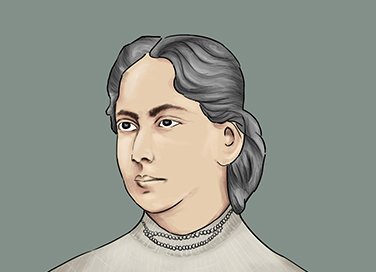
Remarkable Facts About Mrs. Swarnakumari Devi Ji That Prove Her Powerful Legacy
At a time when women faced considerable restrictions in education and social participation, Swarnakumari Devi demonstrated that intellectual ability, creativity and leadership were not limited by gender. Through her writing, editorial work and social initiatives, she helped create opportunities for women to express themselves and participate in society.
Her legacy is not simply about literary achievements. It is also about courage, independent thinking, education, compassion and the determination to build a better future.
1. Who Was Mrs. Swarnakumari Devi Ji?
Swarnakumari Devi was an influential Bengali literary personality born in 1855 into the distinguished Tagore family of Jorasanko, Kolkata (then Calcutta). She was the daughter of Debendranath Tagore and the elder sister of Nobel Prize-winning poet Rabindranath Tagore.
She became known for her contributions to Bengali novels, poetry, drama, music and journalism. Her literary career was especially significant because she was among the earliest Bengali women to establish herself as a successful novelist.
She also worked as an editor and participated in social and cultural initiatives. Her life challenged the traditional belief that women’s responsibilities should be restricted to domestic activities.
Her journey teaches us that education is not merely a qualification; it is a source of confidence, independence and social transformation.
2. Early Life and Family Background of Swarnakumari Devi Ji
Swarnakumari Devi was born on 28 August 1855 in the famous Jorasanko Tagore family of Calcutta. Her father, Debendranath Tagore, was a respected religious thinker and social reformer associated with the Brahmo Samaj. Her mother was Sarada Devi.
Growing up in the Tagore household exposed her to literature, music, philosophy, education and intellectual discussions. The family environment encouraged artistic expression and independent thought.
Unlike many girls of her generation, she received an opportunity to study at home with private tutors. Her education included languages and other subjects that helped develop her literary abilities.
She married Janakinath Ghosal in 1868. Despite the responsibilities of family life, she continued to read, write, compose and participate in intellectual activities.
Her story reminds us of an important lesson: personal responsibilities and intellectual ambitions do not necessarily have to be enemies. With determination and opportunities, people can contribute to both family and society.
3. History of Swarnakumari Devi Ji: Her Journey Towards Literary Excellence
The nineteenth century was a period of significant social and cultural transformation in Bengal. The Bengal Renaissance encouraged new discussions about education, literature, science, social reform and women’s participation.
However, women still faced numerous barriers. Access to formal education and public recognition was limited, and female authors often struggled to receive the same respect as male writers.
Swarnakumari Devi emerged during this challenging period.
Her first major novel, Dipnirban (also written as Deep Nirban), was published in 1876. It helped establish her reputation as an important Bengali novelist.
She subsequently wrote novels, short stories, plays, poems, essays and musical compositions. Her writing explored historical and social themes, including human relationships, women’s experiences and contemporary society.
Her literary career was not limited to writing books. She also became involved in editing Bharati, an influential Bengali literary magazine associated with the Tagore family.
Her contribution was important because she created opportunities for literary discussion and encouraged the participation of other writers.
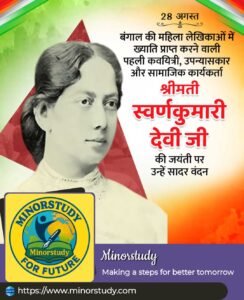
4. 10 Remarkable Facts About Mrs. Swarnakumari Devi Ji
Here are ten remarkable facts that explain why Swarnakumari Devi Ji deserves a respected place in Indian history.
1. She Was the Elder Sister of Rabindranath Tagore
One of the most recognised aspects of her family background is her relationship with Rabindranath Tagore, the celebrated Bengali poet, philosopher and Nobel Prize winner.
However, Swarnakumari Devi was not simply known because she belonged to the Tagore family. She developed her own identity through literature, journalism and social service.
Her achievements demonstrate that every individual deserves recognition for their own contributions.
2. She Was One of the Earliest Prominent Bengali Women Novelists
Swarnakumari Devi was among the pioneering women who established a strong presence in Bengali fiction.
Her first novel, Dipnirban, appeared in 1876 and helped open new possibilities for women in literary expression.
At a time when female authorship was not widely encouraged, she proved that women could create serious literary works and influence intellectual discussions.
3. She Edited the Famous Bengali Magazine Bharati
One of her most important achievements was her editorial work for Bharati.
She took charge of the magazine in 1884 and edited it until 1895. She later returned to the editorial position from 1908 to 1915.
Through this publication, she helped promote Bengali literature, intellectual discussion and creative expression.
Her work as an editor also challenged the traditional belief that journalism and literary leadership were exclusively male responsibilities.
4. She Established Sakhi Samiti for Women’s Welfare
Swarnakumari Devi was deeply concerned about the difficulties faced by disadvantaged women and children.
In 1896, she established Sakhi Samiti, an organisation intended to support vulnerable women, widows and orphaned children.
The organisation focused on helping women who lacked financial and family support. Its activities included assistance and educational opportunities.
This initiative reflected her belief that social progress should include people who are often neglected.
5. She Wrote Several Important Novels
Her literary contribution included several novels that explored different aspects of human life and society.
Some notable works include:
Dipnirban (1876)
Mibar Raj (1877)
Chhinna Mukul (1879)
Malati (1881)
Vidroha (1890)
Snehalata (1892)
Kahake (1898)
Bichitra (1920)
Swapnabani (1921)
Milanrati (1925)
Her novels demonstrated her versatility and her ability to explore historical, social and emotional subjects.
6. She Contributed to Drama, Poetry and Music
Swarnakumari Devi did not restrict herself to novel writing.
She also composed poems, songs, plays and musical works. Her creative interests included different forms of artistic expression.
Her musical drama Basanta Utsav is among her notable works.
This diversity demonstrates that her literary talent extended beyond one particular genre.
7. She Encouraged Scientific Knowledge Through Writing
Another remarkable aspect of her intellectual life was her interest in science.
Her work Prithibi addressed scientific subjects, including the natural world and the Earth.
This was particularly significant in an era when scientific discussions and educational opportunities were often dominated by men.
She demonstrated that women could participate in scientific thinking, knowledge creation and intellectual debate.
8. She Participated in Public and National Life
Swarnakumari Devi was also connected with the growing public and political discussions of her time.
She attended the Indian National Congress session in Calcutta in 1890 as a woman delegate.
Her participation reflected the expanding role of educated women in public affairs.
She helped demonstrate that women could contribute not only through literature and family life but also through wider social and national discussions.
9. She Received the Jagattarini Gold Medal
In 1927, the University of Calcutta honoured Swarnakumari Devi with the Jagattarini Gold Medal.
She is recognised as the first woman to receive this distinction.
This recognition was an important milestone in her life because it acknowledged her intellectual and literary contributions.
10. Her Legacy Continued Beyond Her Lifetime
Swarnakumari Devi passed away on 3 July 1932 in Calcutta.
However, her contribution to Bengali literature, women’s welfare, journalism and education continued to inspire later generations.
Her daughter Sarala Devi Chaudhurani also became an influential writer and social activist.
Her life illustrates how knowledge, courage and social responsibility can create an impact that continues long after an individual is gone.
Historical references for these achievements include the Government of India’s science publication, the Marathi Vishwakosh, and historical research published by the University of North Bengal.
5. Major Literary Works of Swarnakumari Devi Ji
Her literary achievements deserve special attention because she contributed to multiple forms of Bengali literature.
| Literary category | Notable works |
|---|---|
| Novels | Dipnirban, Mibar Raj, Malati, Snehalata, Kahake |
| Drama | Rajkanya, Divyakamal, Koney Badal, Pak Chakra |
| Poetry and music | Gatha, Gitiguchchha, Basanta Utsav |
| Science and essays | Prithibi and other essays |
| Short stories | Short Stories (English collection, 1919) |
Her writings explored historical events, social relationships, human emotions and the challenges of contemporary society.
One of the most interesting aspects of her literary career was her ability to combine creativity with intellectual curiosity.
6. Timeline of Swarnakumari Devi Ji’s Life
Important events in chronological order
28 August 1855 – Birth
Born into the Tagore family at Jorasanko, Calcutta.
1868 – Marriage
Married Janakinath Ghosal.
1876 – First novel
Published Dipnirban, establishing her literary career.
1884 – Editorial leadership
Took responsibility for editing the magazine Bharati.
1890 – Public participation
Attended the Indian National Congress session in Calcutta as a woman delegate.
1896 – Social welfare
Established Sakhi Samiti to support disadvantaged women and children.
1908–1915 – Second editorial period
Returned to editing Bharati.
1927 – Recognition
Received the Jagattarini Gold Medal from the University of Calcutta.
1929 – Literary leadership
Presided over the Vangiya Sahitya Sammelan.
3 July 1932 – Death
Passed away in Calcutta, leaving behind a significant literary and social legacy.
7. Significance of Swarnakumari Devi Ji in Indian History
Swarnakumari Devi’s importance extends far beyond her literary achievements. She represents a generation of Indian women who challenged traditional limitations and participated in the intellectual development of society.
Her significance can be understood through five major contributions.
1. Women’s empowerment: She demonstrated that women could become successful writers, editors, intellectuals and social workers.
2. Literary development: Her novels, poems and plays enriched Bengali literature and encouraged women’s participation in creative writing.
3. Social welfare: Through Sakhi Samiti, she worked to support vulnerable women and orphaned children.
4. Education and scientific thinking: Her intellectual interests showed that women should have access to knowledge across different subjects, including science.
5. Leadership: Her editorial responsibilities and participation in public life helped expand the possibilities for women’s leadership.
Her life is an example of how education and determination can gradually transform society.
8. Why Is Swarnakumari Devi Ji Important to Our Daily Life?
You may wonder how a Bengali writer who lived more than a century ago can influence our everyday lives.
The answer is simple: her values remain relevant even today.
Here are some practical lessons from her life.
A. Believe in Education
Education gives people the ability to think independently and make informed decisions.
Swarnakumari Devi’s intellectual journey encourages students, especially girls, to pursue education and develop their talents.
B. Respect Women’s Contributions
Women contribute to families, businesses, education, science, literature and public administration.
Her achievements remind us to recognise women’s abilities and provide equal opportunities.
C. Help People in Need
Her work through Sakhi Samiti teaches us that society becomes stronger when people support those who face difficulties.
Even small acts of kindness can create meaningful change.
D. Develop Reading and Writing Habits
Reading improves knowledge, vocabulary, creativity and critical thinking.
Students can learn from her commitment to literature and make reading a regular part of their lives.
E. Become Independent Thinkers
Her life teaches us not to accept social limitations without questioning them.
Young people should develop confidence, curiosity and the ability to express their ideas respectfully.
9. Daily Life Impacts: Five Lessons for Students and Young Generations
Swarnakumari Devi Ji’s legacy offers practical lessons for today’s students and professionals.
| Life lesson | How to apply it |
|---|---|
| Education | Continue learning throughout life |
| Confidence | Express your ideas without unnecessary fear |
| Creativity | Explore writing, music, science and art |
| Social responsibility | Help disadvantaged people |
| Leadership | Take initiative and encourage others |
For students, her story is particularly inspiring.
A student does not need to wait until becoming wealthy, famous or powerful to make a difference. A commitment to learning, helping others and developing useful skills can begin today.
For parents, her life provides another message: children, including girls, should be encouraged to explore their interests and ambitions.
For teachers, her journey demonstrates the importance of providing students with opportunities to think independently.
10. Observance and Remembrance of Swarnakumari Devi Ji
There is no widely established official national observance dedicated exclusively to Swarnakumari Devi Ji.
However, her birth anniversary on 28 August and death anniversary on 3 July provide meaningful opportunities to remember her achievements.
Educational institutions, libraries, literary organisations and cultural groups can use these occasions to introduce students to her life.
Some meaningful activities include:
Organising Bengali literature reading sessions.
Conducting essay-writing competitions about women pioneers.
Discussing her novels and contributions to journalism.
Arranging educational programmes about women’s empowerment.
Holding discussions about the history of the Tagore family.
Encouraging students to read works by early Indian women authors.
Supporting literacy and educational initiatives for disadvantaged girls.
Such activities can help preserve her memory and introduce her contributions to younger generations.
11. Important Points to Remember About Swarnakumari Devi Ji
Here are some quick facts for students, competitive examination preparation and general knowledge.
| Question | Answer |
|---|---|
| Full name | Swarnakumari Devi |
| Birth date | 28 August 1855 |
| Birthplace | Jorasanko, Calcutta |
| Father | Debendranath Tagore |
| Mother | Sarada Devi |
| Famous brother | Rabindranath Tagore |
| Husband | Janakinath Ghosal |
| Profession | Novelist, poet, editor and social reformer |
| First novel | Dipnirban |
| First novel publication | 1876 |
| Famous magazine | Bharati |
| Social organisation | Sakhi Samiti |
| Major recognition | Jagattarini Gold Medal |
| Award year | 1927 |
| Death date | 3 July 1932 |
| Literary language | Primarily Bengali |
Important note: Some historical publications differ in the spelling of her works and certain biographical details. The dates above follow the historical references cited in this article.
12. Swarnakumari Devi Ji’s Importance to Society
A person’s greatness should not be measured only by awards, wealth or popularity. It should also be measured by the positive changes that person creates in society.
Swarnakumari Devi’s contribution is important for several reasons.
For women: She helped demonstrate that women could participate in literature, public life and social reform.
For children: Her commitment to education and social welfare provides an example of why vulnerable children deserve opportunities and support.
For writers: Her literary journey encourages aspiring authors to express their ideas and explore different subjects.
For society: Her work reminds us that social development requires education, compassion and collective responsibility.
For India: She forms an important part of India’s literary and cultural heritage, particularly the history of the Bengal Renaissance.
Today, when conversations about gender equality, women’s leadership and inclusive education are increasingly important, her contributions deserve renewed attention.
13. Review Section: Swarnakumari Devi Ji’s Life and Legacy
Overall review: An inspiring pioneer of Bengali literature and women’s empowerment.
Swarnakumari Devi’s life offers an impressive combination of literary creativity, intellectual development and social responsibility.
Her greatest achievement was not simply writing novels or editing a magazine. It was establishing an independent identity at a time when women had limited opportunities to participate in public intellectual life.
Her work with Bharati highlights her editorial abilities, while Sakhi Samiti demonstrates her concern for disadvantaged women and children.
Her novels also deserve attention from readers interested in the development of Bengali literature and women’s perspectives in Indian fiction.
What makes her legacy remarkable?
Her pioneering role in Bengali literature.
Her contribution to women’s literary participation.
Her editorial leadership.
Her efforts towards social welfare.
Her interest in scientific knowledge.
Her influence on future generations.
Our verdict: Swarnakumari Devi Ji deserves greater recognition in Indian history and educational discussions. Her story should be introduced to students not merely as a biography but as an example of courage, creativity and social responsibility.
14. Frequently Asked Questions (FAQs)
Q1. Who was Mrs. Swarnakumari Devi Ji?
Swarnakumari Devi was a pioneering Bengali novelist, poet, playwright, editor, composer and social reformer. She was also the elder sister of Rabindranath Tagore.
Q2. When was Swarnakumari Devi born?
She was born on 28 August 1855 in Jorasanko, Calcutta, British India.
Q3. Who was the father of Swarnakumari Devi?
Her father was Debendranath Tagore, a prominent religious thinker and social reformer.
Q4. Who was Swarnakumari Devi’s famous brother?
Her famous younger brother was Rabindranath Tagore, the Nobel Prize-winning Bengali poet and writer.
Q5. What was Swarnakumari Devi’s first novel?
Her first novel was Dipnirban, published in 1876.
Q6. What was Sakhi Samiti?
Sakhi Samiti was a social welfare organisation established by Swarnakumari Devi in 1896. It aimed to support disadvantaged women, widows and orphaned children.
Q7. Which magazine did Swarnakumari Devi edit?
She edited Bharati, a Bengali literary magazine associated with the Tagore family.
Q8. What award did Swarnakumari Devi receive in 1927?
She received the Jagattarini Gold Medal from the University of Calcutta in 1927.
Q9. What were her major literary contributions?
Her major contributions included novels, poems, short stories, plays, songs, essays and scientific writing.
Q10. When did Swarnakumari Devi die?
She passed away on 3 July 1932 in Calcutta.
Q11. Why is Swarnakumari Devi important in Indian history?
She is important because of her pioneering contribution to Bengali literature, women’s education, journalism and social welfare.
Q12. What can students learn from Swarnakumari Devi’s life?
Students can learn the importance of education, confidence, independent thinking, creativity, gender equality and helping disadvantaged people.
15. Wishes and Inspirational Messages for Swarnakumari Devi Ji
On her birth anniversary and other occasions of remembrance, we can celebrate her life through meaningful messages.
Here are some wishes and inspirational lines suitable for students, educational institutions and social media.
1. Tribute to Swarnakumari Devi Ji! Your contribution to literature and women’s empowerment will continue to inspire generations.
2. Your life teaches us that education, courage and determination can break social barriers. Respectful remembrance to a remarkable pioneer.
3. A woman of knowledge, creativity and compassion, Swarnakumari Devi Ji remains an inspiration for every generation.
4. May your legacy encourage young girls to dream fearlessly, learn continuously and contribute positively to society.
5. Remembering Swarnakumari Devi Ji, whose literary achievements and commitment to social welfare created an important chapter in Indian history.
6. True greatness lies in empowering others. Your life continues to remind us of this timeless truth.
7. Let us celebrate education, equality and creativity by remembering the extraordinary journey of Swarnakumari Devi Ji.
Inspirational quote for students:
“Knowledge becomes meaningful when it inspires us to improve our lives and serve society.”
An original inspirational line for this article, not a historical quotation by Swarnakumari Devi.
16. Conclusion: The Powerful Legacy of Mrs. Swarnakumari Devi Ji
The life of Mrs. Swarnakumari Devi Ji is an important chapter in the history of Indian literature and women’s empowerment.
Born into the Tagore family, she created an identity of her own through her remarkable literary achievements, editorial leadership and commitment to social welfare.
Her novels helped expand the presence of women in Bengali literature. Her work with Bharati demonstrated her intellectual and editorial abilities. Through Sakhi Samiti, she showed that social progress must include disadvantaged women and children.
Her achievements are especially meaningful because she worked during a period when women faced considerable restrictions in education and public participation.
Today, her story offers valuable lessons to students, teachers, parents, writers and social reformers.
We should remember her not only as the sister of Rabindranath Tagore but also as an accomplished writer, independent thinker and social reformer in her own right.
Her legacy gives us a powerful message: education creates opportunities, courage breaks barriers, and knowledge becomes more valuable when it benefits society.
Let us continue sharing the stories of remarkable Indian women like Swarnakumari Devi Ji so that future generations can understand the people who helped shape our literary, educational and cultural heritage.
17. References and Further Reading
For readers who want to explore her life and achievements in greater detail:
Editorial note For readers: Before Reading, verify historical spellings and dates against the original Bengali editions and authoritative biographies. The article’s review and inspirational messages are editorial content, not quotations from historical sources.








Can you be more specific about the content of your article? After reading it, I still have some doubts. Hope you can help me.
Your article helped me a lot, is there any more related content? Thanks!
Your article helped me a lot, is there any more related content? Thanks!
I don’t think the title of your article matches the content lol. Just kidding, mainly because I had some doubts after reading the article.
I don’t think the title of your article matches the content lol. Just kidding, mainly because I had some doubts after reading the article.
I don’t think the title of your article matches the content lol. Just kidding, mainly because I had some doubts after reading the article. https://www.binance.com/register?ref=IHJUI7TF
Can you be more specific about the content of your article? After reading it, I still have some doubts. Hope you can help me. https://www.binance.info/en-NG/register?ref=YY80CKRN
Your article helped me a lot, is there any more related content? Thanks! https://www.binance.bh/register?ref=L4EUT9FG
Your article helped me a lot, is there any more related content? Thanks!
Thank you for your sharing. I am worried that I lack creative ideas. It is your article that makes me full of hope. Thank you. But, I have a question, can you help me? https://www.binance.bh/register?ref=JW3W4Y3A
Your point of view caught my eye and was very interesting. Thanks. I have a question for you.
Thanks for sharing. I read many of your blog posts, cool, your blog is very good. https://accounts.binance.bh/register/person?ref=GGYHGRE
Thank you for your sharing. I am worried that I lack creative ideas. It is your article that makes me full of hope. Thank you. But, I have a question, can you help me? https://www.binance.bh/register?ref=IHJUI7TF
Your point of view caught my eye and was very interesting. Thanks. I have a question for you. https://www.binance.bh/es-MX/register?ref=A00OPRX4
Can you be more specific about the content of your article? After reading it, I still have some doubts. Hope you can help me.