

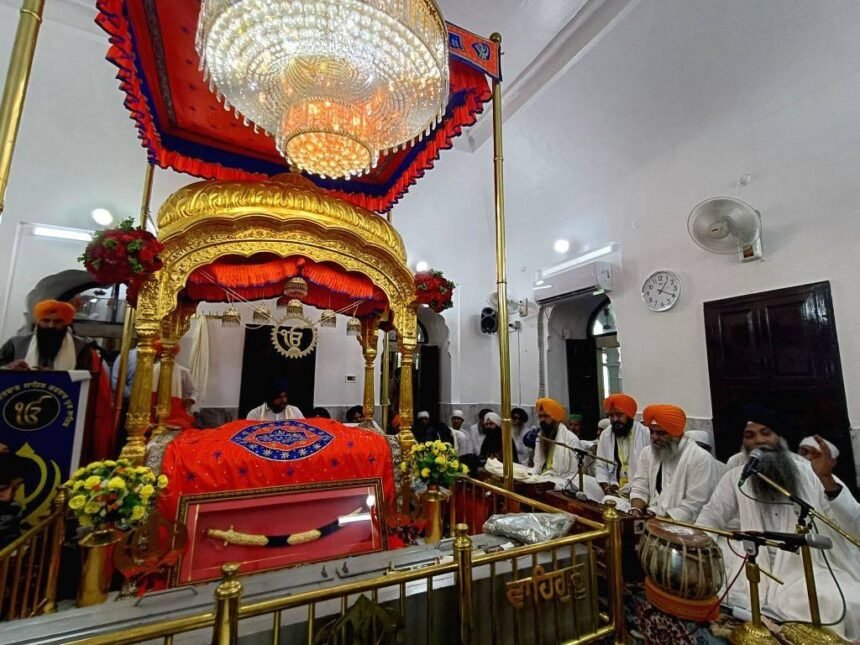
Shri Guru Granth Sahib Ji Holds Eternal Significance in Our Lives

- Introduction
- 1. Early preservation of Gurbani
- 2. First installation in 1604
- 3. Later recension
- 4. Eternal Guru in 1708
- 1. It Is the Eternal Guru of Sikhs
- 2. It Teaches Equality and Human Dignity
- 3. It Connects Spirituality With Daily Life
- What about visiting a Gurdwara?
- At home
- At school
- At work
- During failure
- During success
- During conflict
- During hardship
- In society
- Historical importance
- Spiritual importance
- Literary importance
- Social importance
- Student relevance
- 1. Who compiled Guru Granth Sahib Ji?
- 2. When was it first installed?
- 3. Who was the first Granthi?
- 4. When did Guru Granth Sahib Ji become the eternal Guru?
- 5. How many pages does Guru Granth Sahib Ji have?
- 6. Is Guru Granth Sahib Ji only written by Sikh Gurus?
- 7. Why is music important?
- 8. Can non-Sikhs learn from Guru Granth Sahib Ji?
- 9. Can Guru Granth Sahib Ji be treated like an ordinary book?
- 10. What is the simplest lesson one can take from it?


Introduction
Shri Guru Granth Sahib Ji occupies a unique and central place in Sikh spiritual life. It is not simply regarded as a historical religious book; within Sikh tradition, it has the status of the eternal Guru and remains central to worship, reflection, prayer and community life.
The journey of Guru Granth Sahib Ji is deeply connected with the history of the Sikh Gurus. The scripture was compiled under the guidance of Guru Arjan Dev Ji, installed at Sri Harmandir Sahib in Amritsar in 1604, and later given the status of the eternal Guru by Guru Gobind Singh Ji in 1708. (SGPC)
For many people, its importance is not limited to religious ceremonies. Its teachings encourage reflection on truth, humility, equality, compassion, honest living, remembrance of the Divine and service to humanity.
This article explores 7 powerful reasons for its enduring significance, together with its history, important facts, timeline, costs, observance, daily-life lessons, social importance, review and frequently asked questions.
What Is Guru Granth Sahib Ji?
Guru Granth Sahib Ji is the central sacred scripture of Sikhism. The Shiromani Gurdwara Parbandhak Committee (SGPC) describes it as the Sikh scripture containing the hymns of the Sikh Gurus and other spiritual contributors, and records that after Guru Gobind Singh Ji’s passing, the scripture held the position of successor in the line of Sikh Gurus. (SGPC)
The scripture is also commonly referred to as the Adi Granth in connection with its earlier form.
Its contents include compositions of several Sikh Gurus as well as Bhagats and other contributors. SGPC’s account records compositions from the first five Gurus and the ninth Guru, along with works of 15 Bhagats and 11 Bhattas. (SGPC)
One particularly distinctive feature is its organization around music and raag. The SGPC account states that 31 raags are used in the scripture’s organization. (SGPC)
📜 History of Guru Granth Sahib Ji
Understanding its history helps us appreciate why the scripture has such an important place in Sikhism.
1. Early preservation of Gurbani
The Sikh Gurus composed spiritual hymns that were preserved and transmitted among the Sikh community. Guru Arjan Dev Ji undertook the major task of collecting and compiling these compositions.
According to the SGPC, Guru Arjan collected hymns associated with the earlier Gurus and Bhagats and added compositions of Guru Ram Das Ji and his own compositions. Bhai Gurdas Ji wrote the compiled volume. (SGPC)
2. First installation in 1604
A major milestone occurred in 1604, when Guru Arjan Dev Ji installed the scripture at Harmandir Sahib, Amritsar. Baba Buddha Ji was appointed as its first Granthi, or keeper. (SGPC)
3. Later recension
The Sikh tradition records that Guru Gobind Singh Ji worked on the final recension at Damdama Sahib, with Bhai Mani Singh Ji associated with the preparation of the text. (SGPC)
4. Eternal Guru in 1708
In 1708 at Nanded, Guru Gobind Singh Ji established the Guru Granth Sahib Ji as the Guru for the Sikh community, ending the succession of human Gurus. The SGPC records this as the point at which the scripture was acknowledged in place of a human successor. (SGPC)
🕰️ Timeline of Guru Granth Sahib Ji
| Year | Important Event |
|---|---|
| 15th–16th centuries | Spiritual compositions of the Sikh Gurus and other contributors develop |
| 1604 | Guru Arjan Dev Ji compiles and installs the Adi Granth at Harmandir Sahib |
| 1604 | Baba Buddha Ji becomes the first Granthi |
| 1706 | Guru Gobind Singh Ji is traditionally associated with preparing the final recension at Damdama Sahib |
| 1708 | Guru Gobind Singh Ji confers eternal Guruship upon Guru Granth Sahib Ji |
| Today | Guru Granth Sahib Ji remains central to Sikh worship and community life |
The 1604 installation and the 1708 establishment of the scripture as Guru are particularly important milestones. (SGPC)
🌟 7 Powerful Reasons Guru Granth Sahib Ji Holds Eternal Significance
1. It Is the Eternal Guru of Sikhs
The most fundamental reason for its importance is its status as Guru.
In Sikh tradition, spiritual guidance does not depend on the presence of a human Guru today. Instead, the teachings contained in the Guru Granth Sahib Ji serve as the continuing spiritual guide.
This makes reading, listening to and reflecting upon Gurbani an important part of Sikh life.
The concept also encourages a person to move beyond simply respecting a sacred text and to consider how its teachings can influence everyday conduct.
2. It Teaches Equality and Human Dignity
Another important theme is the dignity and spiritual worth of human beings.
The SGPC describes the compilation as including teachings connected with the unity of God and the brotherhood of humanity, while also noting themes concerning equality of men and women. (SGPC)
In everyday life, this message can encourage people to:
- Respect people regardless of social background.
- Avoid discrimination.
- Treat workers and colleagues with dignity.
- Listen to others with humility.
- Reject unnecessary social divisions.
- Help people experiencing hardship.
For students, this can translate into a simple lesson: your character is more important than your social status.
3. It Connects Spirituality With Daily Life
Guru Granth Sahib Ji is not only concerned with ceremonies or places of worship.
Its teachings address human experiences such as:
- Ego
- Anger
- Attachment
- Greed
- Fear
- Humility
- Compassion
- Truth
- Contentment
- Love
- Service
This makes the scripture relevant to ordinary situations.
For example, when someone faces criticism, Gurbani can become a source for reflection. When someone becomes successful, its teachings can encourage humility. When someone experiences difficulty, prayer and remembrance can provide spiritual support.
The goal is therefore not simply reading words, but trying to understand and apply their values.
4. Its Poetry and Music Make Its Message Unique
Guru Granth Sahib Ji has an extraordinary literary and musical character.
The hymns are organized through raag, connecting spiritual expression with music. The SGPC records that the scripture uses 31 raags and organizes compositions according to musical and poetic structures. (SGPC)
This is why Kirtan, the singing of Gurbani, has such an important place in Sikh worship.
Music can help people slow down and reflect. A person may understand an idea intellectually, but singing and listening can create another form of engagement.
This combination of language, poetry, philosophy and music is one of the distinctive characteristics of the scripture.
5. It Preserves a Broad Spiritual Heritage
Guru Granth Sahib Ji contains compositions not only of Sikh Gurus but also of spiritual figures from different backgrounds.
The SGPC lists contributors including Kabir, Ravidas, Namdev, Sheikh Farid, Dhanna, Pipa, Sain and others. (SGPC)
This gives the scripture a broad literary and spiritual character.
It also provides an important historical example of how spiritual ideas from different social and cultural backgrounds were brought together within one sacred compilation.
For modern society, this can encourage:
respect → dialogue → understanding → coexistence.
6. It Encourages Seva, Humility and Responsible Living
The teachings associated with Sikh tradition place great importance on living responsibly rather than separating spirituality completely from everyday action.
The Sikh tradition connects spiritual life with practices such as:
- Naam remembrance
- Honest living
- Sharing
- Seva
- Community participation
- Helping people in need
This becomes especially visible through the institution of Langar, where people sit together and share food.
The broader lesson is powerful: spirituality can be expressed through how we treat other people.
A person does not need to perform something extraordinary every day. Helping a neighbour, supporting someone who is struggling, feeding someone hungry or offering one’s time can become meaningful acts of service.
7. Its Teachings Remain Relevant to Modern Life
Technology has changed dramatically since the Guru Granth Sahib Ji was compiled, but many human challenges remain familiar.
People still experience:
- Stress
- Competition
- Anger
- Jealousy
- Material attachment
- Loneliness
- Family conflicts
- Social inequality
- Fear about the future
The scripture provides a spiritual framework for reflection on such challenges.
For a modern student, for example, its teachings can inspire a healthier perspective toward examinations: work sincerely, avoid excessive ego, accept setbacks and continue learning.
For a professional, the emphasis on honest conduct can become a reminder that career success should not require abandoning integrity.
For families, its teachings can encourage compassion and patience.
📚 Important Facts About Guru Granth Sahib Ji
Here are some useful facts for students and general readers:
- Guru Arjan Dev Ji played the central role in compiling the Adi Granth. (SGPC)
- It was installed at Harmandir Sahib in 1604. (SGPC)
- Baba Buddha Ji was appointed as the first Granthi. (SGPC)
- Guru Gobind Singh Ji established its status as the eternal Guru in 1708. (SGPC)
- The standard edition has 1,430 angs/pages. (SGPC)
- Its compositions are organized substantially through 31 raags. (SGPC)
- The scripture includes compositions associated with Sikh Gurus, Bhagats and Bhattas. (SGPC)
- Japji Sahib appears at the beginning of the main text. (SGPC)
- Gurbani is closely connected with Kirtan and musical expression.
- Guru Granth Sahib Ji is treated with deep reverence in Sikh places of worship. (SGPC)
💰 What Is the Cost of Guru Granth Sahib Ji?
This is an important question, especially for students researching Sikhism.
Guru Granth Sahib Ji should not be treated as an ordinary commercial product with a spiritual “price.” Its religious significance comes from its status as Guru within Sikh tradition.
Printed editions and related Gurbani publications may involve printing, paper, binding and distribution costs. For example, SGPC documents show that specialized paper is procured for printing the scripture. (SGPC)
However, there is no meaningful single “cost of Guru Granth Sahib Ji” that represents its spiritual value.
What about visiting a Gurdwara?
Generally, entering a Gurdwara and participating in worship does not require purchasing a ticket. Langar is traditionally provided as community food, while donations and seva may be offered voluntarily.
Costs can arise from travel, accommodation, transportation or personal offerings, depending on the location and circumstances.
🛕 How Is Guru Granth Sahib Ji Observed and Respected?
Sikh tradition includes specific practices concerning the respectful handling and presence of Guru Granth Sahib Ji.
The Sikh Rehat Maryada contains guidance concerning the opening and closing of the Guru Granth Sahib, Akhand Path, Sadharan Path and conduct in a Gurdwara. (SGPC)
Common forms of reverence include:
- Covering one’s head.
- Removing footwear before entering the designated worship area.
- Maintaining cleanliness.
- Sitting respectfully.
- Listening to Gurbani attentively.
- Participating in Kirtan.
- Avoiding disrespectful behaviour.
- Following established Gurdwara practices.
Visitors who are not Sikh can respectfully observe local Gurdwara guidelines.
🌱 Importance of Guru Granth Sahib Ji in Daily Life
The teachings can be reflected in ordinary activities.
At home
Practice patience with family members.
At school
Respect classmates and teachers.
At work
Choose honesty over short-term dishonesty.
During failure
Learn from mistakes instead of allowing failure to define your identity.
During success
Remain humble.
During conflict
Try to control anger before responding.
During hardship
Seek spiritual strength, community support and constructive action.
In society
Serve others without constantly expecting recognition.
This is one reason sacred teachings can remain meaningful even in a technologically advanced world.
🌍 Importance to Society
Guru Granth Sahib Ji has significance beyond individual prayer.
Its influence can be seen in Sikh institutions and community practices emphasizing:
Seva + Sangat + Langar + Equality + Spiritual reflection
These ideas have contributed to a community tradition in which religious practice is closely connected with serving others.
The message of equality also has social relevance because discrimination based on status, wealth or background remains a challenge in many societies.
For young people, one practical lesson is particularly valuable: education and spiritual development should ideally shape character as well as knowledge.
🎉 Wishing Message
On an occasion connected with Guru Granth Sahib Ji, one may share a respectful message such as:
“May the divine wisdom of Sri Guru Granth Sahib Ji inspire us to walk on the path of truth, humility, compassion, equality and seva. May Gurbani bring peace to our hearts and guide us toward a life of kindness and righteousness. Waheguru Ji Ka Khalsa, Waheguru Ji Ki Fateh.”
For general audiences, respectful wording is preferable to treating the scripture merely as a festival symbol.
📝 Review: Guru Granth Sahib Ji
Historical importance
Guru Granth Sahib Ji is closely connected with the development and continuity of Sikh religious tradition, from Guru Arjan Dev Ji’s compilation to Guru Gobind Singh Ji’s establishment of its eternal Guruship. (SGPC)
Spiritual importance
Its teachings provide a framework for prayer, reflection, humility, remembrance of the Divine and ethical living.
Literary importance
Its poetry, varied contributors and musical organization make it an important work within Punjabi and wider Indian literary history. (SGPC)
Social importance
Themes such as human equality, compassion and service have relevance to community life.
Student relevance
Students can approach it not only as a religious scripture but also as a source for studying history, language, literature, music and social thought.
❓ Frequently Asked Questions
1. Who compiled Guru Granth Sahib Ji?
Guru Arjan Dev Ji compiled the Adi Granth, with Bhai Gurdas Ji associated with writing the compiled volume. (SGPC)
2. When was it first installed?
It was installed at Harmandir Sahib, Amritsar, in 1604. (SGPC)
3. Who was the first Granthi?
Baba Buddha Ji was appointed as the first Granthi. (SGPC)
4. When did Guru Granth Sahib Ji become the eternal Guru?
The Sikh tradition records 1708, during the final period of Guru Gobind Singh Ji’s life at Nanded. (SGPC)
5. How many pages does Guru Granth Sahib Ji have?
The standard edition is commonly described as having 1,430 angs/pages. (SGPC)
6. Is Guru Granth Sahib Ji only written by Sikh Gurus?
No. It also contains compositions attributed to various Bhagats and Bhattas. (SGPC)
7. Why is music important?
Many compositions are organized according to raag, making musical expression an integral part of Gurbani presentation. (SGPC)
8. Can non-Sikhs learn from Guru Granth Sahib Ji?
People from other backgrounds may study its history, literature and philosophy. Anyone entering a Gurdwara should follow the established rules of respectful conduct.
9. Can Guru Granth Sahib Ji be treated like an ordinary book?
Within Sikh tradition, no. It has the status of Guru and is treated with profound reverence. (SGPC)
10. What is the simplest lesson one can take from it?
A practical starting point is to cultivate truthfulness, humility, compassion, remembrance of the Divine and service to others.
📌 Important Points for Students
- Learn the historical timeline rather than memorizing isolated dates.
- Understand the difference between Adi Granth and the later status of Guru Granth Sahib Ji.
- Remember the importance of 1604 and 1708.
- Study the role of Guru Arjan Dev Ji and Guru Gobind Singh Ji.
- Explore the contribution of Bhagats and Bhattas.
- Understand why raag and Kirtan are important.
- Learn about Sikh concepts of seva, sangat and langar.
- Approach the scripture with cultural and religious respect.
🌟 Conclusion
Shri Guru Granth Sahib Ji is much more than a historical manuscript. Within Sikh tradition, it is the eternal Guru and remains a central source of spiritual guidance.
Its historical journey—from the compilation associated with Guru Arjan Dev Ji in 1604 to the establishment of its eternal Guruship by Guru Gobind Singh Ji in 1708—is fundamental to understanding Sikh history. (SGPC)
Its teachings address timeless human concerns: ego, anger, attachment, compassion, humility, equality, truth and service. Its poetry and musical structure provide a distinctive spiritual and literary tradition, while its inclusion of compositions from different spiritual contributors gives it a broad historical character. (SGPC)
For modern life, perhaps the most meaningful approach is not simply to know about Guru Granth Sahib Ji, but to reflect upon the values associated with it: live honestly, remain humble, respect others, serve humanity and seek wisdom beyond material success.
That is why its significance continues to be felt in Sikh homes, Gurdwaras, communities and individual lives across the world.
Waheguru Ji Ka Khalsa, Waheguru Ji Ki Fateh.











Very interesting info !Perfect just what I was looking for! “If you bungle raising your children, I don’t think whatever else you do matters.” by Jacqueline Lee Bouvier Kennedy Onassis.
Your article helped me a lot, is there any more related content? Thanks!
Your article helped me a lot, is there any more related content? Thanks! https://accounts.binance.com/bn/register?ref=WTOZ531Y
Your point of view caught my eye and was very interesting. Thanks. I have a question for you.
Thanks for sharing. I read many of your blog posts, cool, your blog is very good. https://www.binance.info/register?ref=QCGZMHR6
I don’t think the title of your article matches the content lol. Just kidding, mainly because I had some doubts after reading the article.
I’d have to examine with you here. Which is not one thing I usually do! I take pleasure in reading a post that may make folks think. Additionally, thanks for permitting me to comment!
Thank you for your sharing. I am worried that I lack creative ideas. It is your article that makes me full of hope. Thank you. But, I have a question, can you help me? https://accounts.binance.com/register/person?ref=IHJUI7TF
Thank you for your sharing. I am worried that I lack creative ideas. It is your article that makes me full of hope. Thank you. But, I have a question, can you help me?
Thanks for sharing. I read many of your blog posts, cool, your blog is very good.
Your point of view caught my eye and was very interesting. Thanks. I have a question for you. https://www.binance.com/zh-CN/register?ref=DCKLL1YD
Can you be more specific about the content of your article? After reading it, I still have some doubts. Hope you can help me.