

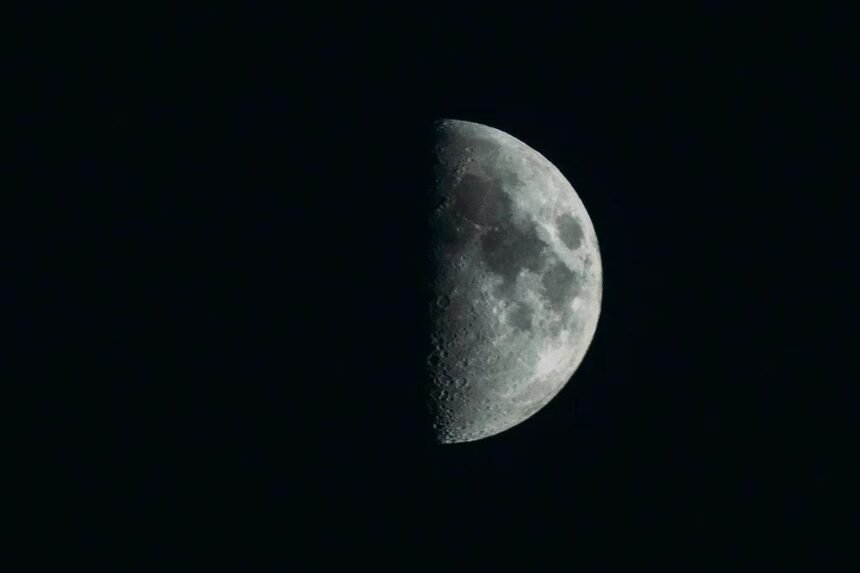
🌙 Chauchan (Quarter Moon) That Illuminate Life and Society

- 1. What Is Chauchan or the Quarter Moon?
- 2. Fascinating Truth #1: The Quarter Moon Is a Result of Geometry
- 3. Fascinating Truth #2: There Are Two Quarter Moons
- 4. Fascinating Truth #3: Quarter Moon Has Helped Humans Measure Time
- 5. History of Chauchan and Lunar Observation
- Ancient civilizations
- Indian astronomical traditions
- 1. Education
- 2. Photography
- 3. Night-sky observation
- 4. Cultural calendars
- 5. Scientific curiosity
- A simple student activity
- Basic observation
- Binocular observation
- Telescope observation
- Astronomy club or observatory
- Educational Value: ⭐⭐⭐⭐⭐
- Accessibility: ⭐⭐⭐⭐⭐
- Scientific Interest: ⭐⭐⭐⭐⭐
- Cultural Value: ⭐⭐⭐⭐☆
- Photography Potential: ⭐⭐⭐⭐☆
- What is Chauchan?
- Is a quarter moon one-quarter illuminated?
- How many quarter moons are there?
- How long does it take to reach the first quarter after a new moon?
- Can we see the quarter moon during the day?
- Is the Moon actually changing shape?
- Does a quarter moon affect tides?
- Can children observe Chauchan?
- Do I need a telescope?
- Is Chauchan scientifically or spiritually important?
- Progress takes time
- Change is natural
- Every phase has value
- Observation creates understanding
- Science begins with curiosity


The Moon has always been more than an object shining in the night sky. It has helped human beings understand time, seasons, calendars, tides, agriculture and cultural traditions. Among its most recognizable stages is the quarter moon, commonly associated with the Moon appearing approximately half illuminated from Earth.
In some regional or traditional usage, a term such as “Chauchan” may be used for a quarter-moon or half-moon phase. However, terminology can vary by language, region and calendar tradition. Scientifically, astronomers generally use first quarter and third (last) quarter to describe two specific lunar phases.
This article explains Chauchan from scientific, historical, cultural and everyday perspectives.
1. What Is Chauchan or the Quarter Moon?
The Moon does not produce its own visible light. It reflects sunlight. As the Moon travels around Earth, we see different portions of its sunlit half.
A quarter moon occurs when the Moon is positioned so that, from Earth, approximately half of its visible disk is illuminated.
There are two quarter phases:
- First Quarter Moon – the Moon is waxing.
- Third/Last Quarter Moon – the Moon is waning.
Despite the name “quarter moon,” the Moon itself is not one-quarter illuminated. Approximately 50% of the visible lunar disk appears illuminated.
The word “quarter” refers to the Moon being roughly one-quarter of the way through its complete cycle around Earth at the first-quarter stage, and approximately three-quarters through at the last-quarter stage.
Why does it look like a half moon?
Imagine holding a ball under a lamp. Depending on where you stand, you see different amounts of its illuminated surface. The same basic principle applies to the Moon.
2. Fascinating Truth #1: The Quarter Moon Is a Result of Geometry
One of the most fascinating facts about Chauchan is that the Moon’s changing appearance is primarily a matter of geometry.
The Sun illuminates half of the Moon at all times. As the Moon orbits Earth, our viewing angle changes.
This produces the familiar sequence:
New Moon → Waxing Crescent → First Quarter → Waxing Gibbous → Full Moon → Waning Gibbous → Last Quarter → Waning Crescent → New Moon
A complete cycle from one new moon to the next is called a synodic month, lasting approximately 29.5 days.
This cycle has been important to human societies for thousands of years.
3. Fascinating Truth #2: There Are Two Quarter Moons
Many people think there is only one quarter moon. Scientifically, there are two major quarter phases.
First Quarter
The first quarter occurs roughly one week after the new moon.
It is called “first quarter” because the Moon has completed approximately one-quarter of its synodic cycle.
In the Northern Hemisphere, it commonly appears approximately like a right-side illuminated half moon.
Last Quarter
The last quarter occurs roughly one week after the full moon.
It is also called the third quarter.
In the Northern Hemisphere, it commonly appears approximately like a left-side illuminated half moon.
The apparent orientation is reversed in the Southern Hemisphere.
4. Fascinating Truth #3: Quarter Moon Has Helped Humans Measure Time
Before mechanical clocks and modern calendars, observing the sky was an important way to understand time.
The changing Moon provided a natural repeating cycle.
Ancient communities used lunar observations for:
- Tracking months
- Organizing agricultural activities
- Planning religious observances
- Recording historical events
- Understanding seasonal cycles
- Navigating at night
- Creating calendars
Different civilizations developed different lunar and lunisolar calendar systems.
Even today, lunar phases remain important in several traditional calendars.
5. History of Chauchan and Lunar Observation


Human fascination with the Moon is extremely old.
Long before modern astronomy, people noticed that the Moon repeatedly changed shape. Careful observation allowed communities to recognize patterns.
Ancient civilizations
Civilizations in Mesopotamia, Egypt, India, China, Greece and elsewhere developed sophisticated systems for observing celestial bodies.
The Moon was particularly useful because its changing appearance was easy to observe without instruments.
Indian astronomical traditions
India has a long history of astronomical observation. Traditional Indian calendrical systems consider lunar days, phases and the positions of celestial bodies.
Concepts such as:
- Tithi
- Paksha
- Amavasya
- Purnima
- Nakshatras
have played important roles in Indian calendars and cultural practices.
It is important, however, not to equate every traditional lunar term directly with the modern astronomical definition of a quarter moon. A tithi and an astronomical lunar phase are related to lunar-solar geometry but are not identical measurements.
6. Fascinating Truth #4: Chauchan Can Be Seen Without a Telescope
One beautiful thing about the quarter moon is that you do not need expensive equipment to observe it.
A clear sky and your eyes are usually enough.
A pair of binoculars can reveal additional details, while a telescope can show:
- Lunar craters
- Mountains
- Valleys
- Shadows
- Differences in lunar surface brightness
The quarter phase is particularly interesting for observing lunar surface features because the angle of sunlight creates prominent shadows near the terminator—the boundary between the illuminated and dark portions of the Moon.
7. Fascinating Truth #5: The Quarter Moon Is Excellent for Studying Lunar Shadows
The line separating the bright and dark portions of the Moon is called the terminator.
Near this boundary, sunlight arrives at a low angle over parts of the lunar surface.
As a result, mountains and crater walls can cast long shadows.
This creates an excellent opportunity for amateur astronomers to observe lunar terrain.
A crater that may look subtle near full moon can appear dramatically different near the terminator.
That is why quarter-moon observations are popular among beginner astronomy enthusiasts.
8. Fascinating Truth #6: The Moon Influences Earth
The Moon has a measurable physical influence on Earth.
Its gravitational interaction with Earth contributes significantly to ocean tides.
The Sun also contributes to tides. When the Sun, Earth and Moon are aligned around new and full moon, stronger spring tides occur.
Near the first and third quarters, the Sun and Moon pull from approximately perpendicular directions relative to Earth, contributing to neap tides, which have a smaller tidal range.
So the Moon is not merely beautiful—it participates in a physical system that affects Earth’s oceans.
9. Fascinating Truth #7: The Quarter Moon Can Teach Us Patience
The Moon does not suddenly transform from darkness to fullness.
Its appearance changes gradually.
This can provide a simple human lesson:
Growth is often a process rather than a single moment.
A student learning mathematics, a person building a career, an entrepreneur developing a business, or a society progressing through change can experience something similar.
The quarter moon can therefore be used as a metaphor for:
- Progress
- Patience
- Learning
- Balance
- Transition
- Reflection
- Continuous improvement
This is a cultural and philosophical interpretation rather than an astronomical fact.
Chauchan Timeline: From New Moon to New Moon
| Approximate Stage | Lunar Phase | What We See |
|---|---|---|
| Day 0 | New Moon | Moon is difficult to see |
| Days 3–6 | Waxing Crescent | Small illuminated crescent |
| Days 7–8 | First Quarter | About half the visible disk illuminated |
| Days 10–13 | Waxing Gibbous | More than half illuminated |
| Around Day 14–15 | Full Moon | Nearly entire visible disk illuminated |
| Days 16–20 | Waning Gibbous | Illumination decreases |
| Days 21–22 | Last Quarter | About half illuminated |
| Days 24–28 | Waning Crescent | Thin crescent |
| Around Day 29.5 | New Moon | Cycle begins again |
The exact timing varies because the Moon’s orbit is not a perfect circle and its motion is not uniform.
Scientific Significance of Chauchan
The quarter moon is important in astronomy because it provides a clear example of the relationship among:
Sun → Earth → Moon
It demonstrates:
- Orbital motion
- Reflected sunlight
- Changing viewing angles
- Lunar phases
- Celestial geometry
- Earth’s relationship with the Moon
For students, the quarter moon is an excellent real-world example of astronomy that can be observed without a laboratory.
Importance of Chauchan in Daily Life
Although modern society relies heavily on clocks, smartphones and digital calendars, lunar observations remain relevant.
1. Education
Students can use the Moon to learn about astronomy through direct observation.
2. Photography
The quarter moon provides interesting photographic opportunities because shadows make lunar terrain more visible.
3. Night-sky observation
It provides a convenient target for beginner astronomers.
4. Cultural calendars
Lunar phases continue to be relevant to several traditional calendar systems.
5. Scientific curiosity
Observing the Moon encourages people to ask questions about space and Earth’s place in the universe.
Cultural and Social Significance
The Moon has appeared in literature, music, poetry, mythology, art and storytelling across civilizations.
Different societies have attached different meanings to lunar phases.
Some traditions associate the Moon with:
- Renewal
- Time
- Change
- Beauty
- Fertility
- Spiritual reflection
- Nature
- Cycles of life
These meanings differ between cultures and should not be treated as universal scientific conclusions.
The quarter moon can nevertheless serve as a common symbol of transition and balance.
Chauchan and Students: Why Should Students Learn About It?


Students do not need to become professional astronomers to benefit from understanding lunar phases.
Learning about Chauchan can improve:
- Scientific curiosity
- Observation skills
- Understanding of geometry
- Knowledge of Earth science
- Understanding of calendars
- Critical thinking
- Appreciation of nature
A simple student activity
Keep a notebook for one lunar month.
Every two or three nights:
- Record the date.
- Draw the Moon.
- Note its approximate shape.
- Record the approximate time.
- Note where it appears in the sky.
- Compare your observations with a lunar-phase calendar.
After one month, the student can see the complete pattern.
Costs of Observing Chauchan
One of the most positive aspects of lunar observation is that it can be almost free.
Basic observation
Cost: ₹0
You need only:
- Your eyes
- A clear sky
- A safe outdoor location
Binocular observation
Existing household binoculars may be sufficient.
Telescope observation
A beginner telescope can provide a significantly closer view, but prices vary considerably depending on aperture, mount, optics and brand.
Astronomy club or observatory
Some astronomy clubs, science centres and planetariums provide public observing sessions. Fees, where applicable, depend on the organization and location.
For students, expensive equipment is not necessary to start learning.
How to Observe the Quarter Moon Safely
Unlike solar observation, looking at the Moon with the naked eye is generally safe.
For better observations:
- Choose a location with an unobstructed sky.
- Avoid unnecessary bright lights.
- Give your eyes time to adjust to darkness.
- Use binoculars carefully.
- Use a tripod for steady binocular viewing.
- Never point optical equipment at the Sun without appropriate solar protection.
A smartphone can also be used to photograph the Moon, although capturing detailed lunar images may require manual camera settings or additional equipment.
Chauchan Review: Is It Worth Observing?
Educational Value: ⭐⭐⭐⭐⭐
The quarter moon is an excellent natural classroom for understanding basic astronomy.
Accessibility: ⭐⭐⭐⭐⭐
It can be observed without expensive equipment.
Scientific Interest: ⭐⭐⭐⭐⭐
The phase demonstrates orbital geometry and provides an opportunity to study lunar surface features.
Cultural Value: ⭐⭐⭐⭐☆
Its cultural significance varies among communities and traditions.
Photography Potential: ⭐⭐⭐⭐☆
The shadows around the terminator can produce interesting lunar photographs.
Overall review: Chauchan/quarter moon is a simple but scientifically rich celestial phenomenon that can connect everyday observation with astronomy, education and cultural understanding.
Important Facts About Chauchan
- A quarter moon is approximately half illuminated from Earth’s perspective.
- There are two major quarter phases.
- The first quarter is a waxing phase.
- The last quarter is a waning phase.
- A lunar cycle is approximately 29.5 days.
- The Moon reflects sunlight rather than producing visible light itself.
- The terminator separates the illuminated and dark portions.
- Lunar phases result from the changing geometry of the Sun, Earth and Moon.
- The Moon contributes significantly to Earth’s tides.
- Quarter-moon observation can be done without a telescope.
FAQs About Chauchan
What is Chauchan?
“Chauchan” can be used in some contexts to refer to a quarter-moon or half-moon appearance, but terminology varies regionally. In modern astronomy, the standard terms are first quarter and last/third quarter.
Is a quarter moon one-quarter illuminated?
No. Approximately half of the Moon’s visible disk is illuminated during a quarter phase.
How many quarter moons are there?
There are two principal quarter phases: first quarter and last quarter.
How long does it take to reach the first quarter after a new moon?
Approximately one week, although the exact interval varies.
Can we see the quarter moon during the day?
Yes. Depending on its position in the sky, a quarter moon can be visible during daylight hours.
Is the Moon actually changing shape?
No. The Moon remains approximately spherical. We see changing portions of its sunlit half.
Does a quarter moon affect tides?
Yes, lunar gravity contributes to tides. Around the quarter phases, the Sun and Moon’s tidal effects tend to produce smaller tidal ranges known as neap tides.
Can children observe Chauchan?
Absolutely. It is one of the easiest astronomical phenomena for children to observe.
Do I need a telescope?
No. The naked eye is enough to recognize the phase. Binoculars or telescopes can reveal more detail.
Is Chauchan scientifically or spiritually important?
Its scientific importance comes from lunar orbital geometry and Earth’s relationship with the Moon. Spiritual and cultural interpretations vary among traditions.
Wishes and Reflections Inspired by Chauchan
The quarter moon can inspire a simple message:
May every phase of life teach us something valuable, and may every small step bring us closer to our goals.
For students:
“Like the Moon, you do not have to become complete in one day. Keep learning, keep growing and keep moving forward.”
For society:
“May we learn from nature’s cycles and build a society that values patience, knowledge and continuous progress.”
Why Chauchan Is Important to Society
The Moon connects science with culture.
It reminds us that human beings have always looked toward the sky for answers.
Today, we have satellites, space probes, observatories and advanced telescopes. Yet the basic experience remains remarkably simple: look up and observe.
The quarter moon can encourage:
- Scientific literacy
- Interest in astronomy
- Environmental awareness
- Cultural understanding
- Student learning
- Family activities
- Curiosity about space
In a world increasingly dominated by screens, taking a few minutes to observe the night sky can also encourage people to reconnect with nature.
Daily-Life Lessons From the Quarter Moon
The Moon’s phases can inspire several practical ideas.
Progress takes time
The Moon becomes full gradually. Human development also usually happens step by step.
Change is natural
The Moon continuously changes its apparent appearance. Change is a normal part of life.
Every phase has value
A crescent, quarter moon and full moon are different stages of the same lunar cycle.
Observation creates understanding
Simply watching the Moon over several weeks can reveal a predictable pattern.
Science begins with curiosity
Many scientific discoveries begin with a simple question: “Why does this happen?”
Conclusion
Chauchan, or the quarter moon, is a fascinating meeting point of astronomy, history, culture and everyday life. Scientifically, it demonstrates how the changing positions of the Sun, Earth and Moon create lunar phases. Historically, observations of the Moon helped humans understand time and develop calendars. Socially and culturally, the Moon has inspired stories, traditions, poetry and reflection across generations.
Perhaps the most valuable lesson is simple: we do not need expensive technology to begin exploring science.
A clear night, a curious mind and a few minutes of observation can be enough.
The next time you see a quarter moon, take a moment to look carefully. You are not simply seeing a beautiful shape in the sky—you are observing a predictable celestial process that has fascinated humanity for thousands of years.
The Moon changes phase, but its lesson remains constant: progress happens one phase at a time.










Your article helped me a lot, is there any more related content? Thanks!
Thank you for your sharing. I am worried that I lack creative ideas. It is your article that makes me full of hope. Thank you. But, I have a question, can you help me?
Your point of view caught my eye and was very interesting. Thanks. I have a question for you.
Thank you for your sharing. I am worried that I lack creative ideas. It is your article that makes me full of hope. Thank you. But, I have a question, can you help me?
Can you be more specific about the content of your article? After reading it, I still have some doubts. Hope you can help me.