

Why “Adopt Swadeshi, Advance the Nation” Is a Positive Change We Need

- Introduction
- 1905: Partition of Bengal
- 1905–1908 and beyond
- Gandhi and Khadi
- 1. It Can Support Local Employment
- 2. It Encourages Entrepreneurship
- 3. It Can Help Preserve Traditional Skills
- Students can:
- Clothing
- Food
- Gifts
- Technology
- Education
- Business
- Tourism
- Economic significance
- Social significance
- Cultural significance
- Educational significance
- Entrepreneurial significance
- National significance
- What the idea highlights
- What consumers should remember
- 1. What is the meaning of “Adopt Swadeshi, Advance the Nation”?
- 2. When did the Swadeshi Movement begin?
- 3. Why was the Swadeshi Movement started?
- 4. What is the connection between Swadeshi and khadi?
- 5. Does Swadeshi mean buying only Indian products?
- 6. How can students support Swadeshi?
- 7. Is Swadeshi expensive?
- 8. What is National Handloom Day?
- 9. Why is Swadeshi important to society?
- 10. Can technology be Swadeshi?


Introduction
“Adopt Swadeshi, Advance the Nation” is a simple expression built around a powerful idea: the choices people make as consumers can influence families, businesses, artisans, communities and the wider economy.
The word Swadeshi broadly refers to something originating from one’s own country. In Indian history, however, Swadeshi has a much deeper meaning. It became associated with economic self-reliance, indigenous production and the freedom struggle, particularly after the Partition of Bengal in 1905.
The formal proclamation of the Swadeshi Movement took place at a public meeting at Calcutta Town Hall on 7 August 1905. The movement encouraged people to boycott foreign goods and promote Indian-made products and industries. (Amrit Mahotsav)
Today, the phrase can also be understood in a broader, non-historical sense: supporting capable Indian producers, artisans, entrepreneurs and businesses when their products meet your needs, quality expectations and budget.
That last point matters. Supporting local production does not have to mean ignoring quality, safety, affordability or consumer choice. Modern Swadeshi can be thoughtful, informed and practical.
What Does “Adopt Swadeshi, Advance the Nation” Mean?
The phrase can be understood in three parts:
- Adopt – consciously choose products, services, skills or businesses produced within the country where practical.
- Swadeshi – encourage domestic capabilities, local enterprise, indigenous knowledge and Indian production.
- Advance the Nation – contribute, through economic activity and responsible consumption, to employment, entrepreneurship, skills and community development.
Historically, Swadeshi was closely connected with resistance to colonial economic structures. Modern interpretations can extend the idea to entrepreneurship, manufacturing, handloom, handicrafts, technology, agriculture and small businesses.
India’s Ministry of MSME notes that MSMEs play an important role in employment and industrialisation, including in rural and less-developed areas.
A Brief History of Swadeshi in India
The roots of economic nationalism developed during the nineteenth century as Indian thinkers criticised colonial economic policies and the decline of indigenous industries. IGNOU’s historical material describes economic nationalism as an important intellectual opposition to colonial rule and notes that the Swadeshi movement eventually emerged as a major expression of anti-colonial nationalism. (eGyankosh)
1905: Partition of Bengal
In 1905, the British colonial government partitioned Bengal. The decision generated widespread political opposition.
The resulting movement combined several approaches:
- Boycott of foreign goods
- Promotion of Indian goods
- Development of indigenous industries
- National education
- Public meetings
- Literature and journalism
- Economic self-reliance
The Swadeshi resolution was also adopted at the 1905 Indian National Congress session in Banaras. (Amrit Mahotsav)
1905–1908 and beyond
The strongest phase of the Swadeshi Movement occurred in the years following 1905, although the ideas continued to influence later phases of India’s freedom struggle.
The movement helped stimulate indigenous enterprises in areas such as textiles, chemicals, soap, matches, banking and insurance. Historical accounts also document the growth of enterprises associated with the Swadeshi period. (The Indian Express)
Gandhi and Khadi
The idea later acquired another important dimension through Mahatma Gandhi’s promotion of khadi and village industries.
Khadi became associated with self-reliance, employment and the freedom movement. The Indian Culture Portal records the development of the khadi movement and its importance as a symbol of India’s struggle for independence. (Amrit Mahotsav)
Timeline of “Adopt Swadeshi, Advance the Nation”
| Year | Important Development |
|---|---|
| 19th century | Economic nationalism developed as Indian thinkers criticised colonial economic policies. |
| 1905 | Partition of Bengal triggered widespread opposition. |
| 7 August 1905 | Swadeshi was formally proclaimed at Calcutta Town Hall. (Amrit Mahotsav) |
| 1905 | Indian National Congress adopted a Swadeshi resolution at its Banaras session. (Amrit Mahotsav) |
| 1906 onward | Indigenous enterprises and industries received increased attention. |
| 1911 | Partition of Bengal was annulled. |
| 1915 onward | Gandhi increasingly connected self-reliance, village industries and constructive work with the freedom movement. |
| 1918 | Khadi received a particularly important place in Gandhi’s programme. (Amrit Mahotsav) |
| 1920s–1940s | Swadeshi and khadi remained important elements of nationalist economic activity. |
| 2015 onward | India observes National Handloom Day on 7 August, linking the date to the Swadeshi movement and recognising the contribution of handloom. (Texmin) |
| Today | Swadeshi can be discussed through local entrepreneurship, manufacturing, artisans, handloom, technology and domestic value creation. |
9 Powerful Reasons Why Adopting Swadeshi Can Matter
1. It Can Support Local Employment
When consumers purchase from Indian manufacturers, artisans, farmers, small businesses and entrepreneurs, money can move through domestic supply chains.
This does not automatically mean every rupee stays within the local economy, because modern products often contain components and services from multiple countries. Nevertheless, supporting domestic enterprises can contribute to domestic economic activity.
The Ministry of MSME specifically highlights the employment-generating role of the MSME sector.
2. It Encourages Entrepreneurship
A small Indian business needs customers to grow.
Imagine a young entrepreneur producing:
- Handmade stationery
- Software
- Clothing
- Food products
- Furniture
- Educational products
- Handicrafts
- Environment-friendly packaging
A customer choosing that business gives the entrepreneur an opportunity to improve, hire people and reinvest.
This is one practical meaning of “Advance the Nation.”
3. It Can Help Preserve Traditional Skills
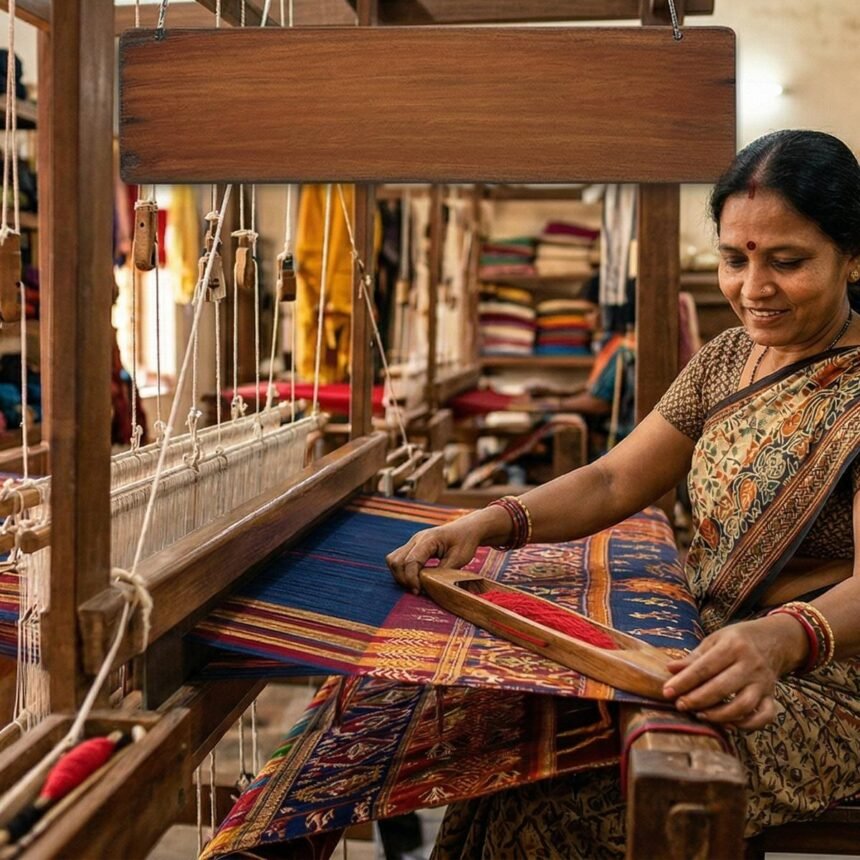
India has thousands of traditional crafts and textile traditions.
Handloom weaving, pottery, metalwork, woodwork, embroidery, basket-making and other crafts represent accumulated knowledge passed between generations.


Modern markets can provide opportunities for these skills to remain economically relevant.
Government programmes such as SFURTI are designed to organise traditional industries and artisans into clusters and improve their competitiveness, skills, facilities and marketability. (MSME)
4. It Can Encourage Domestic Innovation
Swadeshi should not be understood only as buying traditional products.
It can also include Indian innovation.
For example:
- Indian software
- Indian startups
- Indian scientific research
- Indian educational technology
- Indian manufacturing
- Indian agricultural technology
- Indian electronics
- Indian design
A modern economy needs innovation as much as it needs traditional craftsmanship.
Therefore, a student learning artificial intelligence, a startup developing software or an engineer designing a new machine can all contribute to the broader idea of domestic capability.
5. It Can Strengthen Small Businesses
Large companies often have access to substantial capital, marketing and distribution networks.
Small businesses may depend much more directly on customers.
A conscious purchase from a local bakery, tailor, handicraft seller, farmer, manufacturer or service provider can therefore have significance beyond the individual transaction.
India’s PMEGP, for example, identifies employment generation and support for traditional artisans and prospective entrepreneurs among its objectives. (PMEGP)
6. It Can Make Consumers Think More Carefully
“Swadeshi” can also encourage a useful consumer habit:
Before buying, ask where the product came from, who made it, what it costs, how long it will last and whether it genuinely meets your needs.
This is better than blindly purchasing something simply because it carries a “local” label.
A responsible consumer should consider:
- Quality
- Price
- Safety
- Durability
- Warranty
- Environmental impact
- Authenticity
- Need versus impulse
Supporting domestic production and being a smart consumer can exist together.
7. It Connects Consumers With Communities
A mass-produced product can sometimes hide the human story behind it.
A handwoven sari, handmade basket, locally produced food item or craft product can create a direct connection between the consumer and the producer.
This can encourage appreciation for:
- Artisan skills
- Rural entrepreneurship
- Traditional knowledge
- Local materials
- Family businesses
- Cultural diversity
The value of a product can therefore include not only its physical characteristics but also the human effort behind it.
8. It Can Encourage Economic Self-Reliance
Historical Swadeshi was deeply connected with economic independence.
Modern self-reliance, however, does not necessarily mean producing everything domestically.
Global trade remains an important part of modern economies.
A practical approach is to strengthen domestic capabilities while participating in international trade, cooperation and competition.
In other words:
Self-reliance does not have to mean isolation.
9. It Can Turn Everyday Choices Into Responsible Participation
Perhaps the most relatable aspect is that people do not need to be politicians, industrialists or economists to participate in economic life.
A student buying a notebook, a family purchasing clothes, a business selecting software, or a customer ordering handicrafts is already making an economic choice.
When those choices are informed, they can contribute to broader patterns of demand.
That is why the message “Adopt Swadeshi, Advance the Nation” can be interpreted as a call for conscious participation rather than merely a slogan.
What Does Swadeshi Cost?
There is no fixed “Swadeshi cost.”
The price depends on the product, location, quality, brand, production method and seller.
For example:
| Purchase | Possible Budget Approach |
|---|---|
| Local stationery | Compare ordinary and premium products |
| Handloom clothing | Prices can vary substantially by fabric and craftsmanship |
| Handmade handicrafts | Artisan time and material can affect price |
| Local food | Compare quality, freshness and quantity |
| Indian software | Costs depend on the service or subscription |
| Local services | Compare skill, reviews, reliability and price |
| Domestic electronics | Compare specifications, warranty and after-sales support |
An important lesson is that Swadeshi should not automatically mean “buy the most expensive product.”
For students and families with limited budgets, buying a reasonably priced domestic product when it satisfies the required quality can be a practical approach.
Swadeshi and Students
Students can understand the concept without spending large amounts of money.
Students can:
- Learn the history of the Swadeshi Movement.
- Support local stationery businesses.
- Explore Indian educational platforms and tools.
- Learn about Indian scientists and entrepreneurs.
- Visit local craft markets.
- Learn traditional skills.
- Build Indian products and startups.
- Prefer quality local products when appropriate.
- Avoid unnecessary purchases.
- Develop skills that contribute to India’s knowledge economy.
The most valuable form of Swadeshi for a student may sometimes be building knowledge and capability.
Swadeshi in Daily Life
Here are simple examples:
Clothing
Consider Indian handloom, khadi and domestic textile products where they suit your needs.
Food
Buying from local farmers, producers and small food businesses can support local economic activity.
Gifts
Handicrafts and locally produced items can make meaningful gifts.
Technology
Consider Indian-developed software and technology products where they provide the functionality, security, price and support you require.
Education
Learn about Indian research, inventions, entrepreneurship and traditional knowledge alongside global knowledge.
Business
Entrepreneurs can source from domestic suppliers where quality and economics make sense.
Tourism
Exploring local destinations can support hotels, guides, transport providers, artisans and small businesses.
Important Facts About Swadeshi
Fact 1: The Swadeshi Movement is strongly associated with the 1905 Partition of Bengal. (Amrit Mahotsav)
Fact 2: 7 August 1905 is associated with the formal proclamation of the movement at Calcutta Town Hall. (Amrit Mahotsav)
Fact 3: The 1905 Congress session at Banaras adopted a Swadeshi resolution. (Amrit Mahotsav)
Fact 4: Boycott and promotion of indigenous production were central elements of the movement. (Amrit Mahotsav)
Fact 5: The movement contributed to the growth of indigenous enterprises in several sectors. (The Indian Express)
Fact 6: Khadi later became an important symbol of self-reliance and India’s freedom struggle. (Amrit Mahotsav)
Fact 7: National Handloom Day is observed annually on 7 August in India. (Texmin)
Fact 8: Modern support for traditional industries includes cluster-based programmes such as SFURTI. (MSME)
Fact 9: India’s MSME sector has an important role in employment and industrial development.
Significance of Swadeshi for Society
Swadeshi has significance at several levels.
Economic significance
It draws attention to domestic production, entrepreneurs, artisans and supply chains.
Social significance
It can increase appreciation for the work of communities and traditional producers.
Cultural significance
Handloom, handicrafts and traditional skills form part of India’s diverse cultural heritage.
Educational significance
The history of Swadeshi teaches students about colonialism, economic nationalism, entrepreneurship and consumer behaviour.
Entrepreneurial significance
It reminds young people that building products and services can be a form of contribution to society.
National significance
Historically, Swadeshi connected economic behaviour with the broader struggle for self-rule.
Is Swadeshi the Same as Boycotting Every Foreign Product?
No.
Historical Swadeshi included organised boycotts of foreign goods as part of an anti-colonial political and economic movement. (Amrit Mahotsav)
Modern consumers live in a different economic environment.
Many products are globally manufactured, and supply chains cross national borders. A sensible modern interpretation can therefore focus on supporting domestic capability and making informed choices, rather than assuming every imported product is undesirable.
The distinction between historical Swadeshi and modern consumer choice is important.
Observance and National Handloom Day
There is no single universally observed modern holiday called “Adopt Swadeshi, Advance the Nation Day.”
However, 7 August has a major historical connection with Swadeshi because the movement was formally proclaimed at Calcutta Town Hall on that date in 1905.
India has also officially observed National Handloom Day on 7 August since 2015, recognising the handloom sector and its contribution to India’s socio-economic development. (Texmin)
This provides a natural opportunity for schools, colleges, organisations and communities to discuss:
- Swadeshi history
- Handloom
- Indian crafts
- Entrepreneurship
- Local businesses
- Sustainable consumption
- Artisan livelihoods
How Schools and Colleges Can Promote the Idea
Educational institutions can organise:
- Swadeshi history exhibitions
- Local-product fairs
- Handloom demonstrations
- Entrepreneurship workshops
- Artisan interaction sessions
- “Made in India” innovation competitions
- Local-business case studies
- Traditional craft workshops
- Student startup exhibitions
- Essay and debate competitions
The goal should be education and informed participation, rather than forcing students to purchase particular products.
A Simple Swadeshi Checklist for Consumers
Before purchasing something, ask:
1. Is there a suitable Indian alternative?
2. Is the quality good enough for my purpose?
3. Is the price reasonable?
4. Is the product authentic?
5. Can I identify the manufacturer or artisan?
6. What is the warranty or after-sales support?
7. Do I actually need the product?
8. Is it durable?
9. What is its environmental impact?
This turns Swadeshi from a slogan into a practical decision-making habit.
Review Section: Is “Adopt Swadeshi, Advance the Nation” Relevant Today?
A useful review should consider both its historical meaning and modern limitations.
What the idea highlights
- Local entrepreneurship
- Domestic manufacturing
- Artisan livelihoods
- Traditional knowledge
- Economic awareness
- Consumer responsibility
- Innovation
- Skill development
What consumers should remember
Supporting local products does not remove the need to evaluate quality, safety and price.
Likewise, buying an imported product does not automatically make a consumer irresponsible. Modern economies are interconnected.
Therefore, a balanced modern approach can be:
Support domestic capability where practical + demand quality + respect consumer choice + encourage innovation + participate responsibly in the global economy.
Frequently Asked Questions (FAQs)
1. What is the meaning of “Adopt Swadeshi, Advance the Nation”?
It means encouraging people to consider domestic products, services, businesses, skills and industries where appropriate, with the broader aim of strengthening economic and social capabilities.
2. When did the Swadeshi Movement begin?
The movement is generally associated with the 1905 anti-Partition agitation, with its formal proclamation taking place at Calcutta Town Hall on 7 August 1905. (Amrit Mahotsav)
3. Why was the Swadeshi Movement started?
It developed primarily in response to the Partition of Bengal and became a wider movement involving boycott of foreign goods, promotion of indigenous production and nationalist mobilisation. (Amrit Mahotsav)
4. What is the connection between Swadeshi and khadi?
Khadi became an important expression of self-reliance and nationalist economic activity, particularly through Gandhi’s programmes. (Amrit Mahotsav)
5. Does Swadeshi mean buying only Indian products?
Historically, Swadeshi involved strong opposition to foreign goods. In modern life, however, people can interpret support for domestic production alongside considerations such as quality, affordability, safety and consumer choice.
6. How can students support Swadeshi?
Students can learn about Indian industries, support suitable local products, explore entrepreneurship, develop technical skills and participate in local innovation and craft initiatives.
7. Is Swadeshi expensive?
Not necessarily. Costs vary by product. Local products can range from inexpensive everyday goods to premium handmade products.
8. What is National Handloom Day?
National Handloom Day is observed in India on 7 August. The date commemorates the historical connection with the Swadeshi Movement and recognises India’s handloom sector. (Texmin)
9. Why is Swadeshi important to society?
It can encourage awareness of domestic production, employment, entrepreneurship, traditional skills and responsible consumption.
10. Can technology be Swadeshi?
Yes. In a modern context, Swadeshi can include Indian-developed technology, software, research, manufacturing and innovation, provided the concept is understood as strengthening domestic capability rather than rejecting global cooperation.
Wishing Message
May the spirit of Swadeshi inspire us to respect the hands that create, the minds that innovate and the entrepreneurs who build. May every thoughtful choice encourage skill, creativity, dignity of work and opportunity.
🌱 Adopt Swadeshi.
🇮🇳 Support Enterprise.
🧵 Respect Artisans.
💡 Encourage Innovation.
🚀 Advance the Nation.
Conclusion: Swadeshi Begins With Awareness
The historical Swadeshi Movement was far more than a campaign to purchase Indian goods. It emerged from a particular colonial political and economic context and became an important part of India’s freedom struggle. (eGyankosh)
In the twenty-first century, the phrase “Adopt Swadeshi, Advance the Nation” can be understood through a broader lens.
It can mean appreciating the artisan behind a product, giving a small business a fair opportunity, encouraging Indian innovation, learning valuable skills, supporting domestic manufacturing when appropriate and becoming a more conscious consumer.
The most meaningful approach is not simply “local versus foreign.” It is about asking better questions:
Who made this?
What value does it create?
Is it good quality?
Is the price fair?
Can domestic capability meet this need?
Can my choice support innovation or livelihoods?
When millions of people make informed economic choices, those choices can become part of larger economic and social patterns.
That is the enduring lesson behind “Adopt Swadeshi, Advance the Nation”: individual choices can connect with collective progress when they are informed, responsible and practical.










Maltepe su kaçak tespiti Başakşehir su kaçağı tespiti: Başakşehir’de su kaçağı tespitinde uzman ekibimizle yanınızdayız. https://blooder.net/read-blog/114562
I just could not depart your web site prior to suggesting that I really enjoyed the standard information a person provide for your visitors? Is gonna be back often in order to check up on new posts
**mitolyn official**
Mitolyn is a carefully developed, plant-based formula created to help support metabolic efficiency and encourage healthy, lasting weight management.
I am continually invstigating online for ideas that can facilitate me. Thx!
Your point of view caught my eye and was very interesting. Thanks. I have a question for you.
Can you be more specific about the content of your article? After reading it, I still have some doubts. Hope you can help me. https://www.binance.info/register?ref=IXBIAFVY
That is really attention-grabbing, You are an excessively professional blogger. I’ve joined your feed and sit up for in the hunt for extra of your great post. Additionally, I’ve shared your site in my social networks!
Thanks for sharing. I read many of your blog posts, cool, your blog is very good.
Thanks for sharing. I read many of your blog posts, cool, your blog is very good.
Your article helped me a lot, is there any more related content? Thanks!
Thank you for your sharing. I am worried that I lack creative ideas. It is your article that makes me full of hope. Thank you. But, I have a question, can you help me? https://www.binance.bh/futures/ref?code=QCGZMHR6
Can you be more specific about the content of your article? After reading it, I still have some doubts. Hope you can help me. https://accounts.binance.com/register/person?ref=IHJUI7TF
Your point of view caught my eye and was very interesting. Thanks. I have a question for you.