⚡ Why Energy Conservation Creates a Brighter and Sustainable Future

- What Is Energy Conservation?
- 1. It Can Reduce Electricity Bills
- 2. It Helps Protect Natural Resources
- 3. It Can Reduce Environmental Pressure
- 4. It Supports Energy Security
- 5. It Encourages Responsible Student Behaviour
- 6. It Encourages Better Technology
- 7. It Can Improve Household Energy Management
- 8. It Supports Sustainable Buildings
- 9. It Can Create New Career Opportunities
- 10. It Builds a Culture of Responsibility
- Fact 1
- Fact 2
- Fact 3
- Fact 4
- Fact 5
- Fact 6
- At home
- At school
- Zero-cost actions
- Low-cost actions
- Higher-investment measures
- Economic development
- Environmental protection
- Energy security
- Better urban development
- Education
- Employment
- Student Review
- 1. What is energy conservation?
- 2. Why is energy conservation important?
- 3. When is National Energy Conservation Day celebrated in India?
- 4. Who established BEE?
- 5. What is the Energy Conservation Act, 2001?
- 6. Can students help conserve energy?
- 7. Does energy conservation always require money?
- 8. What is the difference between conservation and efficiency?
- 9. Can energy conservation reduce electricity bills?
- 10. Is renewable energy the same as energy conservation?
- 11. What are some energy-efficient technologies?
- 12. Why should children learn about energy conservation?
- A simple message to remember:


Energy Conservation: Energy is one of the foundations of modern life. We use it when we switch on a light, charge a phone, travel to school or work, cook food, run a computer, operate a hospital, manufacture products or communicate online.
But energy is not unlimited, and wasting it can increase household expenses, place additional pressure on energy systems and contribute to environmental problems. Energy conservation means using energy thoughtfully and avoiding unnecessary consumption. Energy efficiency is closely related: it means achieving the same useful result while using less energy.
The International Energy Agency (IEA) reported that global energy-efficiency progress was estimated at 1.8% in 2025, compared with about 1% in 2024, although the world remains off track for the global efficiency ambition established at COP28. (IEA)
For students, families, businesses and communities, energy conservation is not simply a technical subject. It is a daily-life habit.
What Is Energy Conservation?
Energy conservation is the practice of reducing unnecessary energy consumption through responsible behaviour, better planning and efficient use of energy.
For example:
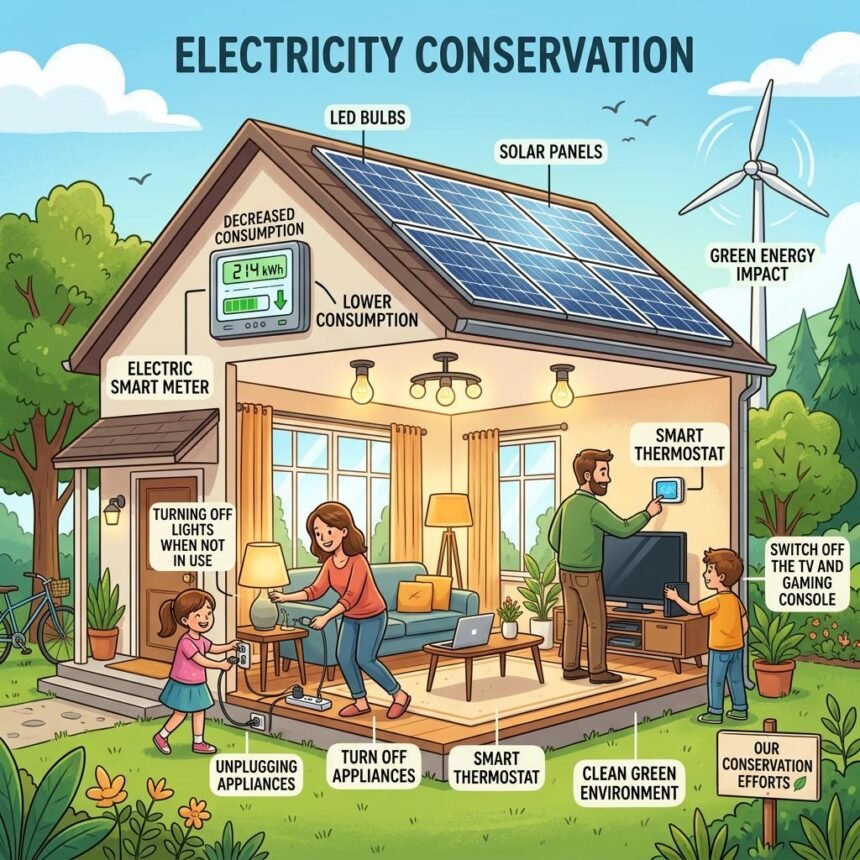
- Turning off lights when leaving a room
- Switching off fans when nobody is present
- Using natural daylight
- Avoiding unnecessary air-conditioning
- Choosing energy-efficient appliances
- Using public transport or cycling when practical
- Unplugging equipment that does not need to remain powered
- Maintaining electrical appliances properly
- Using renewable energy where suitable
A simple way to remember it is:
“Use the energy you need, avoid the energy you don’t need, and use efficient technology whenever possible.”
10 Powerful Benefits of Energy Conservation
1. It Can Reduce Electricity Bills
One of the most immediate benefits of conserving energy is the possibility of reducing electricity consumption.
Simple actions such as switching off unused lights, fans and appliances do not necessarily require an expensive investment.
Government energy-conservation guidance also recommends using natural light, switching off appliances when not required and avoiding unnecessary standby consumption. (Electricity Python)
For a family, small savings repeated every day can become meaningful over a month or year.
2. It Helps Protect Natural Resources
Much of the world’s energy system has historically relied on fuels such as coal, oil and natural gas.
Using energy carefully can reduce unnecessary demand for energy production and therefore help conserve natural resources.
This does not mean that every unit of energy comes from the same source. Modern electricity systems increasingly contain renewable sources as well as fossil fuels, nuclear power and other technologies.
Energy conservation therefore works alongside the transition toward cleaner energy.
3. It Can Reduce Environmental Pressure
Energy production and consumption can create greenhouse-gas emissions and other environmental impacts, depending on the energy source.
The IEA notes that energy efficiency has already played a substantial role in limiting energy demand and emissions; its analysis estimates that without efficiency gains since 2010, today’s greenhouse-gas emissions would be significantly higher. (IEA)
This is why energy conservation is connected with climate action.
4. It Supports Energy Security
Every country needs reliable access to energy.
When individuals, businesses and industries reduce unnecessary consumption, the same energy system can provide useful services with less wasted energy.
The IEA identifies energy efficiency as an important contributor to energy security, affordability and economic competitiveness. (IEA)
For India, where energy demand continues to grow alongside economic development, efficient energy use is particularly relevant.
5. It Encourages Responsible Student Behaviour
Energy conservation can become an educational activity.
Students can learn:
- Physics
- Environmental science
- Economics
- Mathematics
- Engineering
- Climate science
- Sustainable development
- Responsible citizenship
A school can conduct an energy audit by recording how many lights, fans, computers and other appliances are used.
Students can then calculate where energy might be saved.
This transforms a textbook concept into a practical experiment.
6. It Encourages Better Technology
Energy conservation also creates demand for efficient technology.
Examples include:
- LED lighting
- Efficient air conditioners
- Energy-efficient refrigerators
- Efficient electric motors
- Smart meters
- Solar water heaters
- Rooftop solar systems
- Efficient fans
- Energy-management systems
- Electric vehicles
India’s Bureau of Energy Efficiency (BEE) works on policies and strategies designed to improve energy efficiency and reduce the energy intensity of the Indian economy. BEE was established on 1 March 2002 under the Energy Conservation Act, 2001. (Bureau of Energy Efficiency)
7. It Can Improve Household Energy Management
Energy conservation encourages people to understand how their homes actually consume electricity.
For example, instead of asking:
“Why is my electricity bill high?”
a family can ask:
“Which appliances are consuming the most electricity, and when are we using them?”
That small change in thinking can lead to better decisions.
8. It Supports Sustainable Buildings
Buildings consume substantial amounts of energy for cooling, lighting, heating, ventilation and appliances.
BEE states that India’s building sector accounts for over 30% of the country’s total electricity consumption. (Bureau of Energy Efficiency)
Energy-conscious buildings can incorporate:
- Natural lighting
- Ventilation
- Insulation
- Efficient cooling
- Efficient lighting
- Smart controls
- Solar power
- Energy-efficient equipment
BEE introduced the Energy Conservation Building Code (ECBC) in 2007 to promote energy efficiency in new commercial buildings. (Bureau of Energy Efficiency)
9. It Can Create New Career Opportunities
Energy conservation is not only about switching off lights.
It is connected to a growing range of careers, including:
- Energy engineer
- Electrical engineer
- Sustainability consultant
- Energy auditor
- Renewable-energy engineer
- Solar technician
- Building-energy analyst
- Environmental scientist
- Energy manager
- Climate-policy professional
- EV technology professional
- Data analyst for energy systems
The IEA reported that nearly 18 million people were employed in energy efficiency worldwide in 2024, while also highlighting continuing demand for skills and workers. (IEA)
For students, this means energy conservation can be both an environmental subject and a career pathway.
10. It Builds a Culture of Responsibility
Perhaps the most important benefit is behavioural.
A person who learns to conserve energy may begin to think differently about:
- Water
- Food
- Fuel
- Electricity
- Paper
- Plastic
- Transportation
- Natural resources
Conservation teaches a simple life lesson:
Resources have value, so use them thoughtfully.
Energy Conservation vs Energy Efficiency
These terms are related but not exactly identical.
| Energy Conservation | Energy Efficiency |
|---|---|
| Avoiding unnecessary energy use | Using less energy for the same useful output |
| Switching off an unused light | Replacing an inefficient bulb with an efficient LED |
| Turning off AC when unnecessary | Using an efficient AC |
| Walking for a short journey | Using a more efficient vehicle |
| Avoiding unnecessary appliance use | Buying an efficient appliance |
Both approaches can work together.
History of Energy Conservation
Energy conservation became increasingly important as industrialisation expanded.
During the Industrial Revolution, societies began using coal on a large scale to power factories, transportation and machinery. Later, oil, natural gas, electricity and nuclear energy transformed modern economies.
As energy demand increased, scientists, engineers and governments increasingly focused on improving energy efficiency.
The modern energy-efficiency movement has involved:
- Better industrial processes
- Efficient engines
- Efficient lighting
- Building standards
- Appliance standards
- Energy labels
- Energy audits
- Renewable energy
- Smart-grid technologies
- Consumer awareness
In India, an important milestone was the Energy Conservation Act, 2001, which provides the legal framework for efficient energy use and conservation. (Bureau of Energy Efficiency)
Energy Conservation in India
India established the Bureau of Energy Efficiency (BEE) on 1 March 2002 under the Energy Conservation Act, 2001. Its mission includes developing policies and strategies to reduce the energy intensity of the Indian economy. (Bureau of Energy Efficiency)
India’s approach includes areas such as:
- Standards and labelling
- Energy-efficient appliances
- Industrial efficiency
- Building efficiency
- Demand-side management
- Efficient lighting
- Energy audits
- Energy conservation awareness
The government’s Standards & Labelling programme helps consumers make informed choices about the energy-saving and potential cost-saving characteristics of appliances. (Press Information Bureau)
National Energy Conservation Day in India
National Energy Conservation Day is observed every year on 14 December.
The observance dates back to 1991. According to BEE, the National Energy Conservation Awards were first presented on 14 December 1991, and the date was declared National Energy Conservation Day. (Bureau of Energy Efficiency)
The day aims to create awareness about:
- Responsible energy consumption
- Energy efficiency
- Energy conservation
- Sustainable development
- Energy-saving technologies
- The role of citizens
Schools, colleges, industries and government institutions can use the occasion for awareness campaigns, competitions, exhibitions, seminars and energy-saving activities.
Important Energy Conservation Timeline
| Year | Important Development |
|---|---|
| 1991 | National Energy Conservation Awards were first presented on 14 December, associated with National Energy Conservation Day. (Bureau of Energy Efficiency) |
| 2001 | India enacted the Energy Conservation Act. (Bureau of Energy Efficiency) |
| 2002 | Bureau of Energy Efficiency was established on 1 March. (Bureau of Energy Efficiency) |
| 2007 | Energy Conservation Building Code was launched for commercial buildings. (Bureau of Energy Efficiency) |
| 2015 | UJALA was launched to accelerate access to energy-efficient LED lighting. (Press Information Bureau) |
| 2023 | Governments at COP28 agreed to work toward doubling the global average annual rate of energy-efficiency improvement by 2030. (IEA) |
| 2025 | IEA estimated global energy-efficiency progress at 1.8%, up from around 1% in 2024. (IEA) |
| 2026 | Energy efficiency remains an important part of global energy policy, affordability and energy-security discussions. (IEA) |
Interesting Facts About Energy Conservation
Fact 1
Global energy demand increased by 2.2% in 2024, according to the IEA. Electricity demand increased by 4.3%. (IEA)
Fact 2
The IEA estimates that global energy-efficiency-related investment could reach almost US$800 billion in 2025. (IEA)
Fact 3
BEE was created under India’s Energy Conservation Act, 2001. (Bureau of Energy Efficiency)
Fact 4
India’s building sector accounts for more than 30% of total electricity consumption, according to BEE. (Bureau of Energy Efficiency)
Fact 5
Energy efficiency is connected not only to the environment but also to affordability, competitiveness and energy security. (IEA)
Fact 6
The global improvement in energy intensity in 2025 was estimated to be stronger than in 2024, but still below the rate required for the COP28 ambition. (IEA)
How Can Students Conserve Energy?
Students do not need expensive technology to begin.
At home
- Turn off lights when leaving a room.
- Use daylight whenever possible.
- Switch off fans when leaving.
- Avoid unnecessarily long AC usage.
- Keep refrigerator doors closed as much as possible.
- Use power-saving modes on computers.
- Disconnect chargers when appropriate.
- Encourage family members to use efficient appliances.
At school
Students can:
- Switch off classroom lights after class.
- Ensure computers are shut down when not required.
- Create energy-awareness posters.
- Conduct an energy audit.
- Organise an Energy Conservation Day activity.
- Calculate electricity consumption.
- Promote natural light and ventilation.
Energy Conservation at Home: A Simple Checklist


Try this simple checklist:
☐ Switch off unnecessary lights
☐ Switch off unused fans
☐ Use LED lighting
☐ Use natural daylight
☐ Avoid unnecessary AC operation
☐ Maintain appliances properly
☐ Use energy-efficient appliances
☐ Unplug equipment when appropriate
☐ Avoid wasting hot water
☐ Consider renewable energy where practical
BEE has also promoted a 24°C AC setting as an energy-efficiency measure.
What Does Energy Conservation Cost?
One of the interesting aspects of energy conservation is that many conservation actions cost nothing.
Zero-cost actions
- Turning off lights
- Turning off fans
- Using daylight
- Avoiding unnecessary appliance use
- Walking for short journeys
- Switching off vehicle engines during appropriate stops
- Using sleep mode on devices
Cost: ₹0
Low-cost actions
- LED bulbs
- Smart plugs
- Timers
- Efficient fans
- Basic energy monitoring
Higher-investment measures
- Energy-efficient air conditioners
- Efficient refrigerators
- Solar water heaters
- Rooftop solar
- Building insulation
- Energy-management systems
- Electric vehicles
The financial outcome of an investment depends on factors such as purchase price, electricity tariff, usage pattern, system size, maintenance and available incentives. Rooftop solar, for example, does not have one universal payback period because household energy use and electricity prices differ. (The Department of Energy’s Energy.gov)
10 Daily-Life Energy Conservation Habits
Here are simple habits that can become part of everyday life:
- Switch off before leaving.
- Use sunlight during daytime.
- Choose efficient lighting.
- Don’t cool empty rooms.
- Use appliances thoughtfully.
- Avoid unnecessary standby consumption.
- Maintain appliances regularly.
- Walk or cycle for suitable short trips.
- Use public transport when practical.
- Teach children and friends about energy conservation.
These habits may look small, but collective behaviour can influence energy demand.
Importance of Energy Conservation for Society
Energy conservation matters beyond individual electricity bills.
It can contribute to:
Economic development
Efficient energy use can help businesses reduce unnecessary operating costs.
Environmental protection
Lower energy demand can reduce environmental pressure associated with energy production.
Energy security
Reducing waste can help energy systems meet useful demand more efficiently.
Better urban development
Efficient buildings and transport systems can reduce unnecessary resource consumption.
Education
Energy conservation gives students an opportunity to connect science with everyday life.
Employment
Energy efficiency and clean-energy transitions create demand for technical and professional skills. (IEA)
Role of Technology in Energy Conservation
Technology is changing how people consume energy.
Modern technologies include:
- Smart electricity meters
- IoT-based energy monitoring
- Smart thermostats
- Efficient motors
- LED lighting
- Solar panels
- Battery storage
- Electric vehicles
- Smart grids
- Building automation
- Artificial intelligence for energy optimisation
The future will increasingly combine human behaviour + efficient technology + better infrastructure.
Energy Conservation and Renewable Energy
Energy conservation and renewable energy are not the same thing.
Energy conservation asks:
“How can we avoid unnecessary energy use?”
Renewable energy asks:
“Can we generate energy from naturally replenished sources?”
Solar, wind and hydropower are examples of renewable energy sources.
A sustainable energy strategy can use both approaches:
Reduce unnecessary demand → improve efficiency → increase clean energy → use resources responsibly.
Review: Is Energy Conservation Practical?
Student Review
Educational value: ⭐⭐⭐⭐⭐
Daily-life usefulness: ⭐⭐⭐⭐⭐
Environmental relevance: ⭐⭐⭐⭐⭐
Initial cost: ⭐⭐⭐⭐☆
Long-term importance: ⭐⭐⭐⭐⭐
These stars are presented as a reader-friendly article framework rather than a scientific rating system. The practical value of an individual energy-saving measure depends on the user’s circumstances.
For students, energy conservation is particularly useful because it connects classroom science with real-world behaviour.
How to Observe National Energy Conservation Day
If you are a student, teacher, school or organisation, you can observe the day through:
- Poster competitions
- Essay competitions
- Energy quizzes
- Science exhibitions
- Energy audits
- Debate competitions
- Awareness rallies
- Short videos
- Social-media campaigns
- Electricity-saving challenges
- Solar-energy demonstrations
- Classroom discussions
A simple school challenge could be:
“Can our classroom reduce unnecessary electricity use for one week?”
Students can record the results and discuss what worked.
Wishes for Energy Conservation Day
Here are some human-friendly wishes:
“Happy National Energy Conservation Day! May we use energy wisely today to create a healthier and more sustainable tomorrow.”
“Save energy, protect nature and inspire others. Every responsible action can make a difference.”
“Let us switch off what we don’t need, use what we need wisely and build a brighter future together.”
“Energy saved today can support the needs of tomorrow. Wishing everyone a meaningful Energy Conservation Day!”
FAQs About Energy Conservation
1. What is energy conservation?
Energy conservation means avoiding unnecessary energy use and using energy responsibly.
2. Why is energy conservation important?
It can help reduce waste, lower energy expenses, improve energy security and reduce environmental pressures associated with energy consumption.
3. When is National Energy Conservation Day celebrated in India?
It is observed annually on 14 December. (Bureau of Energy Efficiency)
4. Who established BEE?
The Government of India established the Bureau of Energy Efficiency on 1 March 2002 under the Energy Conservation Act, 2001. (Bureau of Energy Efficiency)
5. What is the Energy Conservation Act, 2001?
It is Indian legislation providing a framework for efficient use of energy and its conservation. (Bureau of Energy Efficiency)
6. Can students help conserve energy?
Absolutely. Students can switch off unnecessary lights and fans, use natural light, encourage efficient technology and educate others.
7. Does energy conservation always require money?
No. Many conservation behaviours, such as switching off unused appliances, cost nothing.
8. What is the difference between conservation and efficiency?
Conservation generally focuses on avoiding unnecessary consumption, while efficiency focuses on achieving the same useful result with less energy.
9. Can energy conservation reduce electricity bills?
It can, particularly when unnecessary electricity consumption is reduced. Actual savings depend on usage and electricity tariffs.
10. Is renewable energy the same as energy conservation?
No. Renewable energy concerns energy sources that are naturally replenished, while conservation concerns reducing unnecessary energy consumption.
11. What are some energy-efficient technologies?
LED lighting, efficient air conditioners, efficient refrigerators, smart controls, efficient motors, solar systems and other high-efficiency technologies are examples.
12. Why should children learn about energy conservation?
Because habits developed early can influence how people use resources at home, school and later in professional life.
Important Points to Remember
- Energy is essential to modern life.
- Energy should not be wasted.
- Conservation can begin without expensive equipment.
- Efficiency and conservation complement each other.
- Students can play an important role.
- Efficient buildings can reduce unnecessary energy demand.
- Technology can make energy management easier.
- Renewable energy can complement conservation.
- India has a legal and institutional framework for energy efficiency.
- National Energy Conservation Day is observed on 14 December.
- Small individual actions can become significant when adopted by communities.
The Human Side of Energy Conservation
Imagine a student leaving a classroom.
The lights are still on.
The fans are still running.
The computer is still switched on.
Nobody is using the room.
One person might think:
“It is only a few minutes.”
But when thousands of classrooms, offices, shops and homes repeat the same behaviour every day, unnecessary consumption adds up.
Now imagine the opposite.
A student switches off the lights.
Another student reminds the class to switch off the fan.
A teacher explains why energy matters.
A school measures its consumption.
Families adopt similar habits at home.
This is how energy conservation becomes a culture rather than a one-day campaign.
Conclusion: Energy Conservation Starts With Us
Energy conservation is not about living without electricity, technology or comfort. It is about using resources intelligently and responsibly.
A light switched off when unnecessary, an efficient appliance selected carefully, a journey made by public transport, a well-designed building, an energy-saving computer setting or a solar panel installed where appropriate can all be part of a broader energy-conscious lifestyle.
The world is still facing growing energy demand. The IEA’s latest analysis shows improvement in global energy-efficiency progress, but also says that the pace remains insufficient to meet the global 2030 ambition. (IEA)
For India and the rest of the world, the message is simple:
Use less where less is enough. Use efficiently where energy is necessary. Choose cleaner options where practical. And teach the next generation why it matters.
Energy conservation is therefore not only about saving electricity.
It is about saving money, reducing waste, protecting resources, encouraging innovation and creating a more responsible future.
A simple message to remember:
“Save energy today, protect possibilities for tomorrow.”