Makar Sankranti: History and Cultural Importance & Powerful and Inspiring Reasons Why Makar Sankranti Is a Beautiful Celebration of Indian Culture
Introduction: What Is Makar Sankranti?
Makar Sankranti: India is a country where festivals are not simply occasions for celebration; they are meaningful expressions of faith, gratitude, nature, family relationships and cultural identity. Among the many colourful festivals celebrated across the country, Makar Sankranti holds a special place because it connects spirituality with agriculture, seasonal change and the importance of the Sun in everyday life.
- Introduction: What Is Makar Sankranti?
- 1. History of Makar Sankranti
- 2. When Is Makar Sankranti Celebrated?
- 3. Cultural Importance of Makar Sankranti Across India
- Makar Sankranti in Bihar
- Uttarayan in Gujarat
- Pongal in Tamil Nadu
- Magh Bihu in Assam
- Lohri in Punjab
- Other regional celebrations
- 4. Religious Significance of Makar Sankranti
- 5. Why Are Til and Gud Important on Makar Sankranti?
- 6. Important Rituals and Traditions of Makar Sankranti
- 7. Makar Sankranti Timeline: Historical and Cultural Development
- 8. 11 Powerful Reasons Why Makar Sankranti Is Important
- 9. Impact of Makar Sankranti on Daily Life
- A lesson in gratitude
- A lesson in kindness
- A lesson in positive communication
- A lesson in environmental responsibility
- A lesson in family relationships
- 10. Importance of Makar Sankranti in Indian Society
- 11. Scientific and Astronomical Importance of Makar Sankranti
- 12. Environmental Responsibility During Makar Sankranti
- 13. Interesting Facts About Makar Sankranti
- 14. How Is Makar Sankranti Celebrated in Modern India?
- 15. Makar Sankranti Wishes, Greetings and Messages
- 15 Beautiful Makar Sankranti Wishes
- Short Makar Sankranti Captions for Social Media
- Traditional Hindi Wishes
- 16. Review Section: Makar Sankranti Festival
- 17. Frequently Asked Questions (FAQs) About Makar Sankranti
- 18. Conclusion: Makar Sankranti Is a Celebration of Hope, Gratitude and Togetherness
- 19. Important Points to Remember
- References and Further Reading
Makar Sankranti is a traditional Hindu festival that marks the Sun’s transition into the zodiac sign of Capricorn, known as Makara in Sanskrit. This astronomical transition is called Makara Sankramana. It generally takes place around January 14 or 15 every year.
The festival also represents the beginning of the Sun’s northward journey, traditionally known as Uttarayana. It is associated with longer days, the gradual change of seasons and the arrival of the harvest period in different parts of India.
From flying colourful kites in Gujarat and Rajasthan to preparing sesame and jaggery sweets in Maharashtra, celebrating Pongal in Tamil Nadu and enjoying Magh Bihu in Assam, people observe this occasion through different traditions.
But the real beauty of Makar Sankranti goes beyond food, rituals and celebrations. It teaches us to respect nature, appreciate farmers, share happiness and welcome positive changes in life.
Let’s explore the complete history, cultural importance, religious significance, traditions, interesting facts, timeline, wishes and everyday lessons of Makar Sankranti.
1. History of Makar Sankranti
Makar Sankranti is one of the oldest harvest-related festivals celebrated in the Indian cultural tradition. Its origins are connected with ancient agricultural practices, solar observations, Hindu religious beliefs and seasonal celebrations.
Ancient Indian communities closely observed the movements of the Sun, Moon and stars. Agriculture depended heavily on seasonal patterns, rainfall, sunlight and the changing weather. The Sun was therefore regarded as an essential source of energy and life.
In Hindu traditions, Surya Dev (the Sun God) represents light, knowledge, health, discipline and vitality. People began observing important solar transitions through prayers, religious ceremonies, charity and seasonal celebrations.
Meaning of the word Makar Sankranti
The name Makar Sankranti consists of two Sanskrit-derived words:
Makar: Refers to Capricorn, one of the twelve zodiac signs.
Sankranti: Means transition or movement from one zodiac sign to another.
Therefore, Makar Sankranti refers to the Sun’s transition into Makara Rashi (Capricorn).
Unlike many Hindu festivals determined primarily by lunar dates, Makar Sankranti follows a solar astronomical event. This is why it usually falls around January 14 or 15 on the Gregorian calendar.
Religious history and mythology
Several traditional stories explain the religious importance of Makar Sankranti.
1. The importance of Surya Dev
According to Hindu beliefs, the Sun is a symbol of life, energy and divine consciousness. Worshipping Surya Dev on Makar Sankranti expresses gratitude for the sunlight that supports plants, animals and human beings.
2. The story of Bhishma Pitamah
According to the Mahabharata tradition, Bhishma Pitamah had the ability to choose the time of his death. He waited for the auspicious period of Uttarayana before leaving his mortal body.
This story is associated with the belief that Uttarayana is spiritually favourable for attaining liberation.
3. The relationship between Surya Dev and Shani Dev
In Hindu mythology, Shani Dev is considered the son of Surya Dev. Makara is associated with Shani Dev, and the festival is traditionally connected with harmony between the Sun and Saturn.
This story symbolically teaches people about family relationships, forgiveness and the importance of resolving misunderstandings.
4. The arrival of a new agricultural season
For farming communities, Makar Sankranti is a time to celebrate agricultural abundance and express gratitude for nature’s gifts. Farmers welcome the fruits of their hard work and hope for prosperity in the coming agricultural cycle.
These religious and cultural traditions have helped Makar Sankranti remain an important festival across generations.
2. When Is Makar Sankranti Celebrated?
Makar Sankranti is generally celebrated on January 14 or 15, depending on the exact astronomical timing of the Sun’s entry into Capricorn.
The festival is associated with Uttarayana, traditionally understood as the Sun’s northward journey.
It is important to understand that the astronomical winter solstice and the traditional sidereal Makar Sankranti are not exactly the same event. The winter solstice occurs around December 21 or 22, while Makar Sankranti usually occurs in mid-January.
Why does the date sometimes change?
The difference arises from the relationship between the solar calendar, Earth’s orbital movement and the traditional zodiac system.
Unlike festivals whose Gregorian dates vary considerably according to lunar calculations, Makar Sankranti remains close to the same date every year.
3. Cultural Importance of Makar Sankranti Across India
One of the most beautiful things about Makar Sankranti is that different regions celebrate the same seasonal occasion through their own languages, customs, foods and traditions.
It represents India’s cultural diversity and unity.
Makar Sankranti in Bihar
In Bihar, Makar Sankranti is popularly associated with Dahi-Chura, Tilkut, jaggery and seasonal delicacies.
Families prepare traditional meals and share food with relatives, friends and neighbours.
Some communities also take holy dips in rivers and perform charitable activities.
Tilkut, particularly associated with Gaya, is an important traditional sweet enjoyed during this season.
The celebration reminds people of their agricultural roots, family relationships and regional identity.
Uttarayan in Gujarat
In Gujarat, Makar Sankranti is popularly known as Uttarayan.
Flying kites is one of the biggest attractions. Families gather on rooftops, enjoy traditional foods and participate in kite-flying competitions.
The sky becomes colourful with kites of different shapes and sizes.
Pongal in Tamil Nadu
In Tamil Nadu, the harvest celebration is known as Pongal.
It is traditionally observed over four days:
Bhogi Pongal
Thai Pongal
Mattu Pongal
Kaanum Pongal
People prepare a special dish called Pongal using newly harvested rice, milk and jaggery.
The overflowing pot symbolises abundance, happiness and prosperity.
Magh Bihu in Assam
In Assam, the harvest celebration is known as Magh Bihu or Bhogali Bihu.
People celebrate with community feasts, traditional foods, bonfires and cultural activities.
The festival highlights the importance of agricultural prosperity and community relationships.
Lohri in Punjab
Lohri is celebrated around January 13, particularly in Punjab and neighbouring regions.
People gather around bonfires, sing traditional songs and offer foods such as popcorn, peanuts, sesame sweets and rewri.
Lohri and Makar Sankranti are closely connected through their seasonal and harvest-related significance, although they are distinct celebrations.
Other regional celebrations
| State or region | Festival name or tradition |
|---|---|
| Bihar | Makar Sankranti, Khichdi Parv |
| Gujarat | Uttarayan |
| Maharashtra | Makar Sankranti |
| Tamil Nadu | Thai Pongal |
| Assam | Magh Bihu |
| Punjab | Lohri, Maghi |
| Uttar Pradesh | Khichdi Parv |
| West Bengal | Poush Sankranti |
| Odisha | Makara Sankranti |
| Karnataka | Makara Sankramana |
| Andhra Pradesh | Sankranti |
| Kerala | Makaravilakku |
These celebrations demonstrate how one seasonal occasion can bring together different communities through a shared appreciation of nature and agriculture.
4. Religious Significance of Makar Sankranti
Makar Sankranti has deep religious significance in Hinduism.
Worship of Surya Dev
Devotees worship the Sun God and offer prayers for health, happiness, prosperity and wisdom.
Some people offer water to the rising Sun, a traditional practice known as Surya Arghya.
Holy bathing
Taking a holy bath in sacred rivers is an important tradition.
Many devotees visit places such as Prayagraj, Varanasi, Haridwar and other pilgrimage destinations.
The belief is that bathing, prayer and charity during this auspicious period bring spiritual benefits.
Importance of charity and donation
Giving food, clothes, blankets, grains and other useful items to people in need is considered auspicious.
The practice of Daan teaches people that happiness becomes more meaningful when shared with others.
Spiritual transformation
Makar Sankranti also symbolises moving from darkness towards light, ignorance towards knowledge and negativity towards positivity.
It encourages people to develop discipline, kindness, gratitude and spiritual awareness.
5. Why Are Til and Gud Important on Makar Sankranti?
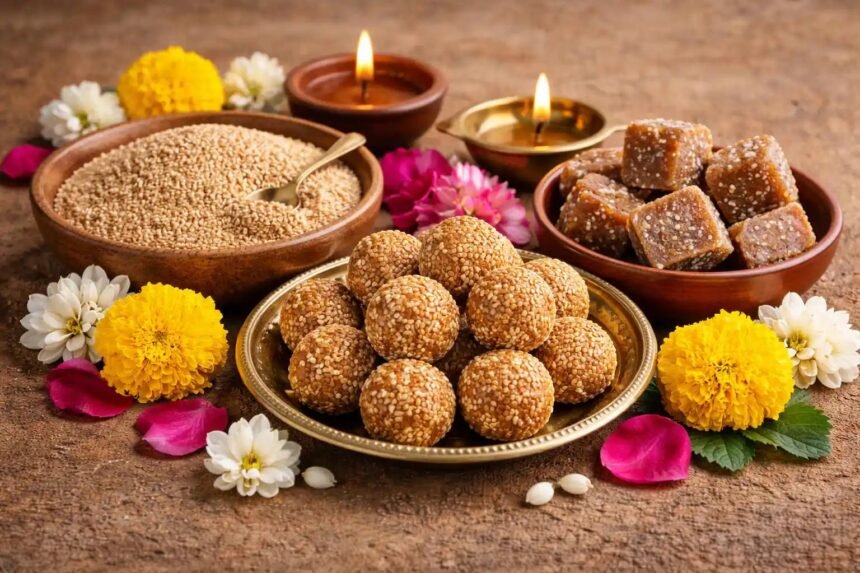
Til (sesame seeds) and Gud (jaggery) are among the most popular traditional foods associated with Makar Sankranti.
In Maharashtra, people exchange sesame and jaggery sweets while saying:
“Tilgul ghya, god god bola.”
This means, “Accept these sesame-jaggery sweets and speak sweetly.”
The message is simple but meaningful: forget bitterness, avoid unnecessary arguments and maintain loving relationships.
Cultural and seasonal importance
Sesame-based foods are traditionally enjoyed during the winter season.
Jaggery provides energy and sweetness.
Sharing sweets strengthens family and social relationships.
Traditional recipes preserve regional culinary heritage.
Makar Sankranti teaches us that even a small gesture, such as sharing sweets, can create happiness in someone’s life.
6. Important Rituals and Traditions of Makar Sankranti
People observe Makar Sankranti through several religious and cultural activities.
1. Early morning bathing: Many devotees wake up early and take a bath before offering prayers.
2. Surya Puja: People worship Surya Dev and express gratitude for sunlight and life.
3. Kite flying: In Gujarat and several other regions, kite flying is an important attraction.
4. Preparing traditional food: Families prepare khichdi, tilkut, laddoos, chikki, Pongal and other seasonal dishes.
5. Charity: People donate food, clothes, blankets and money to those who need assistance.
6. Visiting temples: Devotees visit temples and participate in religious ceremonies.
7. Family gatherings: Relatives and friends come together to share food, exchange gifts and celebrate.
8. Respecting farmers: The festival provides an opportunity to appreciate the contribution of farmers and agricultural workers.
7. Makar Sankranti Timeline: Historical and Cultural Development
The exact origin date of Makar Sankranti cannot be established with certainty. However, its traditions have developed through India’s long history of solar observation, agriculture and religious practices.
| Period | Historical and cultural development |
|---|---|
| Ancient period | Solar observations and agricultural seasonal traditions became part of Indian cultural life. |
| Vedic traditions | Surya worship gained an important place in religious practices. |
| Epic traditions | Uttarayana became associated with spiritual beliefs and stories such as Bhishma’s departure. |
| Classical period | Solar calculations and zodiac-based traditions developed further. |
| Medieval period | Regional religious fairs, bathing traditions and harvest celebrations continued to grow. |
| Traditional rural era | Communities celebrated harvests through food, folk songs, rituals and charity. |
| Modern India | Kite festivals, cultural programmes and large community celebrations became prominent. |
| Present day | Makar Sankranti is celebrated across India and by Indian communities worldwide. |
This timeline is a broad cultural overview rather than a precisely dated chronology of the festival’s origin.
8. 11 Powerful Reasons Why Makar Sankranti Is Important
Makar Sankranti is more than a religious festival. It carries important lessons for individuals and society.
Respect for nature: It reminds us that human life depends on sunlight, water, soil and the natural environment.
Gratitude towards farmers: It recognises the hard work of agricultural communities.
Family bonding: Celebrations bring relatives and generations closer.
Spiritual development: Prayers encourage discipline and positive thinking.
Charity and kindness: Donation traditions inspire people to help the less fortunate.
Cultural preservation: Regional food, music and rituals preserve India’s heritage.
Unity in diversity: Different communities celebrate the occasion in different ways while sharing a common seasonal spirit.
Healthy relationships: Sharing sweets encourages kind words and forgiveness.
Seasonal awareness: The festival connects people with natural and agricultural cycles.
Economic activity: Markets, traditional food businesses, artisans and tourism benefit from seasonal celebrations.
Positive beginnings: It inspires people to welcome new opportunities with hope and determination.
9. Impact of Makar Sankranti on Daily Life
The importance of Makar Sankranti is not limited to one day of celebration. Its values can influence our everyday behaviour and relationships.
A lesson in gratitude
We often enjoy food without thinking about the farmers, workers, sunlight, soil and water involved in producing it.
Makar Sankranti reminds us to appreciate every person and natural resource that contributes to our daily lives.
A lesson in kindness
The tradition of donating food and clothes encourages us to help people who are struggling.
Even a small contribution can make someone’s winter more comfortable.
A lesson in positive communication
The tradition of sharing til and gud teaches us to speak politely and avoid unnecessary conflicts.
In our daily lives, sweet words can improve relationships at home, school, workplaces and society.
A lesson in environmental responsibility
The festival encourages respect for nature. We can celebrate it responsibly by avoiding plastic decorations, reducing waste and protecting birds during kite flying.
A lesson in family relationships
In modern life, people are often occupied with education, careers and professional responsibilities.
Festivals provide an opportunity to spend quality time with parents, grandparents, children and relatives.
Makar Sankranti reminds us that relationships are among life’s most valuable gifts.
10. Importance of Makar Sankranti in Indian Society
Makar Sankranti plays an important role in preserving India’s cultural and social identity.
Agricultural importance: Agriculture is a major part of India’s heritage. The festival recognises the contribution of farmers and celebrates the seasonal harvest.
Social importance: Community gatherings, traditional meals and cultural programmes bring people together.
Economic importance: The festival supports local sweet shops, kite makers, farmers, artisans, markets and tourism-related businesses.
Educational importance: Students can learn about astronomy, the solar calendar, agricultural practices, regional diversity and traditional knowledge through the festival.
Cultural importance: It helps younger generations understand the customs and traditions inherited from their ancestors.
Humanitarian importance: Charity and sharing encourage compassion, equality and social responsibility.
The Government of India’s cultural tourism platform also recognises harvest festivals as important expressions of India’s agricultural heritage and regional diversity.
11. Scientific and Astronomical Importance of Makar Sankranti
Makar Sankranti has an interesting relationship with astronomy.
The Earth revolves around the Sun while rotating on its axis. Because of Earth’s axial tilt, different parts of the planet experience seasonal changes and variations in daylight throughout the year.
Makar Sankranti marks the Sun’s apparent transition into Capricorn in the traditional sidereal zodiac system.
What is Uttarayana?
Uttarayana is a Sanskrit term formed from two words:
Uttar means north.
Ayana means movement or journey.
In traditional Indian astronomy and religious understanding, Uttarayana represents the Sun’s northward journey.
It is associated with longer daylight hours in the Northern Hemisphere as the year progresses beyond the winter solstice.
Why is the Sun important?
Sunlight supports several essential processes:
Photosynthesis in plants.
Agricultural production.
The natural water cycle.
The regulation of biological rhythms.
Solar energy generation.
The survival of ecosystems.
The festival provides an opportunity to understand how closely human civilisation is connected with the natural world.
12. Environmental Responsibility During Makar Sankranti
Makar Sankranti is a joyful festival, but celebrations should also protect the environment.
Kite flying is popular in many regions, but certain sharp or synthetic kite strings can seriously injure birds, animals and people.
Here are some responsible ways to celebrate:
Use safe, non-metallic cotton kite strings.
Avoid glass-coated or synthetic cutting strings.
Never leave kite strings hanging from trees or electric wires.
Keep rooftops and public places clean.
Avoid throwing plastic waste into rivers.
Offer food responsibly without littering.
Protect birds and other animals during celebrations.
A truly meaningful festival is one that creates happiness without causing unnecessary harm.
13. Interesting Facts About Makar Sankranti
Here are some interesting facts about this traditional Indian festival.
Makar Sankranti is one of the major Indian festivals based on a solar transition.
It generally falls on January 14 or 15.
It is dedicated to Surya Dev in Hindu religious traditions.
The festival is associated with Uttarayana.
In Gujarat, it is popularly known as Uttarayan.
In Tamil Nadu, the harvest celebration is known as Pongal.
In Assam, the harvest festival is known as Magh Bihu.
In Bihar, Dahi-Chura and Tilkut are popular traditional foods.
Sesame seeds and jaggery are important seasonal ingredients.
Kite flying is one of the most recognisable traditions associated with the festival.
Taking holy baths and donating food are traditional religious practices.
The festival highlights the relationship between agriculture, nature and human civilisation.
It is celebrated in different forms by Indian communities across the world.
Makar Sankranti encourages people to welcome positive changes and new beginnings.
Its regional celebrations demonstrate India’s unity in diversity.
14. How Is Makar Sankranti Celebrated in Modern India?
Modern celebrations combine traditional customs with contemporary activities.
Families organise gatherings, prepare traditional dishes, exchange greetings and visit religious places.
In cities, kite-flying events, cultural festivals and community programmes attract large numbers of people.
Schools and colleges organise:
Essay-writing competitions.
Drawing and painting competitions.
Traditional food exhibitions.
Cultural performances.
Quiz competitions about Indian festivals.
Environmental awareness activities.
Social media has also changed how people celebrate. Families and friends exchange photographs, videos, greetings and messages.
However, the most meaningful part of the festival remains the same: gratitude, togetherness and respect for nature.
15. Makar Sankranti Wishes, Greetings and Messages
Makar Sankranti is an opportunity to spread love, positivity and happiness. Here are some beautiful wishes that you can share with family, friends, colleagues and students.
15 Beautiful Makar Sankranti Wishes
1. Happy Makar Sankranti! May the divine blessings of Surya Dev fill your life with happiness, good health and prosperity.
2. May this beautiful festival bring new opportunities, success and positive energy into your life. Happy Makar Sankranti!
3. Let your dreams fly as high as colourful kites in the sky. Wishing you a joyful Makar Sankranti!
4. May the sweetness of til and gud bring sweetness to your relationships. Happy Makar Sankranti!
5. May your home always be filled with love, peace, happiness and prosperity.
6. On this auspicious occasion, may the Sun God bless you with strength, wisdom and success.
7. Let us welcome new beginnings with gratitude, kindness and hope. Happy Makar Sankranti!
8. May this harvest festival bring abundance and happiness to every farmer and family.
9. Wishing you a beautiful Makar Sankranti filled with traditional food, laughter and unforgettable memories.
10. May your life shine brighter than the morning Sun. Happy Makar Sankranti!
11. Let us forget bitterness, spread kindness and celebrate togetherness.
12. May your efforts produce the sweetest results, just like a successful harvest.
13. May every sunrise bring fresh hope and every sunset bring peaceful memories.
14. Sending warm wishes to you and your family on the auspicious occasion of Makar Sankranti.
15. May the blessings of nature bring health, wealth, harmony and happiness into your life.
Short Makar Sankranti Captions for Social Media
Fly high, dream big and stay positive. Happy Makar Sankranti!
Celebrate the harvest, respect nature and spread happiness.
Sweetness in words, kindness in actions.
A festival of sunshine, harvest and hope.
New season, new beginnings, new possibilities.
Let happiness soar like a kite!
Traditional Hindi Wishes
मकर संक्रांति की हार्दिक शुभकामनाएं! आपके जीवन में सुख, शांति और समृद्धि बनी रहे।
सूर्य देव की कृपा से आपके जीवन में नई ऊर्जा और सकारात्मकता का संचार हो।
तिल-गुड़ की मिठास आपके रिश्तों में प्रेम और अपनापन बनाए रखे।
यह पावन पर्व आपके परिवार में खुशियां, स्वास्थ्य और खुशहाली लेकर आए।
मकर संक्रांति आपके जीवन में सफलता और नई उम्मीदों का उजाला लेकर आए।
16. Review Section: Makar Sankranti Festival
Makar Sankranti is a beautiful example of how Indian festivals combine spirituality, science, agriculture, regional traditions and social relationships.
| Review category | Evaluation |
|---|---|
| Cultural importance | Excellent |
| Religious significance | Very high |
| Family bonding | Excellent |
| Agricultural connection | Very high |
| Regional diversity | Excellent |
| Traditional food | Excellent |
| Environmental awareness | Needs responsible celebration |
| Educational value | Very high |
What makes the festival special?
Its greatest strength is its ability to connect people with nature and their cultural roots. Whether someone celebrates through kite flying, holy bathing, preparing Pongal, enjoying Dahi-Chura or sharing tilkut, the central message remains gratitude and happiness.
What could be improved?
People should avoid dangerous kite strings, environmental pollution and unnecessary waste. More educational programmes could also help children understand the astronomical and agricultural significance of the occasion.
Overall verdict: Makar Sankranti deserves appreciation as one of India’s most meaningful seasonal and cultural celebrations. It brings together tradition, spirituality, agriculture and humanity.
Editorial note: This is an editorial assessment of the festival, not a collection of verified visitor reviews.
17. Frequently Asked Questions (FAQs) About Makar Sankranti
Q1. What is Makar Sankranti?
Makar Sankranti is a traditional Hindu festival that marks the Sun’s transition into the zodiac sign of Capricorn (Makara). It is associated with harvest celebrations, Uttarayana and the worship of Surya Dev.
Q2. When is Makar Sankranti celebrated?
It is generally celebrated on January 14 or 15 every year, depending on the astronomical timing of the Sun’s transition into Makara Rashi.
Q3. Why is Makar Sankranti celebrated?
It is celebrated to welcome seasonal changes, express gratitude to the Sun God, celebrate agricultural prosperity and encourage happiness, charity and togetherness.
Q4. What is the historical significance of Makar Sankranti?
Its history is associated with ancient solar observations, agricultural traditions, Hindu religious practices and the worship of the Sun.
Q5. Why do people fly kites on Makar Sankranti?
Kite flying is a popular regional tradition, particularly in Gujarat. It has become an important social and cultural activity during the festival.
Q6. What is Uttarayana?
Uttarayana traditionally refers to the northward journey of the Sun. It is associated with auspiciousness and positive transformation in Hindu traditions.
Q7. Why do people eat til and gud on Makar Sankranti?
Sesame seeds and jaggery are traditional winter foods. Sharing sweets made from these ingredients symbolises sweetness, friendship and harmony.
Q8. What is Makar Sankranti called in Bihar?
In Bihar, it is commonly known as Makar Sankranti or Sakraat and is popularly celebrated with Dahi-Chura, Tilkut, jaggery and other traditional foods.
Q9. What is the difference between Makar Sankranti and Pongal?
Makar Sankranti is a broader solar and harvest-related festival celebrated in different parts of India. Pongal is the traditional Tamil harvest festival celebrated around the same seasonal period, particularly in Tamil Nadu.
Q10. Is Makar Sankranti a harvest festival?
Yes. It is closely associated with agricultural prosperity, seasonal harvests and gratitude towards farmers and nature.
Q11. Which God is worshipped on Makar Sankranti?
Surya Dev, the Hindu Sun God, is traditionally worshipped on this occasion.
Q12. What is the importance of charity on Makar Sankranti?
Charity represents kindness, compassion and social responsibility. People donate food, clothes, blankets and other essential items to those in need.
Q13. What is the significance of taking a holy dip?
Devotees believe that bathing in sacred rivers during this auspicious period helps purify the mind and brings spiritual benefits.
Q14. How can students celebrate Makar Sankranti?
Students can celebrate by learning about Indian culture, participating in traditional activities, preparing regional foods, organising educational programmes and spreading environmental awareness.
Q15. What is the main message of Makar Sankranti?
The main message is to express gratitude towards nature, respect farmers, share happiness, maintain good relationships and welcome new beginnings with positivity.
18. Conclusion: Makar Sankranti Is a Celebration of Hope, Gratitude and Togetherness
Makar Sankranti is much more than a traditional Indian festival. It is a celebration of nature, agriculture, spirituality, family relationships and humanity.
From the colourful skies of Gujarat to the traditional Pongal celebrations of Tamil Nadu, from the community feasts of Assam to the delicious Dahi-Chura and Tilkut of Bihar, every region expresses its happiness through unique cultural traditions.
The festival teaches us several valuable lessons. It reminds us to respect the Sun, appreciate farmers, protect nature, help people in need and maintain sweetness in our relationships.
In today’s fast-moving world, where people are often busy with education, careers, technology and personal responsibilities, festivals like Makar Sankranti remind us to reconnect with our families, traditions and communities.
Its message is especially important for younger generations. Progress does not mean forgetting our roots. We can embrace modern technology and new opportunities while preserving our cultural heritage.
Let us celebrate Makar Sankranti not only by flying kites, preparing delicious food and exchanging greetings but also by spreading kindness, supporting farmers, helping underprivileged people and protecting our environment.
The real meaning of Makar Sankranti is not simply welcoming a new season; it is welcoming a better attitude towards life.
May the blessings of Surya Dev bring happiness, health, prosperity and success to every family.
Happy Makar Sankranti! May your life always shine with positivity, peace and endless possibilities.
19. Important Points to Remember
Makar Sankranti is a major Hindu solar festival.
It marks the Sun’s entry into Capricorn (Makara Rashi).
It is generally celebrated on January 14 or 15.
It is associated with Uttarayana.
Surya Dev is worshipped during the festival.
It is closely connected with harvest celebrations.
Til, gud, Dahi-Chura, Tilkut and Pongal are popular traditional foods.
Different Indian states celebrate it under different names.
Charity, holy bathing and family gatherings are important traditions.
Its central message is gratitude, kindness, unity and positivity.
References and Further Reading
The following sources provide additional information about the history, cultural traditions and significance of Makar Sankranti:
About Minorstudy
Minorstudy – Education, Knowledge and Inspiration
Minorstudy is an educational and informational platform dedicated to making knowledge accessible and understandable for students, professionals and lifelong learners.
Through articles covering education, science, technology, history, health, business, travel, culture and current affairs, Minorstudy aims to encourage learning, awareness and positive thinking.
Our message: Learn something new, understand the world and inspire the future.
Website: Minorstudy.com