🌱 Inspiring Facts About a Career in Renewable Energy: Courses, Costs, Jobs & Future Scope

- Career in Renewable Energy: A Complete Guide for Students
- 1. Renewable Energy Is a Multidisciplinary Career
- 2. Solar Energy Has Become a Major Career Area
- After Class 10
- After Class 12 Science
- After Graduation
- Technical Skills
- Digital Skills
- Professional Skills
- Field-based careers
- Office/laboratory careers
- Diploma Route
- Bachelor’s Degree Route
- Master’s Route
- Short-Term Training
- Other costs to remember
- Solar Sector
- Wind Sector
- Broader Energy Sector
- At Home
- Agriculture
- Education
- Transportation
- Business
- Class 9–10
- Class 11–12
- College
- Before Graduation
- Student Review Perspective
- Overall Career Experience
- 1. Is renewable energy a good career for students?
- 2. Can I enter renewable energy after Class 10?
- 3. Which engineering branch is useful for renewable energy?
- 4. Can a computer science student work in renewable energy?
- 5. Is a master’s degree compulsory?
- 6. Is renewable energy only about solar power?
- 7. Is renewable energy expensive to study?
- 8. Are there government training opportunities?
- 9. Can renewable energy become a business?
- 10. What is the future of renewable-energy jobs?


Career in Renewable Energy: A Complete Guide for Students
Imagine a career where your work can involve solar panels, wind turbines, batteries, electric grids, green hydrogen, energy efficiency, data, engineering and environmental solutions.
That is the growing world of renewable energy.
A career in renewable energy is no longer limited to installing solar panels. The sector now requires engineers, technicians, researchers, software professionals, project managers, environmental specialists, financial analysts, sales professionals, policy experts and entrepreneurs.
India’s renewable-energy infrastructure has expanded rapidly. According to the Ministry of New and Renewable Energy (MNRE), as of 31 August 2026, India had about 295.55 GW of total renewable-energy capacity, including large hydro, with solar at about 168.04 GW and wind at about 58.52 GW. (Ministry of New and Renewable Energy)
Globally, renewable-energy employment reached an estimated 16.6 million jobs in 2024, according to IRENA and the ILO. India accounted for approximately 1.28 million renewable-energy jobs in that assessment. (IRENA)
So, for students thinking about engineering, science, technology or sustainability, renewable energy represents a broad field rather than one single profession.
What Is Renewable Energy?
Renewable energy comes from naturally replenishing sources.
Major renewable-energy technologies include:
- ☀️ Solar energy
- 🌬️ Wind energy
- 💧 Hydropower
- 🌱 Biomass and bioenergy
- 🌋 Geothermal energy
- 🌊 Ocean and marine energy
- 🔋 Battery storage linked with renewable electricity
- 💧 Green hydrogen produced using renewable electricity
The International Energy Agency describes solar, wind, hydropower, bioenergy and other renewable technologies as central to the transition toward a less carbon-intensive energy system. (IEA)
11 Powerful Facts About a Career in Renewable Energy
1. Renewable Energy Is a Multidisciplinary Career
One of the biggest misconceptions is that renewable energy is only for electrical engineers.
In reality, the industry needs people from many backgrounds.
Possible areas include:
- Electrical engineering
- Mechanical engineering
- Civil engineering
- Electronics
- Computer science
- Data science
- Environmental science
- Physics
- Chemistry
- Finance
- Business management
- Project management
- Sales and marketing
- Research
- Public policy
This makes renewable energy particularly interesting for students who want to combine technology with real-world problems.
2. Solar Energy Has Become a Major Career Area
Solar photovoltaic technology has expanded rapidly worldwide.
The IEA reported that solar PV represented more than three-quarters of global renewable capacity additions in 2025. (IEA)
India has experienced particularly strong solar expansion. MNRE reports cumulative solar capacity of approximately 168 GW as of August 2026. (Ministry of New and Renewable Energy)
This creates work across the complete solar value chain:
- Site survey
- Design
- Manufacturing
- Procurement
- Installation
- Testing
- Commissioning
- Operations
- Maintenance
- Monitoring
- Project management
- Sales and business development
3. India Is Building a Large Renewable-Energy Workforce
Renewable energy needs people at different qualification levels.
For example, India’s National Skill Development Corporation lists occupational standards for roles such as:
- Solar PV installer
- Solar PV engineer
- Solar site in-charge
- Solar PV project manager
- Solar PV maintenance technician
- Solar PV O&M engineer
- Solar PV manufacturing technician
- Wind-power construction technician
- Wind site surveyor
- Wind planning roles (NSDC India)
This is important for students because you do not necessarily need a master’s degree to enter the renewable-energy industry.
Vocational and technician pathways also exist.
4. You Can Start After Class 10 or 12
Students can choose different routes depending on their goals.
After Class 10
Possible options include:
- ITI-related technical courses
- Vocational training
- Electrical technician training
- Solar installation training
After Class 12 Science
Students can consider:
- B.Tech/B.E.
- B.Sc.
- Diploma
- Renewable-energy certificate programmes
- Electrical engineering
- Mechanical engineering
- Electronics engineering
- Environmental science
After Graduation
Students can move into:
- M.Tech
- M.Sc.
- MBA in energy/sustainability
- Renewable-energy diplomas
- Research
- Project management
- Energy-policy programmes
The important point is that renewable energy is an ecosystem of careers, not a single degree.
5. Renewable-Energy Skills Matter as Much as Degrees
A degree can provide the academic foundation, but employers also need practical skills.
Useful skills include:
Technical Skills
- Electrical systems
- Solar PV fundamentals
- Power electronics
- Energy storage
- Grid systems
- AutoCAD
- Electrical design
- Renewable-energy resource assessment
- Energy modelling
- SCADA
- Data analysis
Digital Skills
- Excel
- Python
- MATLAB
- Data visualization
- GIS
- Simulation software
- Monitoring platforms
Professional Skills
- Communication
- Teamwork
- Project management
- Problem solving
- Safety awareness
- Documentation
- Leadership
For example, NSDC’s Solar PV Installer Civil qualification includes theory, practical and employability/entrepreneurship components, showing the importance of hands-on learning alongside technical knowledge. (NSDC India)
6. There Are Renewable-Energy Jobs Outside Engineering
Not every career requires you to design a solar panel.
You can work in:
| Career Area | Example Roles |
|---|---|
| Engineering | Solar Engineer, Wind Engineer |
| Installation | Solar Technician |
| Maintenance | O&M Technician |
| Project Management | Project Manager |
| Manufacturing | Manufacturing Technician |
| Research | Renewable Energy Researcher |
| Environment | Sustainability Specialist |
| Finance | Energy Finance Analyst |
| Business | Renewable Energy Business Development |
| Sales | Solar Sales Executive |
| Data | Energy Data Analyst |
| Policy | Energy Policy Researcher |
| Software | Energy Software Developer |
| Entrepreneurship | Solar Business Owner |
This diversity makes the sector relevant to students with different interests.
7. Green Hydrogen Is Creating Another Career Area
Renewable electricity is increasingly connected with other technologies.
One example is green hydrogen.
India’s National Green Hydrogen Mission aims to develop domestic green-hydrogen production and has an objective of reaching 5 million metric tonnes per year by 2030, according to MNRE materials. (National Green Highway Mission)
This creates potential opportunities in:
- Electrolysers
- Hydrogen production
- Storage
- Transportation
- Chemistry
- Engineering
- Safety
- Research
- Industrial applications
For students interested in chemistry, engineering or advanced energy technologies, this is an area worth studying.
8. Renewable Energy Is Connected With Artificial Intelligence
The future renewable-energy professional may work with both energy technology and AI.
AI can be used for areas such as:
- Energy-demand forecasting
- Solar generation forecasting
- Predictive maintenance
- Wind forecasting
- Grid optimisation
- Battery management
- Fault detection
- Energy trading analytics
- Plant performance monitoring
This means students studying AI, computer science or data science can also explore energy-sector careers.
9. Renewable Energy Creates Both Field and Office Careers
Some people love fieldwork.
Others prefer computers and offices.
Renewable energy offers both.
Field-based careers
You might:
- Inspect solar installations
- Visit wind farms
- Test electrical equipment
- Supervise construction
- Perform maintenance
- Conduct site surveys
Office/laboratory careers
You might:
- Design energy systems
- Analyse data
- Create financial models
- Conduct research
- Develop software
- Prepare project reports
- Work on policy
So students should think about their personality and preferred working environment, not only the job title.
10. Renewable Energy Can Support Entrepreneurship
A renewable-energy career does not always mean getting a traditional job.
Entrepreneurial opportunities can include:
- Solar installation businesses
- Solar maintenance services
- Energy-audit services
- Solar equipment distribution
- Solar consultancy
- Rooftop-solar businesses
- Battery-storage services
- Energy-efficiency consulting
- Renewable-energy education
- Clean-energy software
India’s MNRE also highlights decentralised renewable-energy applications for livelihoods, healthcare, education and households. (Ministry of New and Renewable Energy)
This means renewable energy can connect technology with local business opportunities.
11. Renewable Energy Is Becoming More Important to the Future Economy
India is working toward 500 GW of non-fossil electricity capacity by 2030, while its broader climate strategy includes a net-zero target for 2070. (National Green Highway Mission)
Meanwhile, the IEA reported that global renewable capacity additions reached about 800 GW in 2025, a record annual level. (IEA)
These developments do not guarantee a particular job for every graduate. However, they demonstrate why energy technology, infrastructure and skilled workers are becoming increasingly important areas of study.
🎓 Courses for a Career in Renewable Energy
Students can choose several routes.
Diploma Route
Suitable for students who prefer practical and technical training.
Possible subjects:
- Electrical systems
- Solar installation
- Energy systems
- Electronics
- Maintenance
- Renewable-energy technology
Bachelor’s Degree Route
Common degrees include:
- B.Tech Electrical Engineering
- B.Tech Mechanical Engineering
- B.Tech Electronics Engineering
- B.Tech Energy Engineering
- B.Tech Renewable Energy
- B.Sc. Physics
- B.Sc. Environmental Science
The exact degree availability varies by institution.
Master’s Route
Possible specialisations include:
- Renewable Energy
- Energy Engineering
- Power Systems
- Sustainable Energy
- Environmental Engineering
- Energy Management
Short-Term Training
Short courses can be useful for beginners or professionals.
For example, the National Productivity Council currently lists a Fundamentals of Renewable Energy e-learning course and a Basics of Solar Panel Installation course. (NPC India)
MNRE’s Human Resource Development programme for 2026–27 to 2030–31 also includes short-term training, scholarships/fellowships/internships and renewable-energy education infrastructure. (Ministry of New and Renewable Energy)
💰 Cost of Studying Renewable Energy
The cost depends heavily on the route you choose.
| Study Route | Approximate Cost Consideration |
|---|---|
| Short online course | Often relatively low |
| Government/technical certificate | Depends on programme |
| Diploma | Institution-dependent |
| B.Tech/B.E. | Highly dependent on college |
| M.Tech/M.Sc. | Institution and programme dependent |
| International study | Usually considerably higher |
As a current example, NPC lists its Fundamentals of Renewable Energy e-learning course at ₹1,770 and Basics of Solar Panel Installation at ₹3,000 on its course listing. (NPC India)
Students should always verify the latest fee directly with the institution because tuition, examination, hostel, equipment and other charges can change.
Other costs to remember
Don’t calculate only tuition.
A renewable-energy student may also need money for:
- Hostel
- Transportation
- Laptop
- Software
- Books
- Laboratory expenses
- Safety equipment
- Internship travel
- Certification examinations
💼 Career Opportunities in Renewable Energy
Some potential job titles include:
Solar Sector
- Solar PV Engineer
- Solar Design Engineer
- Solar Installation Technician
- Solar O&M Engineer
- Solar Site Engineer
- Solar Project Manager
- Solar Site Surveyor
- Solar Manufacturing Technician
Wind Sector
- Wind Site Surveyor
- Wind Planning Engineer
- Wind Construction Technician
- Wind Electrical Technician
- Wind Operations Professional
Broader Energy Sector
- Energy Analyst
- Sustainability Analyst
- Energy Consultant
- Energy Auditor
- Battery Specialist
- Grid Engineer
- Energy Data Analyst
- Green Hydrogen Professional
- Energy Policy Researcher
NSDC’s occupational listings demonstrate how renewable-energy work spans entry-level technical roles through higher-level engineering and management positions. (NSDC India)
📈 Salary in Renewable Energy
There is no single renewable-energy salary.
Pay can vary according to:
- Qualification
- Experience
- Location
- Company
- Technical specialisation
- Project size
- Job responsibility
- Field vs office role
For example, an entry-level installation technician and an experienced renewable-energy project manager should not be expected to have the same compensation.
As one illustration of the range in entry-level employment, a recent National Career Service listing showed a solar-panel-related position offering ₹1.2–1.8 lakh per year for a fresher with ITI/diploma-type qualifications and relevant installation/maintenance skills. This is a single job listing, not an industry-wide salary benchmark. (NCS)
Therefore, students should avoid choosing a course solely because someone promises a particular salary.
🕰️ History of Renewable Energy: A Simple Timeline
| Period | Development |
|---|---|
| Ancient times | Humans used sunlight, wind and flowing water for practical purposes |
| Ancient China/Egypt and other civilisations | Early use of wind and water technologies |
| 1800s | Scientific development of electricity and early solar technologies |
| Late 1800s | Early hydroelectric systems expanded |
| 1950s | Commercial silicon solar-cell development accelerated |
| 1970s | Energy crises increased interest in alternative energy |
| 1990s | Wind and solar industries began expanding significantly |
| 2000s | Renewable-energy policies and investments increased |
| 2010s | Solar PV and wind costs fell significantly and deployment accelerated |
| 2020s | Solar, wind, batteries, green hydrogen and digital energy systems expanded |
| 2030 | India is targeting 500 GW of non-fossil capacity |
| 2070 | India has announced a net-zero emissions target |
The exact history is much longer, but this timeline shows how renewable energy moved from traditional technologies toward modern engineering and digital energy systems.
🌍 Why Is a Career in Renewable Energy Important?
A renewable-energy professional is not simply working with machines.
The work can influence:
- Electricity access
- Energy security
- Industrial development
- Technology innovation
- Employment
- Rural development
- Environmental outcomes
- Energy costs
- Infrastructure
- Future transportation
IRENA and the ILO estimate that renewable energy already supports millions of jobs globally, while also highlighting the continuing need for education and workforce development. (IRENA)
🏠 Impact of Renewable Energy on Daily Life
Renewable energy is increasingly connected with ordinary life.
You may encounter it through:
At Home
- Rooftop solar
- Solar water heaters
- Solar lighting
- Battery storage
Agriculture
- Solar pumps
- Solar-powered irrigation
- Cold storage powered by renewable electricity
Education
- Reliable electricity for schools
- Digital classrooms
- Solar-powered facilities
Transportation
- Electric vehicles
- Charging infrastructure
- Renewable electricity for transport
Business
- Rooftop solar
- Energy management
- Green manufacturing
MNRE specifically identifies decentralised renewable-energy applications for livelihoods, healthcare, education and households. (Ministry of New and Renewable Energy)
👨🎓 Skills Students Should Start Developing
If you are serious about a career in renewable energy, begin early.
Class 9–10
Focus on:
- Mathematics
- Science
- Basic computers
- Communication
- Practical projects
Class 11–12
Build knowledge of:
- Physics
- Mathematics
- Chemistry
- Computer science where available
College
Add:
- CAD
- Programming
- Data analysis
- Electrical systems
- Energy modelling
- Internships
- Project work
Before Graduation
Try to build a portfolio.
For example:
Project 1: Design a small rooftop solar system.
Project 2: Analyse monthly solar-generation data.
Project 3: Build a small solar-powered device.
Project 4: Create a dashboard showing energy production.
Project 5: Study battery-storage performance.
A portfolio can demonstrate practical ability beyond a marksheet.
⭐ Review Section: Career in Renewable Energy
Student Review Perspective
Learning opportunities: ⭐⭐⭐⭐⭐
Technical diversity: ⭐⭐⭐⭐⭐
Entrepreneurship possibilities: ⭐⭐⭐⭐
Need for continuous learning: ⭐⭐⭐⭐⭐
Fieldwork opportunities: ⭐⭐⭐⭐
Research opportunities: ⭐⭐⭐⭐⭐
These stars are not a ranking of the industry or a guarantee of career success. They are simply a reader-friendly way to describe the characteristics discussed in this guide.
Overall Career Experience
A renewable-energy career can be particularly interesting for someone who enjoys science + technology + practical problem-solving + sustainability.
However, the work can also involve outdoor conditions, project deadlines, safety procedures, travel and continuous technological change. Students should understand both the opportunities and the demands before choosing a specific pathway.
❓ Frequently Asked Questions About Career in Renewable Energy
1. Is renewable energy a good career for students?
Renewable energy offers careers across engineering, science, technology, manufacturing, installation, management, research, finance and entrepreneurship. The sector is also expanding in India and globally. (Ministry of New and Renewable Energy)
2. Can I enter renewable energy after Class 10?
Yes. Vocational and technician pathways can provide entry into roles such as solar installation and maintenance.
3. Which engineering branch is useful for renewable energy?
Electrical, mechanical, civil, electronics and related engineering disciplines can be useful depending on the job.
4. Can a computer science student work in renewable energy?
Yes. Software, AI, data analytics, forecasting, energy-management systems and smart-grid technologies all require computing skills.
5. Is a master’s degree compulsory?
No. Some technician and entry-level roles can be entered through vocational or diploma pathways. Higher-level research and specialised roles may require postgraduate education.
6. Is renewable energy only about solar power?
No. It also includes wind, hydropower, bioenergy, geothermal and other technologies.
7. Is renewable energy expensive to study?
The cost depends on the programme. Short courses can be relatively inexpensive, while professional degrees can cost substantially more.
8. Are there government training opportunities?
Yes. MNRE’s current HRD programme includes short-term training, scholarships, fellowships and internships in renewable energy. (Ministry of New and Renewable Energy)
9. Can renewable energy become a business?
Yes. Installation, maintenance, consulting, distribution, energy efficiency and other services can provide entrepreneurial opportunities.
10. What is the future of renewable-energy jobs?
IRENA and the ILO report that renewable-energy employment has reached millions globally, although automation, productivity improvements, supply-chain issues and other factors can affect employment growth. (IRENA)
📌 Important Points Students Should Remember
- Renewable energy is a large ecosystem, not one job.
- Engineering is only one pathway.
- Technicians are also important.
- Solar is currently a major part of the sector.
- Wind energy offers specialised careers.
- Batteries and energy storage are increasingly important.
- Green hydrogen creates another emerging field.
- AI and data science can be combined with energy.
- Internships and practical projects matter.
- Communication skills are important.
- Safety knowledge is essential for field roles.
- Entrepreneurship is possible.
- Continuous learning is necessary.
- Course quality matters more than simply collecting certificates.
- Students should verify current fees, recognition and placement information before paying an institute.
🌱 Significance of Renewable Energy for Society
Renewable energy is closely connected with the larger question:
How can society produce and use energy while addressing environmental, economic and energy-security challenges?
Its importance goes beyond electricity generation.
Renewable energy can support:
- Cleaner technologies
- Local employment
- Rural economic activity
- Energy access
- Industrial innovation
- New businesses
- Scientific research
- Technical education
MNRE notes that modern bioenergy, for example, can create local jobs and business opportunities while supporting energy and environmental objectives. (Ministry of New and Renewable Energy)
At the same time, the transition requires responsible planning. Renewable projects still require land, infrastructure, transmission networks, financing, skilled workers, manufacturing capacity and effective environmental and social planning.
🙏 Renewable Energy Career Wishes for Students
If you are preparing for a career in renewable energy, remember:
May your curiosity become knowledge,
your knowledge become skills,
your skills become meaningful work,
and your work create a better future.
The renewable-energy sector needs not only brilliant engineers but also honest technicians, creative researchers, responsible entrepreneurs, thoughtful managers and students willing to learn continuously.
🖼️ Suggested Images Minorstudy


Recommended Image Text:
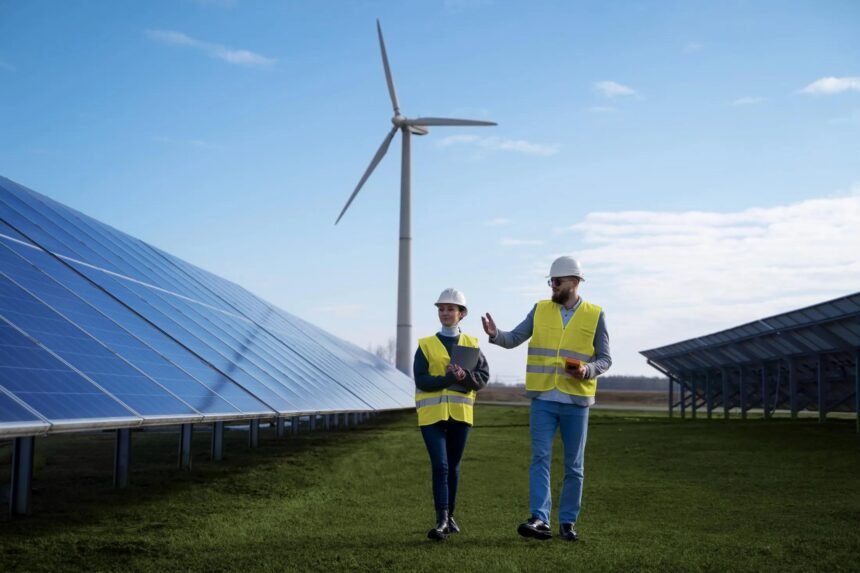
- Renewable energy engineer inspecting solar panels and wind turbines
- Students learning solar and renewable energy technology
- Wind turbine technician working at renewable energy site
- Solar panel installation technician working on renewable energy project
- Renewable energy career opportunities for engineering students
🔮 Future of a Career in Renewable Energy
The energy sector is becoming increasingly connected with AI, batteries, smart grids, electric vehicles, green hydrogen and digital monitoring.
The IEA reported that renewable capacity additions reached a record approximately 800 GW globally in 2025, with solar PV accounting for more than three-quarters of new renewable capacity. (IEA)
India’s own renewable-energy expansion is also substantial: MNRE recorded approximately 295.55 GW of renewable capacity as of 31 August 2026 when large hydro is included. (Ministry of New and Renewable Energy)
For students, this means the field is evolving rapidly.
The professional of tomorrow may not simply be a “solar engineer.” They could be an AI-enabled energy engineer, battery-storage specialist, smart-grid analyst, green-hydrogen engineer, renewable-energy project manager or clean-energy entrepreneur.
🎯 Final Conclusion
A career in renewable energy combines education, technology, engineering, business and social responsibility.
It can begin with a short technical course, diploma, ITI pathway, bachelor’s degree or specialised postgraduate education. Students from electrical, mechanical, civil, electronics, computer science, environmental science, physics and business backgrounds can all find relevant directions.
India’s rapidly expanding renewable-energy capacity, combined with the global growth of renewable technologies and millions of existing jobs, shows why energy skills are becoming increasingly relevant. (Ministry of New and Renewable Energy)
But the most important lesson for students is simple:
Do not choose renewable energy only because it sounds like a “future career.” Choose it because you are willing to learn the science, develop practical skills, solve difficult problems and keep adapting as technology changes.
For a student who enjoys science, technology, engineering, environment, innovation or entrepreneurship, renewable energy can become much more than a course—it can become a lifelong learning journey.
And that is why learning about renewable energy today can be an investment not only in a career, but also in understanding one of the most important technological transformations shaping everyday life.