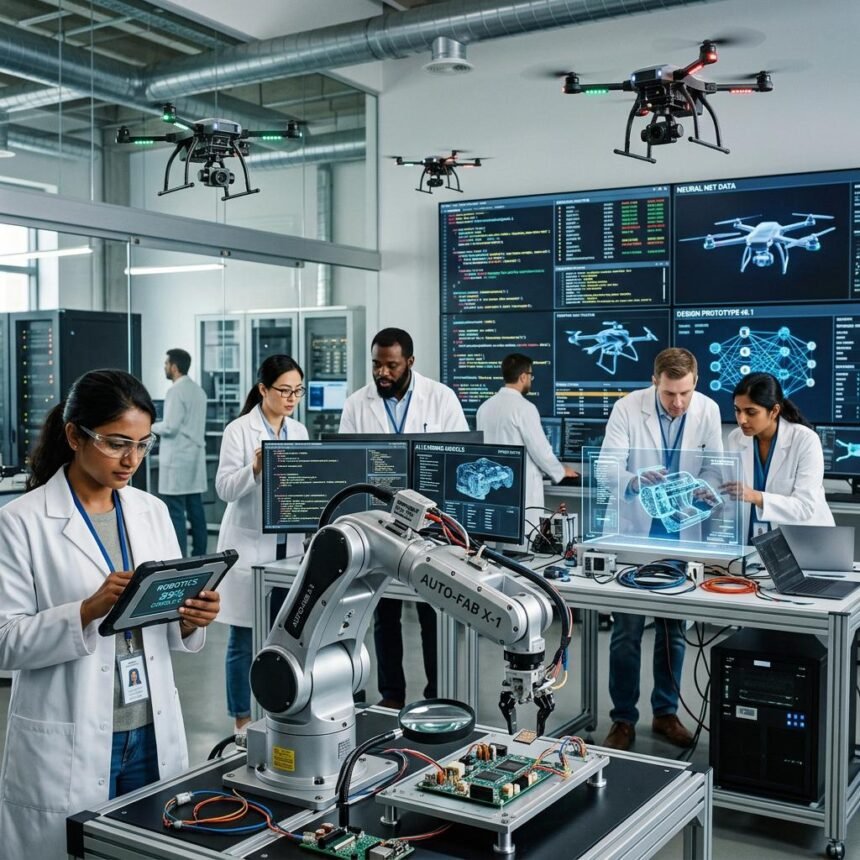
🚀 Powerful Benefits of Science and Technology That Create a Better Future

- Science and Technology: An Introduction
- What Is Science and Technology?
- What is Science?
- What is Technology?
- Ancient period
- Scientific Revolution
- Industrial Revolution
- Electrical and communication revolution
- Computer and Internet era
- Artificial intelligence era
- 1. Better Education
- 2. Improved Healthcare
- 3. Faster Communication
- 4. Agricultural Development
- 5. Space Exploration
- 6. Cleaner Energy Solutions
- 7. Artificial Intelligence and Automation
- 8. Economic Development
- 9. Disaster Management
- 10. Everyday Convenience
- 11. Encourages Human Curiosity and Innovation
- Individual significance
- National significance
- Global significance
- At home
- At school
- During travel
- In banking
- In communication
- In healthcare
- Overall Review
- 1. What is Science and Technology?
- 2. Why is Science and Technology important?
- 3. Is Science and Technology useful for students?
- 4. What careers are available in Science and Technology?
- 5. What is National Science Day?
- 6. When was National Science Day officially designated?
- 7. What can students do on National Science Day?
- 8. Does technology always have positive effects?
- 9. Can students learn technology for free?
- 10. What is the future of Science and Technology?
- For Students


Science and Technology: An Introduction
Science and Technology are two of the strongest forces shaping modern human life. From the mobile phone in our hand to satellites orbiting Earth, from medical diagnosis to online education, almost every part of modern society has been influenced by scientific knowledge and technological innovation.
Science helps us understand how the world works, while technology uses knowledge, methods and engineering to create tools and solutions for human needs.
For a student, Science and Technology are not simply school subjects. They can become a way of thinking, solving problems, asking questions and creating something useful.
Imagine a child asking, “Why does rain happen?” That simple question can lead to meteorology, climate science and weather technology. Another student may ask, “Can a machine learn like a human?” That question can lead toward artificial intelligence, computer science and robotics.
This is why scientific curiosity matters.
What Is Science and Technology?
What is Science?
Science is a systematic way of understanding nature and the universe through:
- Observation
- Questions
- Experiments
- Evidence
- Measurement
- Analysis
- Testing
- Repeated investigation
Physics, chemistry, biology, astronomy, environmental science and earth science are examples of scientific fields.
What is Technology?
Technology refers broadly to the practical application of knowledge, skills, tools and processes to solve problems or accomplish goals.
Technology includes much more than computers. It covers:
- Smartphones
- Internet systems
- Medical equipment
- Transportation
- Satellites
- Renewable-energy systems
- Agricultural machinery
- Robotics
- Artificial intelligence
- Biotechnology
- Construction technologies
Science asks “why” and “how”; technology often asks “how can we use what we know?” In reality, the two continuously influence each other.
A Brief History of Science and Technology
Human technological development began long before modern laboratories and computers.
Ancient period
Early humans developed basic tools, learned to control fire and gradually improved hunting, farming and construction.
Ancient civilizations made important contributions to mathematics, astronomy, medicine, metallurgy and engineering.
Indian civilization also has a long scientific and technological tradition, including developments in mathematics, astronomy, medicine and metallurgy.
Scientific Revolution
During the 16th and 17th centuries, systematic experimentation and mathematical approaches transformed scientific thinking in Europe. Scientists such as Galileo Galilei, Johannes Kepler and Isaac Newton made influential contributions.
Industrial Revolution
The 18th and 19th centuries brought machines, factories, steam power, railways and new manufacturing systems.
Technology increasingly changed how people worked and travelled.
Electrical and communication revolution
Electricity, telegraphy, telephones, radio and later television transformed communication.
Computer and Internet era
The 20th century brought electronic computers, semiconductor technology and eventually the internet.
Artificial intelligence era
Today, AI, robotics, biotechnology, quantum research, advanced materials, space technology and renewable energy are changing the technological landscape.
The history demonstrates an important lesson: innovation is usually a process rather than a single event.
Important Science and Technology Timeline
| Period | Major Development |
|---|---|
| Prehistoric period | Stone tools and controlled fire |
| Ancient civilizations | Mathematics, astronomy, medicine and engineering |
| 15th–17th centuries | Scientific Revolution |
| 18th century | Steam power and Industrial Revolution |
| 19th century | Electricity, telegraph, telephone and modern chemistry |
| Early 20th century | Radio, aviation, modern physics and electronics |
| Mid-20th century | Computers, nuclear technology and space exploration |
| Late 20th century | Internet, personal computers and mobile communication |
| 21st century | AI, biotechnology, robotics, advanced computing and renewable technologies |
| Future | Emerging fields including quantum technologies, advanced AI and new energy systems |
11 Powerful Benefits of Science and Technology
1. Better Education
Technology has changed how students learn.
Digital classrooms, educational videos, simulations, online libraries, learning platforms and AI-based tools can provide students with additional ways to understand difficult concepts.
A student who struggles with a textbook explanation can watch an animation or interact with a simulation.
However, technology works best when combined with good teaching, critical thinking and responsible use.
2. Improved Healthcare
Science and technology have transformed healthcare through:
- Diagnostic imaging
- Laboratory testing
- Vaccines
- Medical devices
- Telemedicine
- Digital health records
- Robotic assistance
- Biotechnology
- Data analysis
Scientific research has helped physicians understand diseases and develop treatments.
Technology can also help healthcare professionals process large amounts of information and communicate with patients.
3. Faster Communication
Think about communication before smartphones and the internet.
Today, a person can send a message across the world within seconds.
Email, video calls, messaging applications, social networks and collaborative platforms have changed education, business, journalism, entertainment and personal relationships.
This has made geographical distance less important for many forms of communication.
4. Agricultural Development
Science and technology are increasingly important in agriculture.
Examples include:
- Soil testing
- Weather forecasting
- Irrigation technology
- Drones
- Satellite imagery
- Agricultural sensors
- Improved crop varieties
- Farm-management software
These technologies can help farmers make better-informed decisions about crops, water and resources.
5. Space Exploration
Space science has expanded humanity’s understanding of Earth, the Solar System and the wider universe.
Satellites support:
- Weather forecasting
- Navigation
- Communication
- Earth observation
- Disaster monitoring
- Scientific research
India’s space programme is one example of how scientific research and engineering can be applied to national and global needs.
6. Cleaner Energy Solutions
Science and technology are helping researchers develop and improve renewable-energy systems.
Solar, wind, hydroelectric, battery-storage and other technologies are important parts of discussions about energy security and environmental sustainability.
The challenge is not simply inventing technology—it is making solutions affordable, reliable, scalable and environmentally responsible.
7. Artificial Intelligence and Automation
Artificial intelligence is one of the most discussed areas of modern technology.
AI can be used in areas such as:
- Language processing
- Image analysis
- Recommendation systems
- Scientific research
- Software development
- Robotics
- Education
- Business analytics
At the same time, responsible AI development requires attention to privacy, security, bias, transparency and the changing nature of work.
8. Economic Development
Scientific research and technological innovation can create new industries, products and jobs.
Technology-related careers include:
- Software developer
- Data scientist
- AI engineer
- Cybersecurity professional
- Robotics engineer
- Biomedical researcher
- Environmental scientist
- Semiconductor engineer
- Cloud engineer
- Research scientist
Students should remember that technology careers require continuous learning because tools and methods change rapidly.
9. Disaster Management
Technology can help society prepare for and respond to disasters.
Satellite systems, weather forecasting, communication networks, geographic information systems and sensors can support disaster monitoring and emergency planning.
Technology cannot eliminate natural disasters, but scientific information can help people make better decisions.
10. Everyday Convenience
Science and technology are present in ordinary activities:
Morning: alarm clock or smartphone
Travel: GPS and digital maps
Education: laptop or online learning
Work: computers and cloud platforms
Healthcare: diagnostic technology
Banking: digital payments
Communication: messaging and video calls
Entertainment: streaming platforms
Home: appliances and smart devices
Much of modern convenience is the result of decades or centuries of scientific and engineering development.
11. Encourages Human Curiosity and Innovation
Perhaps the most important benefit is that Science and Technology encourage people to ask questions.
Why?
How?
What if?
Can we improve it?
Can we make it safer?
Can we make it cheaper?
Can we make it accessible to more people?
These questions are the foundation of innovation.
Science and Technology for Students
Students do not need an expensive laboratory to begin exploring science.
They can start with:
- Reading science books
- Visiting museums and science centres
- Building simple models
- Learning basic coding
- Participating in science exhibitions
- Conducting safe classroom experiments
- Studying mathematics
- Learning about robotics
- Following credible science communication
- Asking teachers questions
- Creating small technology projects


The goal should not always be to build something extraordinary. Learning how to investigate a problem is already a valuable scientific skill.
Costs of Science and Technology Education
The cost depends heavily on the learning route.
| Learning Route | Possible Cost |
|---|---|
| Free online science resources | ₹0 |
| School science projects | Low to moderate |
| Basic coding courses | Free to several thousand rupees |
| Robotics kits | Hundreds to several thousand rupees |
| Laboratory workshops | Varies by institution |
| Undergraduate STEM degree | Varies widely by institution |
| Professional technology certifications | Free to substantial fees |
| Advanced research | Usually institutionally funded, but varies |
These are broad planning ranges rather than fixed national fees. College fees, private courses, equipment and certification charges can differ substantially.
For students, the good news is that learning does not always require expensive equipment. A computer, internet connection and free educational resources can provide a strong starting point for many technology subjects.
Why Science and Technology Are Important in Our Life
Science helps us understand reality.
Technology helps us apply knowledge.
Together, they influence:
- Health
- Education
- Food
- Water
- Energy
- Transportation
- Communication
- Employment
- Agriculture
- Environment
- National infrastructure
- Scientific discovery
But there is another side.
Technology can also create challenges such as:
- Digital addiction
- Privacy concerns
- Cybercrime
- Misinformation
- Electronic waste
- Job disruption
- Unequal access
- Environmental costs
Therefore, technological progress should be accompanied by ethics, responsibility and human judgment.
Science and Technology and Society
A technologically advanced society is not necessarily a perfect society.
The real question is:
How can scientific knowledge and technology improve human well-being while reducing avoidable harm?
This is why science education should include ethics and social responsibility.
Students should learn not only how to create technology, but also:
- Who benefits?
- Who might be excluded?
- Is it safe?
- Is it environmentally responsible?
- What happens to personal data?
- Can the technology be misused?
- Is the information supported by evidence?
These questions help develop responsible innovators.
National Science Day in India
Science also has an important place in India’s public life through National Science Day, observed every year on 28 February.
The day commemorates the announcement of the discovery of the Raman Effect by Indian physicist C. V. Raman. The Government of India designated 28 February as National Science Day in 1986. (Department of Science and Technology)
National Science Day activities can include:
- Science exhibitions
- Lectures
- Quizzes
- Debates
- Demonstrations
- Open laboratory programmes
- Science communication activities
- Student competitions
The Department of Science and Technology describes these programmes as a way to increase public appreciation and understanding of science. (Department of Science and Technology)
Another important date is Technology Day, observed on 11 May in India. (Department of Science and Technology)
Significance of Science and Technology
Science and Technology have significance at three levels.
Individual significance
They improve knowledge, skills, productivity and access to information.
National significance
They contribute to research, infrastructure, healthcare, education, industrial development and innovation.
Global significance
Scientific collaboration can address challenges that cross national borders, including climate change, infectious diseases, food security, energy and space research.
Interesting Facts About Science and Technology
- Science is based on evidence and systematic investigation.
- Technology includes much more than computers.
- National Science Day is observed in India on 28 February.
- The day commemorates the Raman Effect.
- The Government of India designated National Science Day in 1986. (Department of Science and Technology)
- Scientific discoveries can eventually lead to practical technologies.
- Technological problems can also create new scientific questions.
- Satellites support many everyday services, including communication and navigation.
- Artificial intelligence is an interdisciplinary field connected to computer science, mathematics and other areas.
- Science communication helps people understand scientific developments.
- Science exhibitions can give students practical exposure to scientific ideas.
- Modern technology depends on generations of scientific and engineering discoveries.
How Science and Technology Affect Daily Life
At home
Electricity, refrigerators, washing machines, water systems and smartphones depend on technology.
At school
Computers, projectors, online resources, digital libraries and laboratory equipment support learning.
During travel
GPS, traffic systems, aircraft, trains and electric vehicles demonstrate applied science and engineering.
In banking
Digital payments, encryption and authentication technologies have changed financial transactions.
In communication
Internet infrastructure and mobile networks allow rapid global communication.
In healthcare
Laboratory instruments, imaging equipment and digital systems support modern medical services.
Review Section: Science and Technology
Educational value: ⭐⭐⭐⭐⭐
Career relevance: ⭐⭐⭐⭐⭐
Daily-life importance: ⭐⭐⭐⭐⭐
Innovation potential: ⭐⭐⭐⭐⭐
Student learning opportunities: ⭐⭐⭐⭐⭐
Need for responsible use: ⭐⭐⭐⭐⭐
Overall Review
Science and Technology are not merely academic topics. They are interconnected with education, careers, healthcare, communication, business, agriculture, transportation and everyday life.
For students, the most useful approach is to combine scientific curiosity + mathematics + communication + digital skills + ethical thinking.
The field is broad enough for almost every kind of learner—from someone interested in biology to someone fascinated by AI, space, electronics, medicine or environmental science.
FAQs About Science and Technology
1. What is Science and Technology?
Science is the systematic study of the natural world, while technology applies knowledge, tools and processes to solve practical problems.
2. Why is Science and Technology important?
They contribute to education, healthcare, communication, agriculture, energy, transportation, research, industry and many other areas.
3. Is Science and Technology useful for students?
Yes. It develops problem-solving, analytical thinking, experimentation, creativity and technical skills.
4. What careers are available in Science and Technology?
Careers include scientist, engineer, software developer, AI engineer, data scientist, cybersecurity professional, medical researcher, environmental scientist and many others.
5. What is National Science Day?
National Science Day is observed in India on 28 February to commemorate the discovery of the Raman Effect. (Department of Science and Technology)
6. When was National Science Day officially designated?
The Government of India designated 28 February as National Science Day in 1986. (Department of Science and Technology)
7. What can students do on National Science Day?
Students can participate in exhibitions, quizzes, debates, experiments, lectures, science models and science communication activities.
8. Does technology always have positive effects?
No. Technology can provide significant benefits while also creating challenges involving privacy, cybersecurity, inequality, employment and environmental impact.
9. Can students learn technology for free?
Yes. Many introductory resources for programming, mathematics, science and digital skills are available without tuition fees, although advanced courses and equipment may cost money.
10. What is the future of Science and Technology?
Emerging areas include AI, robotics, biotechnology, quantum technologies, advanced materials, renewable energy, semiconductor technology and space research.
Wishing Message for Science and Technology
“May curiosity always lead us to questions, questions lead us to knowledge, and knowledge lead us to solutions that make life better for everyone. Happy Science and Technology learning!”
For Students
“Keep asking why, keep learning how, keep experimenting and never be afraid of failure. Every great innovation begins with a curious mind.”
Important Points to Remember
- Science is based on systematic investigation and evidence.
- Technology applies knowledge to practical purposes.
- Science and Technology continuously influence each other.
- Both have transformed modern healthcare, education and communication.
- Technology should be used responsibly.
- Students can begin learning without expensive equipment.
- Critical thinking is as important as technical skills.
- Digital literacy is increasingly valuable.
- Scientific innovation can create opportunities while also introducing new challenges.
- Society needs technology that is useful, safe, inclusive and responsible.
Conclusion: Building a Better Future Through Knowledge
Science and Technology are ultimately about human curiosity and problem-solving.
A scientist may begin with a question. An engineer may turn an idea into a machine. A programmer may transform an algorithm into software. A doctor may use scientific knowledge to help a patient. A student may build a small model that eventually inspires a much larger idea.
That is the human side of Science and Technology.
The future will not be shaped only by faster computers, smarter machines or more advanced laboratories. It will also be shaped by people who know how to use knowledge responsibly.
For today’s students, learning Science and Technology means preparing not just for a job, but for a world where continuous learning, creativity and responsible innovation will matter increasingly.
Science gives us knowledge. Technology gives us tools. Human values determine how we use them.
That combination can help build a more informed, innovative and responsible society.