🌍 Benefits of Sustainable Development for a Better and Greener Future

- Sustainable Development: An Introduction
- What Is Sustainable Development?
- 1972 – Stockholm Conference
- 1987 – Brundtland Report
- 1992 – Rio Earth Summit
- 2000 – Millennium Development Goals
- 2012 – Rio+20
- 2015 – SDGs Adopted
- 2016 – SDGs Come Into Force
- 1. Protects Natural Resources
- 2. Supports a Cleaner Environment
- 3. Creates Better Opportunities for Future Generations
- 4. Encourages Green Jobs
- 5. Improves Public Health
- 6. Encourages Responsible Consumption
- 7. Supports Sustainable Cities
- 8. Promotes Innovation
- 9. Helps Reduce Inequality
- 10. Strengthens Communities
- 11. Encourages Responsible Businesses
- 12. Builds a Better Future
- Examples of possible initial costs
- Individual-level sustainable choices
- At home
- At school or college
- While travelling
- While shopping
- Fact 1
- Fact 2
- Fact 3
- Fact 4
- Fact 5
- Fact 6
- Fact 7
- What is Sustainable Development?
- How many SDGs are there?
- How many SDG targets are there?
- When were the SDGs adopted?
- When did the SDGs come into force?
- What are the three major dimensions?
- Is sustainability only about the environment?
- What can students do?
- 1. What is Sustainable Development in simple words?
- 2. Why is Sustainable Development important?
- 3. What are the 3 pillars of Sustainable Development?
- 4. What are the 17 SDGs?
- 5. Can Sustainable Development create jobs?
- 6. Is Sustainable Development expensive?
- 7. Can one person make a difference?
- 8. What is India’s role in Sustainable Development?


Sustainable Development: An Introduction
Sustainable Development is one of the most important ideas for building a future in which people can live well without destroying the natural systems and resources that future generations will need.
In simple words, sustainable development means developing today while protecting tomorrow.
Imagine a family that earns money, spends it on education, food and housing, saves some money for the future and avoids wasting everything today. Sustainable development works in a similar way at the level of communities, countries and the entire world.
It connects three broad dimensions:
- 🌱 Environmental protection
- 👨👩👧 Social well-being and inclusion
- 💼 Economic development
The United Nations’ Sustainable Development Goals (SDGs) bring these dimensions together through 17 goals and 169 targets, adopted as part of the 2030 Agenda in 2015. (United Nations)
For students, sustainable development is not simply a chapter in environmental studies. It is connected with education, careers, technology, agriculture, health, transportation, business, cities and everyday choices.
What Is Sustainable Development?
Sustainable development can be understood as a development approach that attempts to improve people’s lives while maintaining environmental resources and social opportunities for the future.
The famous modern formulation came through the 1987 Brundtland Commission report, Our Common Future, which helped establish the concept in international development discussions.
The central idea is straightforward:
Meet present needs without compromising the ability of future generations to meet their own needs.
This does not mean that development should stop.
Instead, it asks an important question:
Can we grow, build, innovate and improve living standards in ways that remain environmentally, socially and economically viable over the long term?
🌎 Why Is Sustainable Development Important?
Our daily lives depend on natural and social systems.
We need:
- Clean air
- Safe drinking water
- Food
- Energy
- Education
- Healthcare
- Employment
- Infrastructure
- Healthy ecosystems
- Stable communities
If development destroys the resources that support these needs, economic progress can become difficult to maintain.
Sustainable development therefore tries to balance human progress with responsible resource use.
The UN describes the SDGs as a universal framework addressing poverty, inequality, economic growth, social inclusion, environmental protection and climate change. (United Nations)
🌱 17 Sustainable Development Goals
The United Nations adopted 17 SDGs under the 2030 Agenda for Sustainable Development.
They are:
- No Poverty
- Zero Hunger
- Good Health and Well-being
- Quality Education
- Gender Equality
- Clean Water and Sanitation
- Affordable and Clean Energy
- Decent Work and Economic Growth
- Industry, Innovation and Infrastructure
- Reduced Inequalities
- Sustainable Cities and Communities
- Responsible Consumption and Production
- Climate Action
- Life Below Water
- Life on Land
- Peace, Justice and Strong Institutions
- Partnerships for the Goals
These goals are interconnected. For example, quality education can support employment, innovation, health awareness and poverty reduction.
📜 History of Sustainable Development
Sustainable development did not suddenly appear in 2015. It developed through decades of international discussion.
1972 – Stockholm Conference
The United Nations Conference on the Human Environment took place in Stockholm, Sweden, from June 5–16, 1972.
It was the first major UN conference focused on international environmental issues and became an important milestone in global environmental cooperation. (United Nations)
The conference also contributed to the creation of the United Nations Environment Programme (UNEP).
1987 – Brundtland Report
The World Commission on Environment and Development published Our Common Future in 1987.
The report helped popularize the modern concept of sustainable development and connected environmental protection with economic and social development.
1992 – Rio Earth Summit
The Earth Summit was held in Rio de Janeiro, Brazil, from June 3–14, 1992.
Representatives from 179 countries participated in the conference, which produced important agreements and initiatives including Agenda 21. (United Nations)
2000 – Millennium Development Goals
World leaders adopted the Millennium Declaration, which led to eight Millennium Development Goals (MDGs) focused on major development challenges through 2015. (Sustainable Development Goals)
2012 – Rio+20
At the United Nations Conference on Sustainable Development, known as Rio+20, countries agreed to begin developing a new set of Sustainable Development Goals. (Sustainable Development Goals)
2015 – SDGs Adopted
In September 2015, world leaders adopted the 2030 Agenda for Sustainable Development, containing 17 SDGs and 169 targets.
2016 – SDGs Come Into Force
The 17 SDGs officially came into force on 1 January 2016. (United Nations)
🗓️ Sustainable Development Timeline
| Year | Important Development |
|---|---|
| 1972 | Stockholm Conference |
| 1987 | Brundtland Report / Our Common Future |
| 1992 | Rio Earth Summit and Agenda 21 |
| 2000 | Millennium Development Goals |
| 2002 | Johannesburg World Summit |
| 2012 | Rio+20 |
| 2015 | 2030 Agenda and 17 SDGs adopted |
| 2016 | SDGs officially came into force |
| 2030 | Target year of the SDG framework |
This history shows that sustainable development is a long-term global process rather than a single environmental campaign. (Sustainable Development Goals)
💚 12 Powerful Benefits of Sustainable Development
1. Protects Natural Resources
Sustainable development encourages responsible use of water, forests, minerals, land and energy.
Using resources efficiently today can reduce unnecessary pressure on future supplies.
2. Supports a Cleaner Environment
Renewable energy, cleaner transportation, waste reduction and pollution control can contribute to healthier environments.
3. Creates Better Opportunities for Future Generations
Children growing up today will become tomorrow’s workers, entrepreneurs, scientists, teachers and leaders.
Sustainable development asks society to consider their future needs.
4. Encourages Green Jobs
Sustainability is creating demand for skills related to renewable energy, environmental science, sustainable construction, electric mobility, waste management, climate technology and responsible business.
5. Improves Public Health
Cleaner air, safe water, sanitation, nutritious food systems and healthier cities can contribute to better living conditions.
6. Encourages Responsible Consumption
Sustainable development encourages people to think before buying, wasting or throwing something away.
The idea can be as simple as:
Buy what you need → use it efficiently → repair when possible → reuse → recycle appropriately.
7. Supports Sustainable Cities
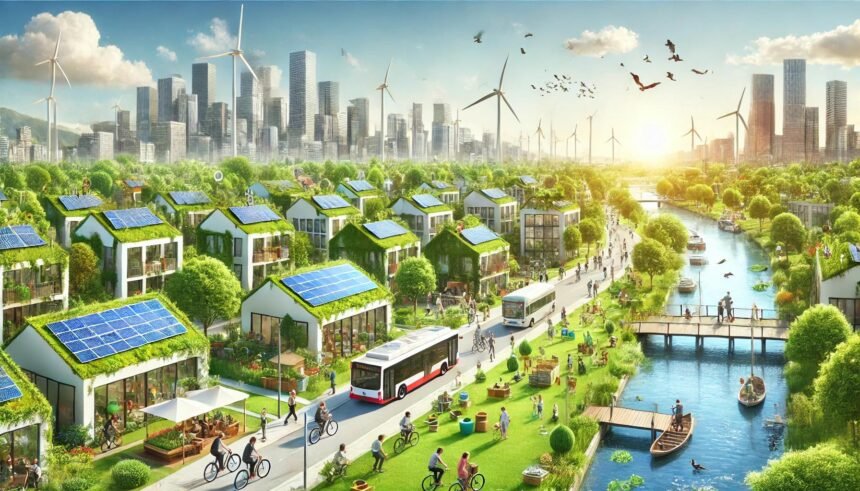
Cities can become more sustainable through public transportation, efficient buildings, green spaces, waste management, water conservation and better urban planning.
8. Promotes Innovation
Sustainability creates opportunities for technological innovation.
Examples include:
- Solar energy
- Battery technology
- Electric mobility
- Smart agriculture
- Water-saving systems
- Energy-efficient buildings
- Recycling technologies
- Climate data systems
9. Helps Reduce Inequality
Sustainable development is not only about trees and energy. It also addresses poverty, education, employment, health and access to opportunities.
10. Strengthens Communities
Local participation can make sustainability more practical.
Community gardens, water conservation, waste segregation, local entrepreneurship and environmental education can involve ordinary citizens.
11. Encourages Responsible Businesses
Businesses increasingly need to consider resource efficiency, environmental impacts, employee welfare and long-term resilience.
12. Builds a Better Future
Ultimately, sustainable development tries to create a future where economic progress, human well-being and environmental protection can exist together.
💰 What Does Sustainable Development Cost?
One common misunderstanding is that sustainability always means higher costs.
The reality is more complicated.
Some sustainable choices require substantial initial investment, while others can reduce costs over time.
Examples of possible initial costs
- Solar panels
- Energy-efficient appliances
- Electric vehicles
- Green buildings
- Water-treatment systems
- Public transportation infrastructure
- Waste-processing facilities
- Sustainable agricultural technology
However, some investments may provide long-term savings through reduced energy consumption, lower operating expenses or improved resource efficiency.
Individual-level sustainable choices
You do not necessarily need a large budget to begin.
Low-cost actions include:
- Switching off unnecessary lights
- Avoiding food waste
- Carrying reusable bags
- Saving water
- Walking short distances
- Using public transportation when practical
- Repairing usable items
- Planting and caring for trees
- Reducing unnecessary consumption
Sustainable living is therefore not simply about spending more money. It is also about wasting less.
🇮🇳 Sustainable Development in India
India has incorporated the SDGs into national and sub-national development monitoring.
NITI Aayog is India’s nodal institution for the SDGs and monitors progress through instruments including the SDG India Index and Dashboard. (NITI Aayog)
According to the SDG India Index 2023–24, India’s composite SDG score increased from 66 in 2020–21 to 71 in 2023–24. The report also identifies areas of stronger progress as well as areas requiring additional attention. (NITI Aayog)
This illustrates an important point: sustainable development is measured not only through environmental indicators but also through poverty, health, education, energy, employment, equality, infrastructure and other development indicators.
🎓 Why Sustainable Development Matters for Students
Students are going to experience many of the economic and environmental changes associated with the coming decades.
Sustainable development can therefore influence future careers in:
- Environmental science
- Renewable energy
- Engineering
- Architecture
- Agriculture
- Biotechnology
- Data science
- Artificial intelligence
- Urban planning
- Public policy
- Healthcare
- Finance
- Business management
- Climate research
- Education
A student does not have to become an environmental scientist to contribute.
For example, a computer science student could develop software that helps monitor energy consumption. An engineering student could work on efficient infrastructure. A business student could study sustainable supply chains.
🏠 Sustainable Development in Daily Life
Sustainability becomes meaningful when it moves from international conferences into ordinary homes.
At home
- Save electricity.
- Avoid unnecessary water use.
- Separate waste where local systems support it.
- Reduce food waste.
- Repair useful products.
At school or college
- Avoid unnecessary printing.
- Carry reusable bottles.
- Organize environmental awareness activities.
- Create campus recycling initiatives.
- Learn about climate and sustainability careers.
While travelling
- Consider public transportation.
- Avoid unnecessary disposable products.
- Respect local ecosystems.
- Avoid littering.
- Support responsible local businesses.
While shopping
Ask yourself:
Do I need this?
Then consider:
Can I reuse, repair or buy a longer-lasting alternative?
These small questions can influence consumption habits.
🌍 Sustainable Development and Society
Sustainable development matters to society because environmental and social problems rarely remain isolated.
For example, water shortages can affect agriculture. Agricultural problems can affect food prices and livelihoods. Poor urban planning can affect transportation and air quality. Pollution can affect health.
This interconnectedness is one reason the SDGs are designed as an integrated framework rather than as 17 completely separate subjects. The UN describes them as interconnected and covering economic, social and environmental dimensions. (United Nations)
📌 Important Principles of Sustainable Development
Remember these important principles:
- Think long term.
- Use natural resources responsibly.
- Reduce unnecessary waste.
- Protect ecosystems.
- Promote social inclusion.
- Support quality education.
- Encourage innovation.
- Build resilient communities.
- Promote responsible production and consumption.
- Work together through partnerships.
🔎 Interesting Facts About Sustainable Development
Fact 1
The UN Sustainable Development framework contains 17 goals and 169 targets. (United Nations)
Fact 2
The SDGs officially came into force on 1 January 2016. (United Nations)
Fact 3
The SDGs apply universally to countries at different income levels. (United Nations)
Fact 4
The 1992 Earth Summit in Rio brought together representatives from 179 countries. (United Nations)
Fact 5
Sustainable development includes much more than environmental protection; it also addresses poverty, education, health, jobs, inequality, peace and institutions. (United Nations)
Fact 6
India’s SDG monitoring framework is led nationally by NITI Aayog. (NITI Aayog)
Fact 7
India’s composite SDG India Index score rose from 66 to 71 between 2020–21 and 2023–24, according to NITI Aayog. (NITI Aayog)
📅 Is There a Sustainable Development Day?
There is no single universally designated UN “Sustainable Development Day” equivalent to a conventional annual observance.
Instead, sustainability is highlighted through several international observances and UN processes, including World Environment Day on June 5, which grew from the 1972 Stockholm Conference. (United Nations)
The SDGs themselves are intended as a continuing global framework through 2030, rather than as a one-day event.
⭐ Significance of Sustainable Development
The significance of sustainable development can be understood through one simple idea:
Progress should improve life without creating unacceptable problems for the future.
A country may build roads, factories and cities, but sustainable development asks additional questions:
- Is the development environmentally responsible?
- Are people benefiting?
- Are opportunities fairly distributed?
- Are resources being used efficiently?
- Can the system continue working in the future?
These questions make development more comprehensive.
📝 Review: Sustainable Development
What is Sustainable Development?
Development that seeks to meet present needs while protecting the ability of future generations to meet their needs.
How many SDGs are there?
There are 17 Sustainable Development Goals.
How many SDG targets are there?
The framework contains 169 targets. (United Nations)
When were the SDGs adopted?
They were adopted by UN Member States in 2015.
When did the SDGs come into force?
January 1, 2016. (United Nations)
What are the three major dimensions?
Economic development, social well-being/inclusion and environmental protection.
Is sustainability only about the environment?
No. It also includes poverty, education, health, jobs, equality, cities, institutions and partnerships.
What can students do?
Students can reduce waste, conserve resources, learn sustainability-related skills, participate in community activities and consider sustainability when making everyday choices.
❓ Frequently Asked Questions About Sustainable Development
1. What is Sustainable Development in simple words?
It means improving people’s lives today while protecting resources and opportunities for tomorrow.
2. Why is Sustainable Development important?
Because society depends on natural resources, healthy environments, strong communities and functioning economies.
3. What are the 3 pillars of Sustainable Development?
They are commonly described as economic, social and environmental dimensions.
4. What are the 17 SDGs?
They cover areas such as poverty, hunger, health, education, equality, water, energy, employment, innovation, cities, responsible consumption, climate, ecosystems, peace and partnerships. (Sustainable Development Goals)
5. Can Sustainable Development create jobs?
Yes. Sustainability-related activities can create employment across renewable energy, engineering, agriculture, construction, transportation, environmental services, technology and other sectors.
6. Is Sustainable Development expensive?
Some sustainable technologies require significant initial investment, but resource efficiency can also create long-term savings. Costs depend heavily on the technology, location, scale and implementation.
7. Can one person make a difference?
Individual actions alone cannot solve every global problem, but everyday behaviour can contribute to broader changes in consumption, waste, resource use and public awareness.
8. What is India’s role in Sustainable Development?
India has integrated SDGs into national monitoring and development planning, with NITI Aayog serving as the national nodal institution for SDG implementation and monitoring. (NITI Aayog)
💐 Sustainable Development Wishes
You can use these messages for schools, colleges, social media campaigns or awareness programmes:
“May we build a future where development creates opportunities, protects nature and leaves a healthier planet for the next generation.”
“Let every small sustainable choice become part of a bigger positive change.”
“A better tomorrow begins with responsible choices today. Let us learn, innovate and grow sustainably.”
“Protect resources, respect nature and support people—because a sustainable future belongs to everyone.”
🌿 10 Simple Sustainable Habits to Start Today
- Carry a reusable water bottle.
- Switch off unused electrical devices.
- Save water while brushing and bathing.
- Avoid unnecessary food waste.
- Reuse products whenever practical.
- Repair before replacing when reasonable.
- Walk or cycle for short journeys when safe.
- Use public transport when practical.
- Learn about responsible consumption.
- Encourage friends and family to adopt sustainable habits.
🌟 Daily-Life Impact of Sustainable Development
Sustainable development may sound like a global concept, but its effects can appear in very ordinary situations.
A cleaner bus system can change a daily commute.
An energy-efficient building can reduce electricity consumption.
Better waste management can improve neighbourhood cleanliness.
Efficient irrigation can help farmers use water more carefully.
Quality education can improve employment opportunities.
Renewable energy can change how electricity is produced.
Therefore, sustainability is not only about saving the planet. It is also about creating systems in which people can live, learn, work and grow more responsibly.
🎯 What Can We Learn From Sustainable Development?
The biggest lesson is that development and responsibility should not be treated as enemies.
Human beings need economic growth, technology, infrastructure and better living standards. At the same time, societies depend on clean water, healthy ecosystems, stable communities and natural resources.
The challenge is finding practical ways to advance both.
For students, the message is especially important:
Your education today can become part of tomorrow’s solution.
Whether you study engineering, medicine, business, agriculture, computer science, arts or social sciences, sustainability can become part of the way you think and work.
🌍 Conclusion: Building a Better Future Together
Sustainable Development is ultimately about responsibility, balance and long-term thinking.
From the Stockholm Conference in 1972 to the Rio Earth Summit in 1992 and the adoption of the 17 SDGs in 2015, the international sustainability movement has evolved considerably. (United Nations)
But sustainable development is not only the responsibility of governments or international organizations.
It involves:
Governments + businesses + schools + universities + communities + families + individuals.
For an ordinary person, sustainability might begin with saving water. For a student, it might begin with learning. For an engineer, it might mean designing efficient technology. For a business, it might mean reducing waste. For a government, it might involve infrastructure and policy.
Every level matters.
The goal is not to create a perfect world overnight. The goal is to make better decisions today that do not unnecessarily limit tomorrow’s possibilities.
That is the heart of Sustainable Development—and it is one of the most important ideas for building a better, greener and more inclusive future.
United Nations Sustainable Development Goals
NITI Aayog Sustainable Development Goals