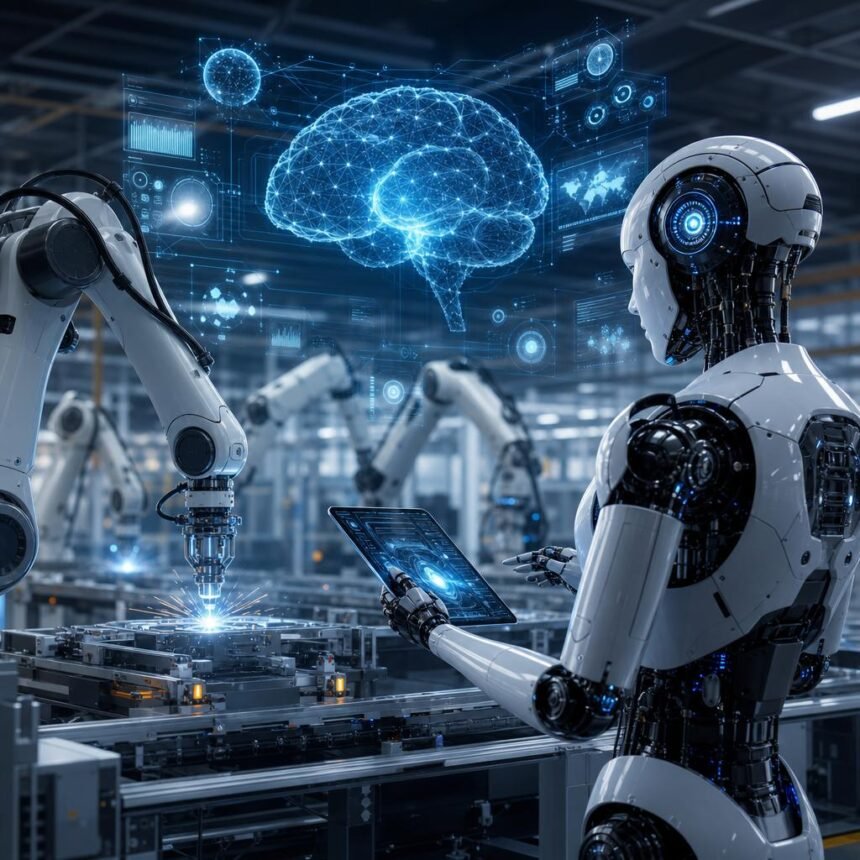
🚀 Insights About AI and Technology: Positive Benefits, Costs, History, Facts and Future

- Introduction: What Are AI and Technology?
- Early computing
- 1950s: The beginning of AI as a field
- 1960s–1970s
- 1980s
- 1990s
- 2000s
- 2010s
- 2020s
- Fact 1: AI is older than today’s chatbots
- Fact 2: AI depends heavily on data and computing
- Fact 3: AI is not the same as human intelligence
- Fact 4: AI can generate content
- Fact 5: AI costs have changed rapidly
- Fact 6: AI can support education
- Fact 7: Technology creates both opportunities and challenges
- Fact 8: Human skills remain important
- Fact 9: Robotics combines software with the physical world
- Fact 10: AI is becoming multidisciplinary
- Fact 11: AI literacy is becoming increasingly important
- Option 1: Free learning
- Option 2: NPTEL
- Option 3: Private online courses
- Option 4: College degree
- Option 5: Self-learning
- Stage 1 — Digital basics
- Stage 2 — Programming
- Stage 3 — Mathematics
- Stage 4 — Data
- Stage 5 — AI
- Stage 6 — Projects
- Smartphones
- Education
- Healthcare
- Banking
- Transportation
- Entertainment
- Employment
- Communication
- Accessibility
- Inequality
- Major Benefits
- Major Challenges
- Suggested activities
- AI + Robotics
- AI + Healthcare
- AI + Education
- AI + Cybersecurity
- AI + Agriculture
- AI + Climate Science
- AI + Creativity
- Student Review
- What students should ask before choosing an AI course
- For students
- For parents
- For teachers
- For society
- 1. What is AI and Technology?
- 2. Is AI a type of technology?
- 3. Is AI difficult to learn?
- 4. Which programming language should I learn for AI?
- 5. Can I learn AI for free?
- 6. Is a degree compulsory for learning AI?
- 7. Can school students learn AI?
- 8. Will AI replace all jobs?
- 9. Is AI always correct?
- 10. What is the biggest skill for the AI era?


Introduction: What Are AI and Technology?
AI and Technology have become two of the most important forces shaping modern life. From smartphones and online education to banking, healthcare, transportation, entertainment and scientific research, technology has changed how people communicate, learn, work and solve problems.
Artificial Intelligence, commonly called AI, is a branch of computing focused on creating systems capable of performing tasks that normally require aspects of human intelligence, such as recognizing patterns, understanding language, making predictions, generating content and assisting with decisions.
But AI is only one part of the much larger technology ecosystem.
Technology also includes:
- Computers and smartphones
- Internet and networking
- Cloud computing
- Software development
- Robotics
- Cybersecurity
- Data science
- Artificial intelligence
- Machine learning
- Biotechnology
- Internet of Things (IoT)
- Semiconductor technology
- Virtual and augmented reality
- Quantum computing
- Automation
For students, AI and Technology are not simply subjects to study. They are increasingly becoming tools for learning, creativity, research and career development.
UNESCO emphasizes a human-centred approach to AI, particularly in education, with attention to inclusion, equity, critical thinking and ethics. (UNESCO)
1. Powerful History of AI and Technology
The history of AI and Technology did not begin with today’s generative AI applications. It developed through decades of mathematics, computing, electronics, programming and scientific research.
Early computing
During the 1940s, electronic computing began demonstrating that machines could perform increasingly sophisticated calculations. Dartmouth’s computing history records an early remote-computing demonstration in 1940 using telephone lines. (Dartmouth)
1950s: The beginning of AI as a field
One of the most important moments came in 1956, when researchers gathered at Dartmouth for the Dartmouth Summer Research Project on Artificial Intelligence.
The term “artificial intelligence” was coined in connection with this project, organized by mathematician John McCarthy. Dartmouth describes the event as a foundational moment for AI research. (AI at Dartmouth)
1960s–1970s
Researchers experimented with:
- Problem-solving programs
- Early natural-language systems
- Robotics
- Expert systems
- Machine reasoning
1980s
Expert systems became an important area of commercial and academic AI research. At the same time, computer technology continued becoming more accessible.
1990s
The growth of personal computers, the internet and digital communication transformed technology.
2000s
Cloud computing, smartphones, social media, search engines and large digital databases changed everyday technology.
2010s
Machine learning and deep learning became increasingly important. AI systems became much more capable in image recognition, speech processing, recommendation systems and language-related applications.
2020s
Generative AI brought another major change. AI systems became capable of generating text, images, audio, software code and other forms of content.
UNESCO describes generative AI as increasingly embedded in education and society while emphasizing the continued importance of human learning and critical thinking. (UNESCO)
2. AI and Technology Timeline
| Year/Period | Important Development |
|---|---|
| 1940s | Early electronic and remote computing experiments |
| 1950 | Alan Turing’s work stimulated discussion about machine intelligence |
| 1956 | Dartmouth workshop and emergence of AI as a named research field |
| 1960s | Early AI programs and computing systems |
| 1970s | Knowledge-based systems and robotics research |
| 1980s | Expert systems and renewed AI investment |
| 1990s | Internet and digital computing expand rapidly |
| 2000s | Web platforms, cloud computing and smartphones accelerate |
| 2010s | Deep learning becomes highly influential |
| 2020s | Generative AI becomes widely accessible |
| Today | AI increasingly combines with cloud, robotics, data and other technologies |
The timeline is important because today’s AI is the result of many generations of technological development, not a sudden invention.
3. 11 Important Facts About AI and Technology
Fact 1: AI is older than today’s chatbots
Although generative AI has become highly visible recently, AI research dates back many decades. The field formally emerged around the Dartmouth research project in 1956. (AI at Dartmouth)
Fact 2: AI depends heavily on data and computing
Modern AI systems generally require substantial computing resources, algorithms and data. Stanford’s 2025 AI Index reported that training compute for notable AI models had been doubling approximately every five months, while training dataset sizes for large language models were growing approximately every eight months. (Stanford HAI)
Fact 3: AI is not the same as human intelligence
AI systems can perform impressive tasks, but that does not automatically mean they understand the world in the same way humans do.
Fact 4: AI can generate content
Generative AI can produce text, images, code and other outputs based on patterns learned during training.
Fact 5: AI costs have changed rapidly
The cost of using capable AI models has fallen significantly. Stanford’s 2025 AI Index reported that the cost of querying a model reaching GPT-3.5-level performance on a particular benchmark fell from $20 per million tokens in November 2022 to $0.07 per million tokens by October 2024. (Stanford HAI)
Fact 6: AI can support education
AI can help learners with explanations, brainstorming, practice questions, language learning and personalized learning activities. UNESCO nevertheless emphasizes responsible and human-centred implementation. (UNESCO)
Fact 7: Technology creates both opportunities and challenges
Technology can improve productivity and access to information while also creating concerns involving privacy, cybersecurity, misinformation, employment disruption and inequality.
Fact 8: Human skills remain important
Communication, creativity, critical thinking, ethical reasoning, teamwork and domain knowledge remain valuable even when AI tools are available.
Fact 9: Robotics combines software with the physical world
Robotics brings together mechanical engineering, electronics, sensors, software, control systems and increasingly AI.
Fact 10: AI is becoming multidisciplinary
AI is no longer limited to computer science. It is increasingly connected with medicine, education, agriculture, finance, manufacturing, climate research and creative industries.
Fact 11: AI literacy is becoming increasingly important
UNESCO’s AI competency framework for students identifies competencies involving a human-centred mindset, ethics, AI techniques and applications, and AI system design. (UNESCO)
4. Cost of Learning AI and Technology
One of the biggest questions students ask is:
“How much does it cost to learn AI and Technology?”
The answer depends heavily on the learning route.
Option 1: Free learning
Students can begin with:
- Free programming tutorials
- Open educational resources
- Documentation
- YouTube educational content
- Open-source software
- Free online courses
In India, SWAYAM provides courses free of cost, although certification examinations can involve fees. (Swayam)
Option 2: NPTEL
NPTEL courses are available for free learning. Its current information states that the optional certification examination costs ₹1,000 per course. (Swayam)
Option 3: Private online courses
Paid online courses can range from relatively inexpensive introductory courses to substantially more expensive professional programs.
Before paying, students should examine:
- Course curriculum
- Instructor quality
- Projects
- Assessment
- Certificate value
- Placement claims
- Refund policy
- Updated content
Option 4: College degree
A student can study AI through programs such as:
- B.Tech Artificial Intelligence
- B.Tech Computer Science
- B.Tech AI & Machine Learning
- B.Sc. Data Science
- BCA
- MCA
- M.Tech AI/Data Science
- Computer Science degrees with AI electives
College costs vary enormously by institution, location and type of program, so students should check the current official fee structure of the institution before making financial decisions.
Option 5: Self-learning
Self-learning can be one of the lowest-cost routes, particularly when combined with free resources.
However, the student must invest another important resource:
time.
5. What Should Students Learn?
A beginner does not need to learn everything simultaneously.
A practical learning path can be:
Stage 1 — Digital basics
Learn:
- Computer fundamentals
- Internet basics
- File management
- Digital safety
- Productivity tools
Stage 2 — Programming
Start with:
- Python
- Basic HTML/CSS
- JavaScript fundamentals
- Git/GitHub
Stage 3 — Mathematics
Understand basic:
- Algebra
- Statistics
- Probability
- Functions
- Linear algebra concepts
Stage 4 — Data
Learn:
- Data cleaning
- Spreadsheets
- SQL
- Data visualization
- Basic statistics
Stage 5 — AI
Then explore:
- Machine learning
- Neural networks
- Natural language processing
- Computer vision
- Generative AI
- Large language models
Stage 6 — Projects
This is where knowledge becomes practical.
Build things such as:
- AI chatbot
- Recommendation system
- Image classifier
- Student study assistant
- Data dashboard
- Simple automation tool
- AI-powered website
6. Importance of AI and Technology in Daily Life
Many people think AI means robots. In reality, most people encounter AI without seeing a physical robot.
Smartphones
AI can support:
- Voice assistants
- Camera processing
- Face recognition
- Keyboard suggestions
- Translation
- Personalization
Education
Students can use technology for:
- Online classes
- Digital libraries
- Simulations
- Coding practice
- Language learning
- Research assistance
But AI-generated information should be checked rather than accepted blindly.
Healthcare
Technology can assist healthcare professionals with:
- Medical imaging
- Data analysis
- Patient management
- Research
- Administrative tasks
Banking
Digital technology supports:
- Online banking
- Fraud detection
- Automated customer support
- Digital payments
Transportation
Technology contributes to:
- Navigation
- Traffic management
- Route optimization
- Vehicle safety systems
Entertainment
Recommendation algorithms influence what users discover on:
- Video platforms
- Music services
- Streaming services
- Social media
7. Significance of AI and Technology for Students
For students, the biggest opportunity is not simply “using AI.”
It is learning how to think with technology without allowing technology to think for you.
A student can use AI to:
- Understand difficult concepts
- Generate practice questions
- Improve writing
- Explore career options
- Debug code
- Translate languages
- Brainstorm project ideas
- Summarize long material
- Practice interviews
However, students should still:
- Read original material.
- Verify important facts.
- Do calculations independently when learning mathematics.
- Understand code rather than blindly copying it.
- Follow academic-integrity rules.
- Protect personal information.
- Develop independent reasoning.
UNESCO’s student competency framework specifically emphasizes critical judgement, ethics, foundational AI knowledge and responsible participation. (UNESCO)
8. AI and Technology in Society
Technology affects society at several levels.
Employment
Automation can change tasks and job roles. Some repetitive activities may increasingly be automated, while new roles can emerge around AI development, implementation, supervision and data.
Therefore, students should focus not only on one software tool but also on transferable skills.
Communication
The internet has made communication faster and more global.
AI now adds another layer by enabling machines to interact through natural language.
Accessibility
Technology can make information and services more accessible to people who previously faced barriers.
Inequality
At the same time, unequal access to devices, internet connectivity, computing resources and quality education can create a digital divide.
UNESCO specifically highlights the importance of ensuring that AI does not widen technological divides. (UNESCO)
9. Benefits and Challenges of AI and Technology
Major Benefits
- Faster information processing
- Automation of repetitive tasks
- Personalized learning
- Improved communication
- Scientific research assistance
- Greater accessibility
- Business innovation
- New career opportunities
- Better data analysis
- Creative experimentation
Major Challenges
- Privacy concerns
- Cybersecurity threats
- Misinformation
- Bias in AI systems
- Overdependence on technology
- Digital inequality
- Job-task disruption
- Intellectual-property questions
- Energy consumption
- Difficulty verifying AI-generated information
Stanford’s AI Index has also highlighted the growing computing and energy demands associated with increasingly large AI systems. (Stanford HAI)
The important lesson is simple:
Technology is a tool. Its social impact depends greatly on how people design, deploy and use it.
10. Observance and Awareness of AI and Technology
There is no single universally recognized global festival called “AI and Technology Day” that functions like a major international observance.
Instead, AI and technology are often discussed through:
- Technology conferences
- AI awareness programs
- Coding events
- Hackathons
- Science exhibitions
- Digital-literacy campaigns
- School technology clubs
- University seminars
- Research conferences
- Cybersecurity awareness activities
For schools and colleges, an AI and Technology Awareness Day can be organized around learning rather than celebration alone.
Suggested activities
- AI quiz
- Coding competition
- Robotics demonstration
- Cybersecurity workshop
- AI ethics discussion
- Technology exhibition
- Student innovation competition
- Digital-safety session
- AI project presentation
This turns technology from something students simply consume into something they understand and create.
11. Future of AI and Technology
The future is likely to involve greater interaction between AI and other technologies.
Important areas include:
AI + Robotics
AI can provide robots with improved perception, planning and interaction capabilities.
AI + Healthcare
AI may increasingly assist medical research, diagnostics and administrative workflows, subject to appropriate validation and professional oversight.
AI + Education
Personalized learning tools could provide additional support to students and teachers.
AI + Cybersecurity
AI can assist with identifying patterns and potential threats, while attackers may also use AI to create new risks.
AI + Agriculture
Technology can support crop monitoring, forecasting and precision agriculture.
AI + Climate Science
Computing and AI can contribute to modeling, monitoring and analysis of environmental systems.
AI + Creativity
People can use AI-assisted tools for:
- Writing
- Design
- Music
- Video
- Animation
- Coding
- Research
The central question for the future is therefore not simply:
“Can AI do this?”
It is also:
“Should AI do this, how should it be used, and what role should humans retain?”
UNESCO’s approach emphasizes human agency, ethics and inclusion as AI becomes more deeply integrated into society. (UNESCO)
Review Section: AI and Technology
Student Review
AI and Technology is a broad and valuable field for students because it connects computer science with real-world problems.
The biggest advantage is that beginners can start at very low cost using free resources, including SWAYAM and NPTEL. (Swayam)
The biggest challenge is that technology changes quickly. A student who learns only one tool may become dependent on that tool. A student who understands programming, mathematics, data, problem-solving, communication and ethics has a stronger foundation for adapting to new tools.
What students should ask before choosing an AI course
- Is the curriculum current?
- Does it teach fundamentals?
- Are practical projects included?
- Does it teach Python and data concepts?
- Are AI limitations explained?
- Is the certificate actually useful for the intended purpose?
- Are placement claims independently verifiable?
- Is the total cost affordable?
- Can I learn the same fundamentals through a lower-cost route?
Important Points to Remember
For students
- Start with fundamentals.
- Learn programming.
- Practice mathematics and statistics.
- Build projects.
- Use AI as a learning assistant, not a substitute for learning.
- Verify important information.
- Protect personal data.
- Learn cybersecurity basics.
- Develop communication skills.
- Keep updating your knowledge.
For parents
Children should be taught both the advantages and limitations of technology.
For teachers
AI can support teaching, but human guidance, classroom interaction and critical thinking remain important. UNESCO recommends human-centred and equitable approaches to AI in education. (UNESCO)
For society
Technology development should consider:
- Safety
- Privacy
- Accessibility
- Accountability
- Sustainability
- Human rights
- Inclusion
AI and Technology FAQs
1. What is AI and Technology?
AI is a field of computing concerned with systems capable of performing tasks associated with aspects of intelligence. Technology is a much broader concept encompassing tools, systems and techniques used to solve problems and accomplish goals.
2. Is AI a type of technology?
Yes. Artificial intelligence is a technological field, while technology includes many other areas such as networking, electronics, software, telecommunications and mechanical systems.
3. Is AI difficult to learn?
It can become technically advanced, but beginners can start with basic programming, mathematics and simple machine-learning concepts.
4. Which programming language should I learn for AI?
Python is a common starting point because of its extensive ecosystem for data science and machine learning.
5. Can I learn AI for free?
Yes. Free educational resources are available. SWAYAM offers courses free to learners, while NPTEL provides free course learning with optional paid certification examinations. (Swayam)
6. Is a degree compulsory for learning AI?
No. You can learn AI independently. However, a formal degree can provide structured education and may be relevant for certain academic or employment pathways.
7. Can school students learn AI?
Yes. Students can begin with digital literacy, logical thinking, basic programming and age-appropriate AI concepts.
8. Will AI replace all jobs?
There is no sound basis for saying that AI will replace all jobs. AI is more realistically understood as changing particular tasks and workflows, with effects differing across occupations and industries.
9. Is AI always correct?
No. AI systems can produce incorrect, incomplete or misleading outputs. Important information should be independently verified.
10. What is the biggest skill for the AI era?
There is no single universal answer, but critical thinking, adaptability, technical literacy and communication are highly useful because tools continue to change.
Wishing Message for AI and Technology
May AI and Technology bring knowledge closer to every student, creativity closer to every dreamer, and useful innovation closer to every community.
May technology help people learn faster without forgetting how to think deeply.
May artificial intelligence become a tool for solving meaningful problems, expanding opportunity and supporting human creativity.
Happy learning, innovating and exploring the world of AI and Technology! 🚀🤖💻
Conclusion: AI and Technology Is About People as Much as Machines
AI and Technology represent one of the most significant technological transformations of the modern era. From the early foundations of computing to the 1956 Dartmouth AI research project and today’s generative systems, progress has been built through decades of research and innovation. (AI at Dartmouth)
For students, the future should not be approached with fear or blind excitement.
It should be approached with curiosity, responsibility and continuous learning.
The most valuable student may not be the person who knows every new AI tool. It may be the person who understands why a technology works, where it can help, where it can fail, how to verify its output and how to use it responsibly.
AI can calculate.
AI can generate.
AI can recognize patterns.
AI can assist.
But humans still provide values, goals, context, responsibility and meaning.
That is why the future of AI and Technology is not simply about creating smarter machines. It is about creating a society where technological progress is connected with education, human creativity, ethics, opportunity and responsible innovation.
The future belongs not only to those who use technology—but to those who understand it, question it and create with it.