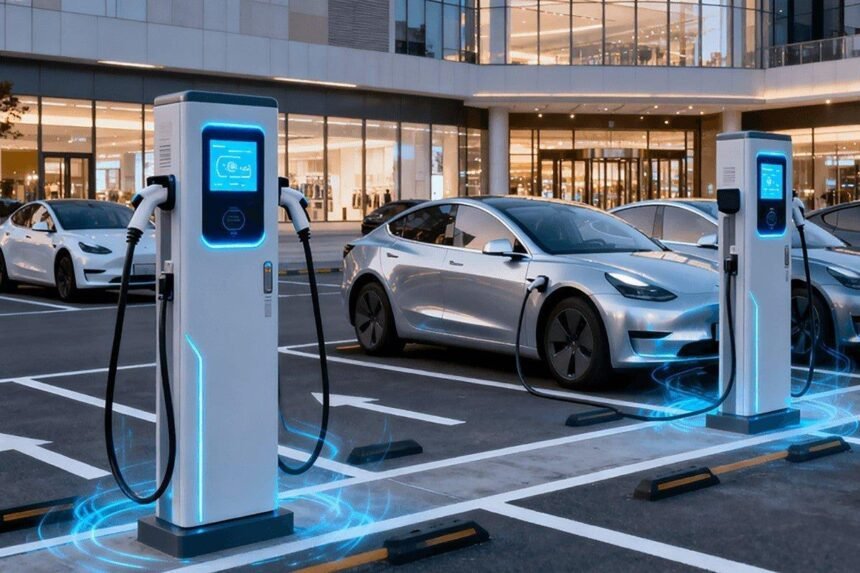
⚡ Electric Vehicles That Could Positively Change Our Future

- Introduction: What Are Electric Vehicles?
- Electric Vehicle Timeline
- An interesting lesson from history
- 1. Battery Electric Vehicle — BEV
- 2. Hybrid Electric Vehicle — HEV
- 3. Plug-in Hybrid Electric Vehicle — PHEV
- 4. Fuel Cell Electric Vehicle — FCEV
- Broad cost structure
- Other costs to consider
- What about government incentives?
- Fact 1: EVs have been around for nearly two centuries
- Fact 2: Electric cars were once popular
- Fact 3: Batteries are central to the EV revolution
- Fact 4: EVs are highly efficient
- Fact 5: EVs do not produce tailpipe exhaust
- Fact 6: Electricity matters
- Fact 7: Charging infrastructure is essential
- Fact 8: Electric two-wheelers are especially important in India
- Fact 9: Electric buses can transform public transportation
- Fact 10: Battery recycling will become increasingly important
- Fact 11: EVs are becoming a major global industry
- Morning commute
- Household electricity
- Shopping
- Office life
- Delivery services
- Public transport
- Lower routine powertrain maintenance
- Potentially lower running costs
- Quiet operation
- No tailpipe exhaust for BEVs
- Regenerative braking
- Software-driven features
- 1. Higher upfront price in some segments
- 2. Charging time
- 3. Charging infrastructure
- 4. Battery degradation
- 5. Raw materials
- 6. Battery recycling
- 7. Electricity demand
- AC Charging
- DC Fast Charging
- Good EV charging habits
- Review Section
- EVs may suit you if:
- A conventional or hybrid vehicle may still be considered if:
- Cleaner urban environments
- New employment
- Energy transformation
- Reduced oil dependence
- New business opportunities
- 2026
- 2027–2028
- 2030
- Beyond 2030
- What is an electric vehicle?
- Are EVs completely pollution-free?
- How long does an EV battery last?
- Are electric vehicles cheaper to run?
- Can an EV be charged at home?
- Are electric vehicles good for city travel?
- Can EVs travel long distances?
- What happens to an EV battery at the end of its life?
- Are electric scooters also EVs?
- Is EV technology suitable for students to study?


Introduction: What Are Electric Vehicles?
Electric Vehicles, commonly called EVs, are vehicles that use electricity as their primary source of propulsion instead of relying entirely on petrol or diesel.
From electric scooters and motorcycles to cars, buses, three-wheelers, trucks and ambulances, EV technology is changing the way people think about transportation.
An EV generally stores electricity in a rechargeable battery. That electricity powers an electric motor, which turns the wheels. Unlike a conventional internal-combustion-engine vehicle, a battery-electric vehicle does not need petrol or diesel to operate.
But electric mobility is not simply about replacing a petrol engine with a battery. It involves batteries, motors, charging infrastructure, software, electronics, renewable energy, manufacturing, recycling and new transportation habits.
The technology is also much older than many people realise. The U.S. Department of Energy traces early electric-vehicle experiments back to the 19th century, including a crude electric vehicle developed around 1832. (The Department of Energy’s Energy.gov)
1. What Exactly Is an Electric Vehicle?
An electric vehicle uses an electric powertrain rather than a conventional petrol/diesel engine.
The major components of a battery-electric vehicle include:
- Battery pack – stores electrical energy.
- Electric motor – converts electrical energy into movement.
- Inverter – manages electrical power between battery and motor.
- Battery Management System (BMS) – monitors battery condition.
- On-board charger – converts AC electricity for battery charging.
- Charging port – connects the vehicle to an external electricity supply.
- Regenerative braking system – can recover some energy during deceleration.
- Vehicle control software – manages many functions electronically.


In simple human terms, think of an EV like this:
Electricity → Battery → Power electronics → Motor → Wheels
Instead of visiting a petrol pump, an EV owner generally recharges the vehicle at home, work or a public charging station.
2. A Short History of Electric Vehicles
Electric vehicles are not a completely new invention.
Electric Vehicle Timeline
| Period | Important development |
|---|---|
| 1828–1835 | Early small-scale electric vehicles were developed in Europe and the United States. |
| Around 1832 | Robert Anderson developed an early crude electric vehicle. |
| 1880s | More practical electric vehicles began appearing. |
| 1889–1891 | William Morrison developed an early successful U.S. electric vehicle. |
| 1890s | Electric cars became increasingly visible in urban markets. |
| 1899 | Electric cars gained popularity partly because they were quiet and relatively easy to operate. |
| 1900–1912 | Electric vehicles reached an early period of popularity. |
| 1908 onward | Mass-produced petrol vehicles, particularly the Model T, dramatically changed automobile economics. |
| 1920s–1930s | Petrol vehicles increasingly dominated because of range, infrastructure and fuel availability. |
| Late 20th century | Interest in electric propulsion returned because of environmental, energy and technological concerns. |
| 21st century | Battery technology, charging infrastructure and vehicle software accelerated EV adoption. |
The U.S. Department of Energy notes that electric vehicles accounted for around a third of vehicles on U.S. roads around the turn of the 20th century before gasoline vehicles eventually became dominant. (The Department of Energy’s Energy.gov)
The Smithsonian similarly explains that by 1905 gasoline vehicles were becoming more popular than steam and electric cars because of factors such as usability and driving range. (Smithsonian Institution)
An interesting lesson from history
Technology does not automatically become dominant simply because it is technically attractive.
Cost + convenience + infrastructure + consumer habits + policy + technology all matter.
That lesson remains important for today’s EV transition.
3. Major Types of Electric Vehicles
Not every vehicle described as an EV works in exactly the same way.
1. Battery Electric Vehicle — BEV
A BEV operates entirely using electricity stored in its battery.
Examples include fully electric cars, scooters and buses.
Energy source: Electricity
Petrol engine: No
2. Hybrid Electric Vehicle — HEV
A hybrid combines an internal-combustion engine with an electric motor.
It normally does not need to be plugged in.
Energy source: Fuel + electricity
3. Plug-in Hybrid Electric Vehicle — PHEV
A PHEV combines an electric powertrain and combustion engine but can also be externally charged.
Energy source: Electricity + fuel
4. Fuel Cell Electric Vehicle — FCEV
A fuel-cell vehicle generates electricity onboard using hydrogen and a fuel cell.
These are different from conventional battery EVs.
4. How Does an Electric Vehicle Work?
Imagine charging your EV overnight.
Electricity enters the vehicle through the charging system and is stored in the battery.
When you press the accelerator:
- The battery supplies electrical energy.
- The power electronics regulate that electricity.
- The inverter controls power delivered to the motor.
- The electric motor generates rotational force.
- The drivetrain transfers that force to the wheels.
- The vehicle moves.
When the driver slows down, regenerative braking can recover some otherwise wasted kinetic energy and return it to the battery.
This is one reason EV driving can feel very different from driving a conventional car.
5. Electric Vehicle Costs in India
One of the biggest questions students, families and consumers ask is:
“Are electric vehicles expensive?”
The answer depends heavily on the vehicle category, battery size, brand, features, location and incentives.
Broad cost structure
| EV category | Typical market positioning |
|---|---|
| Electric scooters | Entry-level to premium |
| Electric motorcycles | Budget to premium |
| Electric 3-wheelers | Commercial/passenger use |
| Small electric cars | Entry-level urban mobility |
| Premium electric cars | Higher purchase price |
| Electric buses/trucks | Commercial and fleet applications |
As of 2026, some electric scooters in India are approaching the price range of mainstream petrol scooters. Recent reporting has cited entry-level models around ₹85,000–₹1 lakh, although prices vary by model and location. (The Financial Express)
Other costs to consider
Buying the vehicle is only one part of the calculation.
You should also consider:
- Registration and insurance
- Home charger
- Public charging expenses
- Electricity cost
- Tyres
- Routine servicing
- Battery warranty
- Battery replacement risk/cost
- Financing interest
- Depreciation
- Accessories
- Software/connectivity costs where applicable
India’s GST framework provides a 5% GST rate for electrically operated vehicles, according to CBIC’s clarification. (CBIC GST)
What about government incentives?
India’s PM E-DRIVE scheme supports electric mobility through demand incentives and other measures. The scheme was originally approved with an outlay of ₹10,900 crore and has subsequently been extended, with the current scheme information showing support continuing to March 2028 for specified categories. (PME Drive)
The exact incentive available to an individual depends on the vehicle category, eligibility requirements and applicable scheme period, so buyers should verify the current official eligibility rather than assuming every EV receives the same benefit.
6. How Much Does EV Charging Cost?
Charging cost depends on:
- Battery capacity
- Electricity tariff
- Charging losses
- State/location
- Home versus public charging
- Public charger pricing
- Driving efficiency
A simple example:
Suppose an EV consumes 15 kWh per 100 km.
If electricity costs ₹8 per kWh:
15 × ₹8 = ₹120 per 100 km
That equals approximately:
₹1.20 per km
This is only an illustration, not a universal EV running cost.
Actual consumption and electricity prices can differ significantly.
For comparison, petrol vehicle costs depend on petrol price and fuel efficiency, while EV economics also depend on charging availability and purchase price.
7. 11 Powerful Facts About Electric Vehicles
Fact 1: EVs have been around for nearly two centuries
Early electric vehicles appeared during the 1800s. Modern EVs are therefore better understood as a technological revival and transformation rather than an entirely new invention. (The Department of Energy’s Energy.gov)
Fact 2: Electric cars were once popular
The Department of Energy notes that around 1900–1912, electric vehicles had a significant presence in the United States. (The Department of Energy’s Energy.gov)
Fact 3: Batteries are central to the EV revolution
Modern EV development is strongly connected to improvements in lithium-ion battery technology, manufacturing scale and battery-management systems.
Global EV battery deployment reached about 1.2 TWh in 2025, according to the IEA. (IEA)
Fact 4: EVs are highly efficient
Electric motors can convert electrical energy into motion efficiently compared with conventional combustion powertrains.
This helps explain why EVs can have relatively low energy consumption per kilometre.
Fact 5: EVs do not produce tailpipe exhaust
A battery-electric vehicle has no tailpipe emissions while driving.
However, this does not mean the vehicle has zero environmental impact. Battery manufacturing, electricity generation, mining, manufacturing and end-of-life treatment all matter.
Fact 6: Electricity matters
An EV charged from a cleaner electricity system has a different lifecycle emissions profile from one charged primarily from carbon-intensive electricity.
The IEA’s lifecycle analysis finds substantial emissions advantages for battery-electric cars globally compared with equivalent conventional vehicles, while noting that the size of the benefit depends on the electricity mix and vehicle lifecycle. (IEA)
Fact 7: Charging infrastructure is essential
People need confidence that they can recharge when required.
That means EV adoption isn’t only about selling vehicles. It also requires:
- Home charging
- Workplace charging
- Highway charging
- Urban public chargers
- Reliable electricity supply
- Interoperable payment systems
Fact 8: Electric two-wheelers are especially important in India
For a country where two-wheelers are a major part of everyday mobility, electric scooters and motorcycles can have an important role.
The PM E-DRIVE programme specifically includes electric two-wheelers among supported categories. (PME Drive)
Fact 9: Electric buses can transform public transportation
Electric buses can reduce tailpipe pollution in cities and can be particularly useful on predictable routes where charging can be planned.
India’s PM E-DRIVE framework includes support for e-buses and public transport procurement. (PME Drive)
Fact 10: Battery recycling will become increasingly important
EV batteries contain valuable materials, but recycling at scale requires appropriate collection, processing, safety standards and economics.
The IEA reports that end-of-life battery availability currently lags behind rapid battery deployment because many newer batteries remain in service. (IEA)
Fact 11: EVs are becoming a major global industry
Global electric-car sales exceeded 17 million in 2024, representing more than 20% of new-car sales. (IEA)
The IEA’s 2026 energy review reports that global electric-car sales rose to about 21 million in 2025, representing approximately one in four cars sold. (IEA)
8. Electric Vehicles and Daily Life
EVs can influence everyday life in surprisingly simple ways.
Morning commute
Instead of stopping at a petrol station, a person may begin the day with a charged vehicle.
Household electricity
An EV turns transportation into another household electricity demand.
Shopping
Shopping centres increasingly have opportunities to combine parking and charging.
Office life
Workplaces can potentially offer charging during working hours.
Delivery services
Electric two- and three-wheelers can be particularly relevant for food delivery, e-commerce and local logistics.
Public transport
Electric buses can become part of cleaner urban transportation systems.
9. Advantages of Electric Vehicles
Lower routine powertrain maintenance
Battery-electric vehicles have fewer moving powertrain components than conventional combustion vehicles.
Potentially lower running costs
Electricity can cost less per kilometre than petrol or diesel in some circumstances.
Quiet operation
Electric motors generally operate more quietly than internal-combustion engines.
No tailpipe exhaust for BEVs
Battery-electric vehicles don’t produce tailpipe exhaust while operating.
Regenerative braking
Energy can be recovered during deceleration.
Software-driven features
Modern EVs increasingly combine transportation with connected software, digital dashboards and over-the-air functionality.
10. Challenges of Electric Vehicles
EVs are not a magic solution to every transportation problem.
1. Higher upfront price in some segments
Although prices are changing, certain EVs still have a higher purchase price than comparable conventional vehicles.
2. Charging time
Even fast charging generally takes longer than filling a conventional fuel tank.
3. Charging infrastructure
Availability differs considerably between cities, highways and rural areas.
4. Battery degradation
Batteries gradually age. Actual degradation depends on chemistry, temperature, usage and charging behaviour.
5. Raw materials
Battery production requires materials such as lithium, nickel, graphite and, depending on chemistry, other minerals. (IEA)
6. Battery recycling
Recycling systems need to expand as more batteries reach the end of their useful life.
7. Electricity demand
As EV numbers grow, electricity grids must manage additional demand. The IEA estimated global EV electricity consumption at around 180 TWh in 2024. (IEA)
11. Electric Vehicles and the Environment
One common misunderstanding is:
“EVs have no environmental impact.”
That statement is too simple.
An EV still has environmental impacts from:
- Raw-material extraction
- Battery production
- Vehicle manufacturing
- Electricity generation
- Transportation
- Road use
- Battery recycling
At the same time, lifecycle studies show that EVs can have substantially lower greenhouse-gas emissions than equivalent conventional vehicles over their operating life. The IEA’s global analysis found a medium-sized battery-electric car sold in 2023 could produce roughly half the lifecycle emissions of an equivalent conventional car under its stated scenario assumptions. (IEA)
Therefore, the better question is not “Are EVs completely pollution-free?”
It is:
“How can we make the entire electric mobility system cleaner, more efficient and more circular?”
That includes cleaner electricity, responsible mining, better batteries, longer vehicle life and stronger recycling.
12. Importance of Electric Vehicles for Students and Young People
EVs are not only a transportation topic.
They create educational and career opportunities in:
- Mechanical engineering
- Electrical engineering
- Electronics
- Battery technology
- Chemistry
- Artificial intelligence
- Data science
- Automotive software
- Embedded systems
- Robotics
- Charging infrastructure
- Renewable energy
- Battery recycling
- Supply-chain management
- EV servicing
- Entrepreneurship
A student interested in technology can therefore study EVs from many different angles.
For example:
AI + EV = intelligent battery monitoring, autonomous driving, predictive maintenance and energy optimisation.
Renewable energy + EV = solar-powered charging and smart grids.
Chemistry + EV = next-generation battery research.
Software + EV = connected vehicle platforms and vehicle operating systems.
13. India’s Electric Vehicle Story
India has increasingly incorporated electric mobility into its transport and industrial policies.
Earlier initiatives such as FAME-II supported EV adoption. According to a 2026 Ministry of Heavy Industries parliamentary answer, FAME-II supported 16,71,606 EVs between 1 April 2019 and 31 March 2024, including 14,69,343 electric two-wheelers, 1,78,952 electric three-wheelers and 23,311 electric four-wheelers. (Ministry of Heavy Industries)
PM E-DRIVE subsequently became a major framework for supporting electric mobility.
As of September 2026, the official PM E-DRIVE dashboard was reporting millions of supported/registered electric vehicles across eligible categories, although the dashboard figures use different definitions and dates, so they should not automatically be interpreted as total EV registrations in India. (PME Drive)
14. Electric Vehicle Charging: What You Should Know


There are broadly two important charging approaches:
AC Charging
Commonly used for home and workplace charging.
It is generally slower but can be convenient because the vehicle can charge for several hours.
DC Fast Charging
DC chargers can provide substantially faster charging and are particularly useful during longer journeys.
However, charging speed depends on the charger, vehicle, battery condition, temperature and other technical factors.
Good EV charging habits
- Avoid unnecessarily keeping the battery at extreme states of charge for long periods.
- Follow the manufacturer’s charging recommendations.
- Use certified equipment.
- Keep charging connectors dry and undamaged.
- Don’t ignore battery or charging-system warnings.
- Plan long-distance trips around charging availability.
15. Electric Vehicle Review: Is an EV Right for You?
Review Section
There is no universal answer because different people have different transportation needs.
EVs may suit you if:
- Your daily driving distance is predictable.
- You have convenient home/work charging.
- You want to reduce dependence on petrol or diesel.
- Your driving pattern is mainly urban.
- You plan to keep the vehicle for several years.
- You have considered battery warranty and service support.
A conventional or hybrid vehicle may still be considered if:
- You frequently drive very long distances.
- Reliable charging is difficult where you live.
- Your local charging network is limited.
- Your preferred vehicle category has limited EV availability.
The important point is to calculate total cost of ownership, not just showroom price.
A useful personal calculation is:
Total Cost = Purchase + Financing + Electricity/Fuel + Insurance + Maintenance + Charging + Battery-related costs − Applicable incentives/resale value
This gives a more realistic picture than simply comparing sticker prices.
16. Important Points Before Buying an EV
Before purchasing, ask these questions:
- What is the real-world range?
- What is the battery capacity?
- What battery warranty is offered?
- How much does a replacement battery cost?
- Is home charging possible?
- What charging connector does the vehicle use?
- How many public chargers are available along your regular routes?
- How quickly can it charge?
- What does insurance cost?
- What is the manufacturer’s service network like?
- Is the vehicle eligible for any current incentive?
- What will the resale value potentially be?
- Does the vehicle meet your daily transportation needs?
17. Electric Vehicles and Society
Electric mobility can influence society beyond individual vehicle ownership.
Cleaner urban environments
Reducing tailpipe emissions can be particularly relevant in densely populated areas.
New employment
EV manufacturing, charging, battery recycling and software can create new job categories.
Energy transformation
Transportation becomes increasingly connected with the electricity sector.
Reduced oil dependence
Greater electricity-based mobility can reduce the amount of road transportation that depends directly on petroleum fuels.
New business opportunities
Entrepreneurs can work in:
- EV charging
- Fleet management
- Battery services
- EV repair
- Software
- Financing
- Recycling
- Energy management
18. Electric Vehicle Future Timeline
2026
EVs continue expanding across two-wheelers, cars, buses and commercial transportation, with policy and charging infrastructure remaining important.
2027–2028
Battery costs, charging networks, vehicle variety and manufacturing scale will continue influencing consumer adoption.
2030
EVs are expected to have a substantially larger role in global road transportation under multiple policy and market scenarios, although the pace will differ between countries and vehicle categories. (IEA)
Beyond 2030
Potential developments include:
- Better battery chemistries
- Faster charging
- Battery recycling
- Vehicle-to-grid systems
- Smarter charging
- More renewable-powered transportation
- Electric heavy trucks
- Improved autonomous systems
- Second-life batteries
These are areas of technological development rather than guaranteed outcomes.
19. Frequently Asked Questions About Electric Vehicles
What is an electric vehicle?
An electric vehicle uses electricity to power an electric motor. A battery-electric vehicle stores that electricity in a rechargeable battery.
Are EVs completely pollution-free?
No. Battery-electric vehicles have no tailpipe exhaust, but manufacturing, electricity generation, raw-material extraction and battery recycling have environmental impacts.
How long does an EV battery last?
There is no single lifespan for every battery. Battery life depends on chemistry, temperature, charging patterns, vehicle use and manufacturer design.
Are electric vehicles cheaper to run?
They can be, particularly because electricity and routine powertrain maintenance may cost less than petrol/diesel operation in suitable circumstances. However, total ownership cost depends on purchase price, electricity rates, financing, insurance and depreciation. (IEA)
Can an EV be charged at home?
Many EVs can be charged at home, provided the appropriate electrical infrastructure and compatible charging equipment are available.
Are electric vehicles good for city travel?
EVs can be particularly convenient for predictable urban journeys where charging is accessible.
Can EVs travel long distances?
Yes, many modern EVs are designed for long-distance travel, but trip planning around charging remains important.
What happens to an EV battery at the end of its life?
It may potentially be reused, refurbished or recycled, depending on its condition and available infrastructure. The IEA identifies battery reuse and recycling as increasingly important areas of the EV ecosystem. (IEA)
Are electric scooters also EVs?
Yes. Electric scooters are electric two-wheelers and form an important part of the EV market, particularly in urban mobility.
Is EV technology suitable for students to study?
Absolutely. EVs connect engineering, physics, chemistry, computer science, AI, energy systems and entrepreneurship.
20. Why Electric Vehicles Matter in Our Life
Transportation is something most people use almost every day.
We use vehicles to:
- Go to school
- Attend college
- Reach work
- Visit family
- Deliver products
- Travel to hospitals
- Run businesses
- Transport food
- Explore new places
Therefore, changing transportation technology can affect ordinary life in profound ways.
Electric mobility introduces a different relationship between transportation and energy.
Your vehicle can effectively become another electricity-consuming device in your life—just like a refrigerator, computer or air conditioner.
That makes energy awareness increasingly important.
21. Important Message for Society
The future of transportation should not be viewed simply as:
Petrol vs EV.
The bigger conversation is about building a transportation system that is:
Affordable + Accessible + Efficient + Safe + Sustainable + Convenient
EVs can be an important part of that system, but their success also depends on electricity infrastructure, public transport, urban planning, battery recycling, manufacturing, consumer awareness and technological innovation.
22. Electric Vehicle Wishing Message
⚡ Happy Electric Mobility Future!
May the roads of tomorrow become smarter, cleaner and more sustainable. May innovation create affordable transportation, new opportunities for young people and healthier cities for future generations.
Let us learn, innovate and move towards a responsible energy future. 🌱🔋🚗
23. Key Takeaways
- Electric vehicles use electricity to power electric motors.
- The concept of electric transportation dates back to the 19th century.
- Modern EVs depend heavily on battery and software innovation.
- EVs include cars, scooters, motorcycles, three-wheelers, buses and trucks.
- Purchase price is only one part of EV economics.
- Electricity, charging, maintenance, insurance and depreciation should also be considered.
- EVs have no tailpipe emissions when operating in battery-electric mode.
- Their overall environmental impact still includes manufacturing and electricity generation.
- Charging infrastructure is critical.
- Battery recycling will become increasingly important.
- EVs are creating opportunities across engineering, software, energy and manufacturing.
- India’s EV policy landscape includes FAME-II and the PM E-DRIVE framework. (Ministry of Heavy Industries)
Conclusion
Electric Vehicles are more than a new type of car—they represent a broader change in how society thinks about mobility, energy and technology.
From the experimental electric vehicles of the 1800s to today’s intelligent electric cars, scooters, buses and trucks, the journey has been surprisingly long.
The biggest opportunity is not simply to replace petrol vehicles with electric ones. It is to build a complete ecosystem around cleaner electricity, efficient vehicles, reliable charging, responsible battery production, recycling and affordable mobility.
For students, EVs also represent a fascinating multidisciplinary field. A person can enter the EV ecosystem through mechanical engineering, electrical engineering, electronics, computer science, AI, chemistry, renewable energy, business or entrepreneurship.
The most important lesson is simple:
The vehicle of the future is not only about how we travel—it is about how intelligently we use energy.
As battery technology, charging infrastructure and renewable energy continue developing, electric mobility is likely to remain an important part of the global transportation conversation. The challenge for society is to ensure that this transition is technologically innovative, economically practical and environmentally responsible.